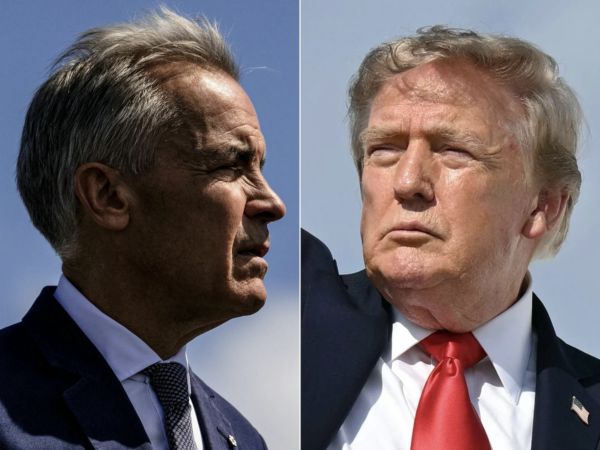
Canada struck back at the United States on Tuesday, announcing new tariffs of up to 50 percent on hundreds of American goods and deepening a trade war between the two longtime allies that has been simmering since President Donald Trump returned to the White House last year.
Beginning Sept. 8, Canada will double its tariffs on American steel and aluminum from 25 percent to 50 percent. And it will impose tariffs ranging from 15 percent to 50 percent on about 700 other products, including fish, milk and food products, plywood, plastics, aluminum foil, appliances, agricultural equipment, motorcycles and electronics
The move — promised Saturday by Canadian Prime Minister Mark Carney — came in response to the imposition last week of 50 percent U.S. tariffs on about $20 billion in Canadian goods, including whisky, dairy products, toys, clothing and hockey sticks. After talks in Washington to avert those levies unexpectedly collapsed, Carney promised that Canada would retaliate “dollar for dollar.”
“You’re at war when you’re attacked, and we got attacked,” he told Canadians on Saturday. “We’re going to hit back.”
On Tuesday, Canadian Finance Minister François-Philippe Champagne provided the details, saying the new “countertariffs are designed primarily to provide protection for Canadian industry impacted by U.S. tariffs and allow them to compete against U.S. products in the Canadian market.”
With two weeks until the tariffs take effect, the two sides have time to prevent a further escalation in economic hostilities. But it was unclear Tuesday whether any further meetings had been set.
In fact, Trump spent Tuesday morning targeting Canada in a series of social media posts. He complained that “Canada has been ‘Ripping Off’ the U.S.A. for decades.” He wrote that “I deal with many countries, and Canada is easily the most difficult and unreasonable. They feel entitled, but they are not a State, and will be entitled no longer!”
And he wrote that he is “giving serious consideration” to changing the name of Lake Ontario to Lake America “in that we don’t expect to be doing much business with Ontario any longer.”
Trump was also posting about Canada on Monday, when he threatened a new round of higher tariffs on Canadian cars, trucks, auto parts and steel to take effect Jan. 1.
MINIMAL EFFECT
The U.S. tariffs had applied to just 5 percent of the $382 billion in Canadian goods that the U.S. imported last year, and Canada’s retaliatory tariffs impact around 6 percent of the $333 billion in U.S. goods exported to Canada. But the two economies remain top trading partners.
“It’s going to be felt,” said Mary Lovely, a senior fellow at the Peterson Institute for International Economics, especially in the targeted industries and states, which will likely put pressure on the Trump administration to strike a deal. “Canada is a good market for U.S. producers.”
The new trade war between the U.S. and Canada is a marked change from the long-standing close relationship between the North American allies, which annually exchange more than $700 billion in goods. Tensions between the Trump administration and Canadian officials have been simmering since Trump upended the country’s traditional trade relationships in an effort to reduce U.S. reliance on global imports and increase exports.
Trump officials have repeatedly expressed frustration that Canada has been the only nation besides China to retaliate for Trump’s tariffs. Carney has presented himself as one of the few world leaders willing to stand up to Trump’s demands, unlike other longtime U.S. partners. The European Union and Britain have both cut deals with the administration in the face of Trump’s tariff threats.
Last week, Carney told reporters that he would end trade negotiations with the Trump administration rather than accept a list of concessions. “We cannot accept what they offered, and we will not give what they’ve asked,” Carney said.
U.S. Trade Representative Jamieson Greer said in a call with reporters Friday that Canada rejected a deal that would have offered “the best treatment of any major exporter to our market.”
While the U.S. tariffs that took effect early Saturday were not expected to have a significant effect on American consumers, U.S. farmers rely on Canadian suppliers for nearly 80 percent of the potash fertilizer they use each year. Northern border states such as New York, Michigan and Maine run on electricity produced by Canadian hydropower. And Midwestern refineries are optimized to process heavy sour crude oil from Canadian wells, which keeps U.S. gas prices lower than they otherwise would be.
THE WASHINGTON POST
