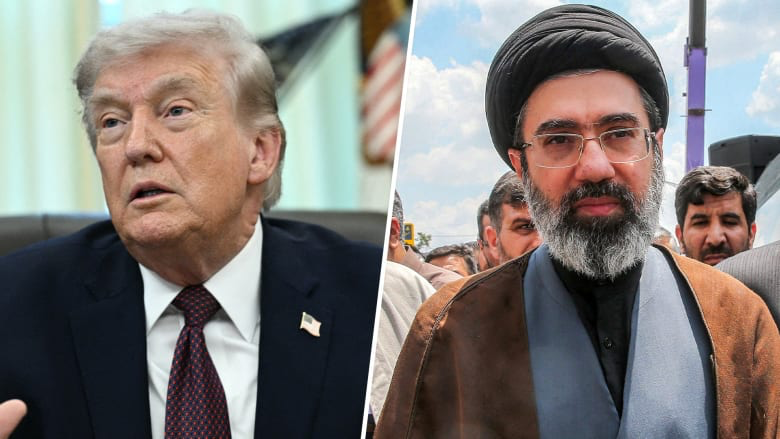
Combined photo of Mojtaba Hosseini Khamenei , Iran’s Supreme leader and President Trump. Khamenei has not been seen in Public ever since he was appointed to succeed his father . Both the US and Iran have declared victory
HERE IS THE LATEST :
- Iran’s President Masoud Pezeshkian said Friday the world had “approved” the country’s victory over the U.S. and the war should therefore end. He added the U.S. was now “hated” globally as well.
- Egypt’s foreign minister spoke to his Iranian counterpart by phone on Saturday in an effort to restart negotiations to end the war. Egypt’s foreign ministry said it discussed Iran continuing talks with Oman over the Strait of Hormuz or returning to the U.S.-Iran memorandum of understanding from June.
- Iran granted some Iraqi oil tankers permission to transit through the Strait of Hormuz after repeated requests from Baghdad, according to state media reports on Saturday.
Iran says any country joining U.S. sanctions considered “enemy”
Iran on Saturday warned countries against participating in the United States’ “economic war” against the Islamic republic, saying they would be considered enemies.
“We declare to all countries … do not join the economic war waged by the United States. Any country participating in the imposition of economic restrictions against us is considered an enemy,” said Mohsen Rezai, the head of Iran’s supreme national security council, on state television.
If the countries concerned refused to “distance themselves” from the United States, Iran would “harm” their interests, he added.
Rezai also insisted Iran had more cards to play in the war, claiming, “We have not yet attacked any American economic interests.”
President Trump said earlier this week the U.S. will enforce “Economic Warfare and Isolation on an unprecedented scale.” But he also called on the rest of the world to come to the aid of the U.S. in enforcing sanctions, the specifics of which have still not been announced.
“This will be an ECONOMIC D-DAY, and we need all of our Allies to stand with the United States of America to isolate, and defeat, the Iran threat,” Mr. Trump wrote Wednesday on Truth Social. These maniacs are on the ropes, and these HISTORIC MEASURES will cripple them and their ability to project terror worldwide.”
At least one major country has already spurned that demand. China, Iran’s largest trade partner, said it opposes “illegal unilateral sanctions that have no basis in international law and are not authorised by the UN Security Council.”
Egypt tries to revive U.S.-Iran negotiations
The top diplomats for Egypt and Iran discussed efforts to bring Tehran and Washington back to the negotiating table to settle the war, Egypt’s foreign ministry said.
Iranian Foreign Minister Abbas Araghchi and Egyptian counterpart Badr Abdelatty also discussed the Iranian-Omani talks on the management of the Strait of Hormuz, the ministry said.
“The call addressed the overall current situation in the region, and the efforts made to create an atmosphere conducive to achieving de-escalation and a return to the diplomatic track, whether in terms of the negotiations between Oman and Iran or the return to implementing the memorandum of understanding signed between the United States and Iran on June 18,” Egypt’s foreign ministry said.
Araghchi briefed Egypt’s foreign minister about “Iran’s view of ongoing developments, the course of negotiations and their challenges,” the ministry said, without elaborating.
There was no immediate statement from Araghchi.
Iranian politician threatens Gulf allies of U.S., “shouldn’t complain” if they become targets
The threats of attacks on allies of the U.S. in the Gulf region continued on Saturday with a prominent politician making the case for them as legitimate targets.
“It has been reported that American enemy aircraft and fuel tankers are present at airports in Qatar, Kuwait, the Emirates, and beyond,” Ebrahim Rezaei, a spokesman for Iran’s Foreign Policy and National Security Committee, said on X. “They have turned their homes into enemy bunkers.”
“They shouldn’t complain later,” he added.
Iran has repeatedly argued any country that assists the U.S. in its attacks will be targeted in retaliation for U.S. strikes. Kuwait, specifically, has repeatedly come under attack, including one in the early days of the war when six American troops were killed at an operations center.
Last month, three U.S. soldiers were killed in an Iranian strike on Muwaffaq Salti Air Base in Jordan.
6 EU countries urge windfall tax on oil companies amid skyrocketing profits during war
Six EU countries are stepping up calls for a bloc-wide windfall tax on oil companies as profits soar due to the Middle East war, according to a letter seen by AFP Saturday.
The finance ministers of Germany, Italy, Austria, Poland and Portugal, along with Spain’s economy minister, sent the joint letter to Ireland’s finance minister.
Ireland currently holds the EU’s rotating presidency, and the ministers urged the issue of a levy be put on the agenda at a meeting of the bloc’s finance chiefs in Dublin next month.
“Oil companies are enjoying overall profitability and margins on refined products that exceed the rise in crude oil prices,” it read.
“We are experiencing one of the biggest supply shocks in decades, and all over the world there is growing discontent about the rise in the cost of living.”
German Finance Minister Lars Klingbeil has repeatedly stressed that energy companies must not “rip off” consumers during the current crisis, a ministry source told AFP.
“Excessive crisis profits must be returned to consumers,” said the source.
French president and Saudi crown prince will meet to discuss Strait of Hormuz
French President Emmanuel Macron and Saudi Crown Prince Mohammed bin Salman are expected to discuss the effects of the Strait of Hormuz closure and plans to develop routes around the waterway during the Saudi leader’s two-day visit to Paris beginning Sunday, according to officials in the presidency who weren’t authorized to be publicly named.
Proposals under consideration include increasing trade through Omani ports outside the Persian Gulf, expanding or doubling pipelines in Saudi Arabia and elsewhere, and developing new rail links, the officials said.
France and Saudi Arabia have formed a task force on energy and logistics connections between the Middle East and Europe that is scheduled to meet at the ministerial level Monday.
The officials said the work was well advanced and would focus on identifying the most strategic projects, securing financing and establishing roles for French companies. The visit will be the crown prince’s first trip abroad since he traveled to Washington in November 2025, according to the officials.
Iran’s neighbors asked about reshaping “security arrangements,” says Tehran’s parliament speaker
Iran’s parliament speaker said Saturday the country had received “numerous messages” from neighboring countries about “reshaping new security arrangements and economic cooperation in the region.”
In a social media post, Mohammad Ghalibaf said: “The United States put the security of every single one of its allies at such risk through bullying and pure disregard for their interests for the sake of Israel that they briefly saw their entire existence on the line.”
Various Gulf states are allies of the United States and host American military bases which have been targeted by Tehran in retaliatory strikes throughout the war.
New U.S. sanctions on Iran amount to an attack on every UN state, says Tehran’s foreign ministry spokesperson
Iran’s foreign ministry spokesperson compared new U.S. sanctions to a return to “full scale classic colonialism.”
In a social media post, Esmaeil Baghaei said the new economic sanctions on Iran are “far more” than economic warfare against his country, and that it amounted to “an assertion of extraterritorial sovereignty of every independent member of the United Nations.”
Baghaei said combined with military “aggression,” economic coercion forces a state to alter its policies and therefore removes its sovereignty.
“The end result would be the complete erosion of sovereignty as the foundational basis of the UN-based inter-State system, and a recipe for an abysmal return to full-scale classic colonialism,” the spokesperson said.
Iran allows Iraqi oil tankers to transit Strait of Hormuz
A number of Iraqi oil tankers have been granted permission by Iran to transit through the Strait of Hormuz, according to Reuters news agency, quoting Iran’s state news agency IRNA.
According to IRNA, the special permission was one of Baghdad’s main requests during the Iranian parliament speaker’s visit to Iraq last week.
South Korea to send first container ship through Arctic route
South Korea was set Saturday to send its first trial container through the Arctic, as the Middle East war rattles global shipping, while environmental groups warned the route could accelerate polar ice melt.
Sailing from Busan New Port, the the “PanStar Acro” container ship will sail to Europe via the Arctic, testing whether a route opened by melting sea ice can be commercially viable.
The ship will leave for Felixstowe in Britain, Rotterdam in the Netherlands and Gdansk in Poland before returning, with the voyage expected to take about 45 days, according to the ministry.
The voyage follows that of the Chinese container ship “Dubai Tower”, which left the eastern port city of Ningbo for Europe this month, heading north through the Bering Strait before turning west along Russia’s Arctic coast.
The usual maritime route between Asia and Europe runs through the Suez Canal, but travelling through the Arctic can cut the journey by around 7,000 kilometres (4,300 miles) and about 10 days, according to the Korea Institute for International Economic Policy.
