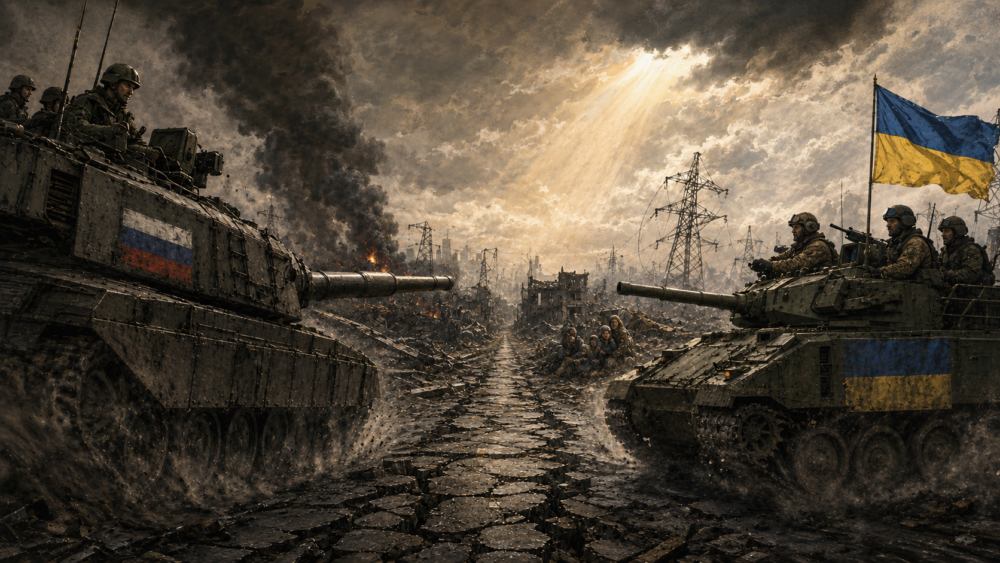
Photo illustration- Russia and Ukraine race toward a devastating collision It is time for diplomacy to end Russia’s war on its neighbor without sacrificing Ukrainian sovereignty.
Russia launched this war, but continued geopolitical brinkmanship is destroying Ukraine while exposing Europe—and potentially the world—to catastrophic escalation.
By ; The Editorial Board, Opinion
Russia’s war against Ukraine has increasingly become a deadly geopolitical game of chicken.
Russia, Ukraine and the Western powers supporting Kyiv are continually testing one another’s limits. Each fears that stepping back will be interpreted as weakness. Each escalation is answered by another. Yet while governments measure resolve, debate red lines and calculate military risks, Ukraine is being progressively destroyed.
The metaphor of a “game of chicken” describes a confrontation in which two drivers race toward each other. The first to turn away loses—but if neither turns, both crash.
That is dangerously close to what is happening in Ukraine.
However, we must never confuse the existence of this strategic standoff with equal responsibility for creating it. Russia invaded Ukraine. Ukraine is defending its territory, its people and its right to exist as a sovereign nation. Russia can end the war by ending its aggression. Ukraine cannot simply surrender without risking the loss of its independence and rewarding the seizure of territory by force.
Nevertheless, the international community must recognize that the present course is producing neither victory nor peace. It is producing devastation.
Brinkmanship Without an Exit
Russia appears determined to demonstrate that it can outlast Ukraine and exhaust Western political will. Ukraine must demonstrate that aggression will not succeed. The United States and Europe seek to support Ukraine while avoiding a direct war between NATO and Russia.
Everyone is testing everyone else’s resolve.
But where is the exit?
When every diplomatic compromise is portrayed as capitulation, the conflict becomes self-perpetuating. Leaders become trapped by their own declarations. Retreat becomes politically impossible, even when continuing the war offers no realistic path to a decisive outcome.
That is precisely what makes a geopolitical game of chicken so dangerous: rational leaders may recognize the approaching disaster but still refuse to turn because they fear appearing weak.
Nuclear Threats Cannot Become Normal
Russia has repeatedly used nuclear rhetoric as an instrument of intimidation. NATO has properly described such rhetoric as dangerous and irresponsible, warning that a nuclear war cannot be won and must never be fought. NATO
These threats may be intended primarily as psychological warfare, but nuclear posturing is never harmless. Miscalculation, technical failure or an incorrectly interpreted military action could produce consequences no leader intended.
Ukraine’s nuclear facilities create an additional danger. The International Atomic Energy Agency has repeatedly warned that shelling, drone activity, damage to electrical systems and the loss of off-site power threaten nuclear safety. A conflict fought around major nuclear installations cannot be treated as an ordinary conventional war. IAEA
The world should not wait for a nuclear accident—or something even worse—before rediscovering the value of restraint.
Ukraine Is Paying the Price
The greatest cost is not being paid in Moscow, Washington, Brussels or any conference room where military strategy is debated.
It is being paid by Ukrainians.
Homes have been destroyed. Families have been separated. Millions have been displaced. Power stations, electrical grids and essential infrastructure have been repeatedly attacked.
According to the United Nations, June 2026 brought the highest monthly number of Ukrainian civilian casualties since April 2022: at least 293 civilians killed and 1,990 injured. Most were recorded in territory controlled by Ukraine. United Nations in Ukraine
These are not pieces on a geopolitical chessboard. They are human beings whose country is being destroyed around them.
The continuation of the war is also damaging food supplies, energy markets and economic stability far beyond Ukraine. But Ukraine remains the battlefield—and Ukrainians remain its principal victims.
What Must Happen Now
Ending the war cannot mean forcing Ukraine to surrender its sovereignty. Nor can peace be built upon the assumption that military conquest deserves international recognition.
But diplomacy must begin somewhere.
First, Russia must halt attacks on civilians, residential areas and critical infrastructure. Ukraine’s cities and energy system cannot continue to be used as instruments of coercion.
Second, both sides should accept a monitored cessation of long-range attacks, particularly around nuclear facilities, power grids and densely populated areas.
Third, neutral international mediators should establish a structured ceasefire process supported by the United Nations, the OSCE and countries capable of communicating credibly with both Moscow and Kyiv.
Fourth, any negotiations must include enforceable security guarantees for Ukraine. A ceasefire that merely gives Russia time to regroup would not be peace. It would be an intermission before the next invasion.
Finally, negotiations must address prisoners of war, detained civilians, displaced families, territorial security and reconstruction. Ukraine has already declared its readiness for constructive negotiations toward an effective ceasefire and the release of prisoners and detained civilians. OSCE
Diplomacy should not be confused with weakness. The true purpose of strength is to create the conditions for a secure and durable peace.
Someone Must Turn Away From the Collision
This war cannot continue indefinitely simply because every participant fears being the first to change course.
Russia must understand that invading and destroying a neighboring country will never provide lasting security. Ukraine must receive credible guarantees that diplomacy will not become another word for abandonment. Western governments must combine support for Ukrainian sovereignty with a serious, coordinated diplomatic strategy for ending the fighting.
The objective must not be to save Putin’s pride, advertise Western resolve or pressure Ukraine into surrender.
The objective must be to save Ukraine.
In a game of chicken, refusing to turn may be portrayed as courage. But when the road ends in the destruction of a nation—and possibly a confrontation between nuclear powers—refusing to turn is not courage.
It is madness.
