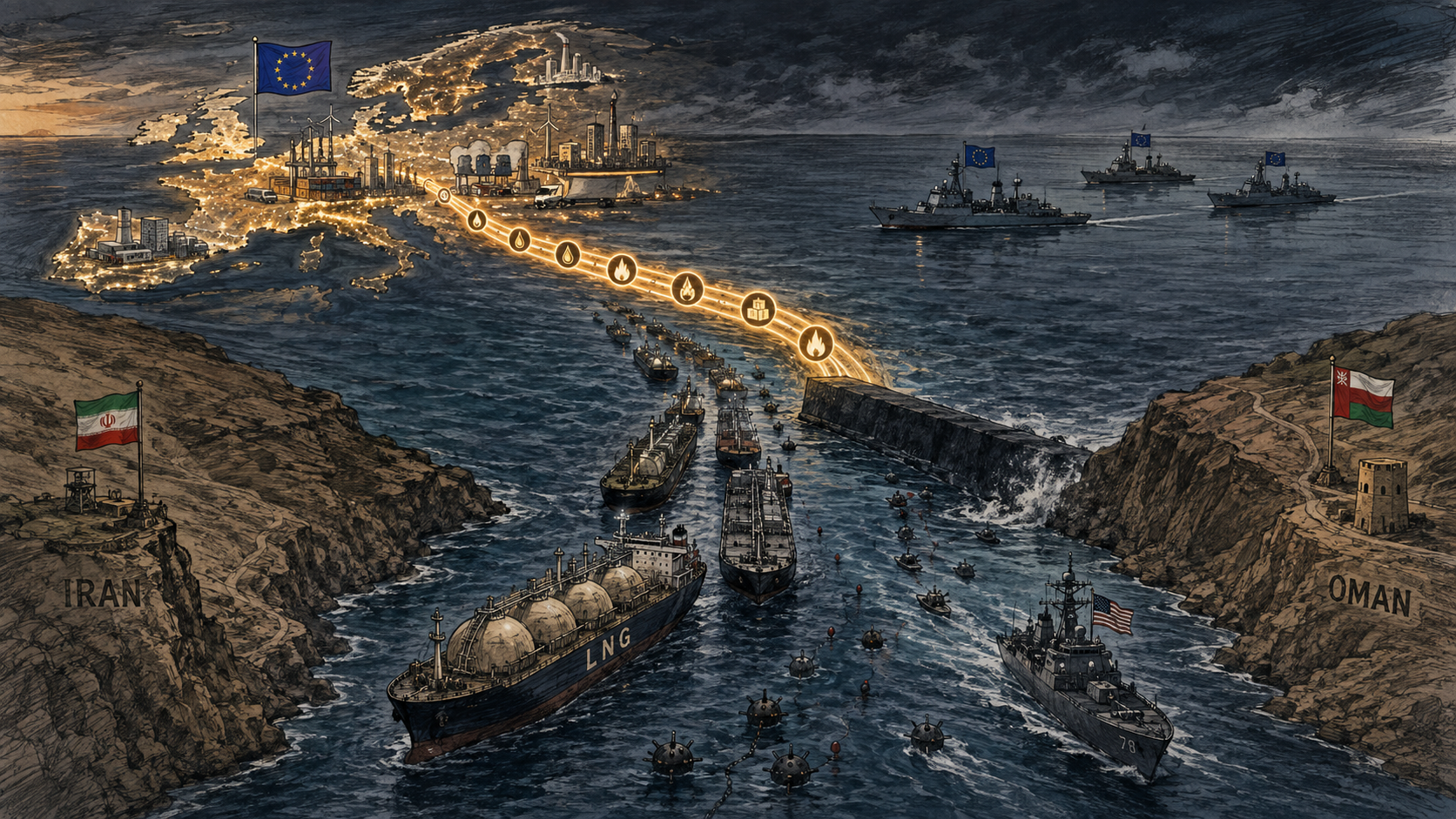
Photo illustration – Europe may call Hormuz someone else’s war, but its factories, cities and energy security remain tied to every vessel passing through it.
Europe did not have to support the war against Iran—but it cannot leave the defense of a vital international waterway almost entirely to the United States
By : The Editorial Board , Opinion .
Europe’s objections to the war against Iran are understandable.
European governments were not consulted before the initial American and Israeli strikes. They consider NATO a defensive alliance, not an instrument for conducting offensive wars in the Middle East. Many European leaders also want to demonstrate that their foreign policy is not automatically dictated by Washington.
But the Strait of Hormuz is no longer merely one front in the war against Iran. It has become a test of whether any country can seize an international chokepoint, attack commercial vessels and dictate the conditions under which the rest of the world may trade.
Europe cannot avoid that question by declaring: “This is not our war.”
It may not be Europe’s war—but it is certainly Europe’s waterway.
What happened to Europe’s plan?
France and Britain began organizing a multinational defensive maritime mission as early as March. Approximately 30 countries participated in preliminary discussions, while France, Britain, Germany, Italy, Japan and the Netherlands said they were prepared to contribute to efforts to secure safe passage.
The plan was deliberately separated from the American-Israeli military campaign. European ships would not operate under American command, and the mission would be defensive: escort merchant vessels, clear mines, monitor threats and protect freedom of navigation.
In May, EU foreign-policy chief Kaja Kallas called for more European ships and proposed expanding Operation Aspides—the EU’s existing defensive naval mission—to help secure Hormuz. By June, France and Britain said that the assets for their proposed mission were ready.
Yet the ships were never meaningfully deployed to reopen the strait.
The European position gradually became conditional: Europe would help protect navigation after a ceasefire, after political conditions improved and after the immediate danger diminished.
That is precisely the problem.
A maritime-security mission is needed when navigation is under attack—not after the danger has passed.
The European Council continues to speak of reinforcing Operation Aspides and supporting freedom of navigation “once the conditions are met.” But who will create those conditions? Iran’s Revolutionary Guards? Oman’s negotiators? Or the United States acting largely on its own?
Europe has produced proposals, declarations and sanctions. What it has not produced is sufficient naval power where it is urgently needed.
Europe has more direct exposure than America
The United States is now a major oil and gas producer and imports relatively little Gulf oil through Hormuz. Europe, by contrast, remains dependent on imported energy and is especially vulnerable to disruptions in global LNG supplies and prices.
Before the crisis, Qatar alone supplied approximately 10 percent of Europe’s LNG imports. Italy, Belgium, Poland, Spain, France and Britain all received Gulf LNG that had to pass through Hormuz. According to the International Energy Agency, the disruption has removed more than 300 million cubic meters of Qatari and Emirati LNG from the market every day.
Europe may reduce its direct dependence through American LNG, renewable energy and alternative suppliers. But it cannot insulate itself from the consequences of a prolonged closure. Energy is priced globally. European factories, transportation networks, fertilizer producers, farmers and families will all pay more when a major portion of the world’s oil and gas cannot move freely.
Asia is even more dependent on Hormuz, but that does not make Europe’s exposure insignificant. It makes the need for a broad international coalition even greater.
Europe does not have to join the war
This is not an argument for placing European forces under American command or asking Europe to participate in attacks on Iranian territory.
It is an argument for a separate, multinational and strictly defensive maritime mission with a clear mandate:
- Escort commercial vessels through internationally recognized shipping lanes.
- Deploy minesweepers and specialized mine-clearing vessels.
- Protect civilian ships from missiles, drones and armed boats.
- Coordinate intelligence and maritime surveillance.
- Establish rules of engagement limited to responding to direct threats against navigation.
- Include Asian importers, Gulf exporters and other countries whose economies depend on the strait.
Such a coalition could be European-led, internationally supported and operationally independent from the wider war.
France and Britain have already developed much of the framework. Operation Aspides and the older European Maritime Awareness mission in Hormuz provide experience, coordination systems and an institutional foundation. Europe does not need to begin from zero. It needs the political will to turn an announced plan into an operational mission.
Neutrality cannot mean surrendering the waterway
Europe is entitled to criticize Washington. It is entitled to pursue diplomacy. It is entitled to refuse participation in an offensive war it neither planned nor approved.
But it is not entitled to demand freedom of navigation while expecting American sailors to assume nearly all the risks required to defend it.
Nor should Europe accept an agreement that effectively grants the Iranian regime permanent authority to decide which vessels may pass, what fees they must pay or what political concessions must be made before an international strait is reopened.
That would transform freedom of navigation into permission from Tehran.
If Europe wants an independent foreign policy, it must also accept independent responsibility. Strategic autonomy cannot mean issuing statements while someone else protects Europe’s energy supplies and trade routes.
The Strait of Hormuz is not American territory, European territory or Iranian property. It is an international waterway through which lawful transit must remain free.
Europe’s pride may explain why it refuses to follow Washington into war.
But pride will not escort a tanker, clear a mine or stop a missile.
Europe has a plan. It has capable navies. It has an overwhelming economic interest in reopening the strait.
What it needs now is the courage to act.
