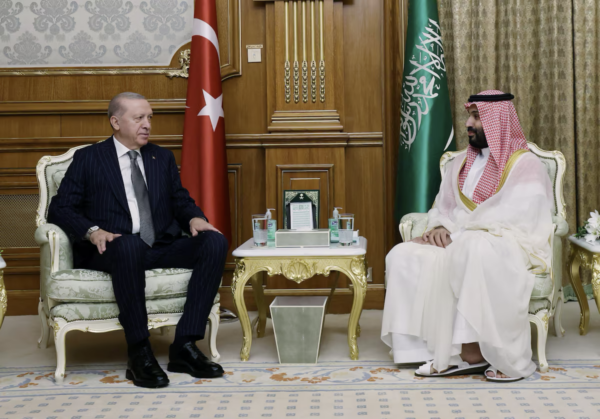
Photo- Turkish President Tayyip Erdogan meets Saudi Crown Prince Mohammed bin Salman, ahead of the expected signing of a defence deal between Saudi Arabia, Pakistan and Turkey, in Mecca, Saudi Arabia, August 7, 2026. Murat Cetinmuhurdar/Turkish Presidential Press Office/Handout via REUTERS
- Turkish Foreign Minister Hakan Fidan said the newly signed Turkey–Pakistan–Saudi Arabia defense pact functions like NATO’s Article 5 (an attack on one is treated as an attack on all) but is not directed against Iran.
- The agreement will create a ministerial committee and a general secretariat based in Saudi Arabia; Fidan indicated Egypt and other countries could eventually join once technical issues are resolved.
- Ankara insists the pact does not conflict with Turkey’s NATO obligations and is intended to strengthen collective deterrence against regional threats such as terrorism, arms smuggling and attacks on maritime routes.
Turkey’s foreign minister claimed a defense agreement signed by Turkey, Pakistan, and Saudi Arabia is not targeting Iran, although he said it is technically the same as NATO’s Article 5 mutual defense pact that means an attack on one is an attack on all.
Foreign Minister Hakan Fidan on August 8 added that the pact — signed a day earlier by leaders of the three nations — could eventually be joined by Egypt and other countries once a number of technical matters were resolved.
“NATO is a giant military alliance where there are 32 countries. We have started here as three countries and we have to take very humble but concrete steps,” he said.
Fidan told state-run Anadolu news agency that a committee of ministers similar to that within the NATO alliance would be established, as well as a general secretariat based in Saudi Arabia.
Fidan did not immediately disclose the issues that needed to be resolved to clear the way for Egypt to joint the accord, led by mostly Sunni Muslim nations. Iran is majority Shi’ite Muslim.
On August 7, the leaders of Turkey, Saudi Arabia, and Pakistan came together in the Saudi city of Mecca to sign the joint defense pact aimed at strengthening “collective deterrence against any act of aggression.”
In the initial announcement, the Turkish government said the “agreement is not in contradiction with the commitments of Turkey’s existing international alliances, including those at the heart of NATO.” Turkey is a member of the Western military alliance.
“The agreement is of particular importance in light of the escalating challenges and threats facing the region, foremost among them terrorist attacks, arms smuggling, and threats targeting neighboring countries and international maritime routes,” the minister added.
He stated: “The maritime security in the Red Sea is vital to our interests, and we must be part of the Saudi-led international coalition.”
The development came amid growing uncertainty in the Middle East, with no immediate end in sight to the confrontation between Tehran and Washington.
Separately, Saudi Arabia last year signed a Strategic Mutual Defense Agreement with Pakistan that included a clause along the lines of NATO’s Article 5, which states “any aggression against either country shall be considered an aggression against both.
Saudi Arabia, a US ally and long a bitter rival of Iran for regional influence in political, military, and religious matters, has often been a target of Iranian missile and drone launches after the US and Israel struck Iran beginning on February 28.
Eurasia Review
