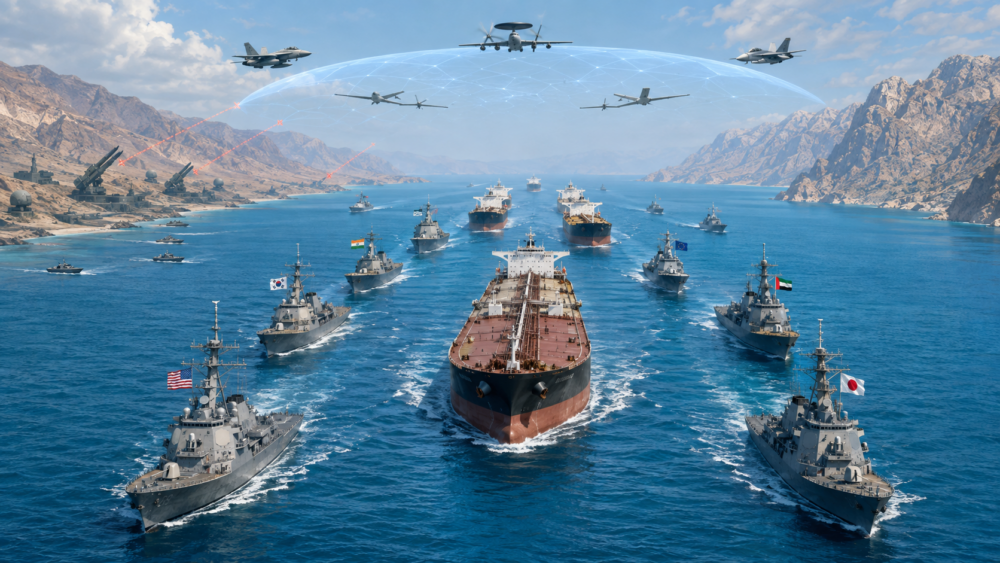
Illustration – Freedom of navigation through the Strait of Hormuz must be protected by lasting international deterrence—not rented temporarily from the IRGC.
The world must stop negotiating for temporary access to an international waterway and build a multinational force capable of keeping it permanently open.
By: Ya Libnan Editorial Board , Opinion
The Strait of Hormuz is not Iran’s private canal, and freedom of navigation is not a concession for the Islamic Revolutionary Guard Corps to grant or withdraw.
Yet the international community is once again negotiating as though Tehran owns this vital waterway and has the authority to decide which vessels may enter the Gulf, what conditions they must satisfy and what political price their governments must pay.
Iran and Oman may be approaching an arrangement for a temporary shipping route through the strait, but Tehran has already made clear that such an agreement would not necessarily reopen the waterway. The IRGC insists that reopening Hormuz depends on Washington accepting Iran’s conditions. Reports also indicate that the proposed arrangement could give Tehran control over vessels entering the Gulf—an outcome the United States has opposed. Reuters
This is not freedom of navigation. It is maritime extortion disguised as diplomacy.
Whatever arrangement Iran and Oman produce is unlikely to satisfy President Donald Trump if it grants Tehran control over international shipping. But even if Washington accepted a temporary compromise today, what would prevent Iran from repudiating it tomorrow?
A signature from Tehran cannot protect a tanker from an IRGC missile, drone, mine or fast-attack boat.
The fundamental problem is that the IRGC appears to be calling the shots. It is an ideological military organization that has repeatedly treated instability as a source of influence and coercion as an instrument of foreign policy. It can reinterpret an agreement, allege a violation, invent a new condition or impose additional demands whenever it wants sanctions relief, money, political concessions or protection for one of its regional proxies.
The world could celebrate the reopening of Hormuz one week only to discover that shipping has been disrupted again the next.
Global commerce cannot remain hostage to the IRGC’s changing calculations.
Iran borders the Strait of Hormuz, but it does not own it. The strait is an international waterway through which vessels enjoy navigational rights. Tehran therefore has no legitimate authority to turn it into a tollbooth, bargaining chip or weapon against the global economy.
Negotiating with Iran over whether it will permit passage risks recognizing a power it should never possess. It rewards the very conduct the international community claims to oppose. Every concession extracted through the closure or disruption of Hormuz teaches Tehran the same dangerous lesson: maritime blackmail works.
A temporary agreement may reduce tensions and allow some ships to pass. But if it leaves Iran with control over incoming vessels—or with the practical ability to close the waterway again—it will merely institutionalize the next crisis.
The objective must not be to rent access to Hormuz from the IRGC. It must be to establish permanent and unconditional freedom of navigation.
That responsibility cannot continue to fall almost entirely upon the United States and its Gulf partners. Europe, Japan, South Korea, China, India and every other major economy whose energy supplies and commercial interests depend upon Hormuz have a direct stake in keeping it open.
Countries that depend on the strait cannot continue outsourcing its defense to the United States while expecting uninterrupted access to their energy supplies.
They should form a broad international maritime coalition dedicated specifically to protecting commercial navigation. Participating nations could contribute naval vessels, surveillance aircraft, intelligence, mine-clearing capabilities, air defenses, logistical support or financing according to their resources.
Commercial vessels transiting the danger zone should be offered direct naval escorts. The coalition should maintain continuous aerial and maritime surveillance, identify missile and drone preparations and possess the capability to clear mines rapidly before they can paralyze shipping.
The coalition must also establish strict and publicly understood rules of engagement. Any IRGC missile, drone, mine-laying unit or naval position used—or demonstrably preparing—to attack international shipping should face an immediate and proportionate response against the military assets responsible.
Deterrence works only when the aggressor knows in advance that an attack will carry consequences greater than any possible gain.
This is not a call for unrestricted war. It is a call for collective defense of an international waterway and the commercial vessels lawfully using it. The purpose of military escorts and credible rules of engagement would be to prevent attacks, protect crews and ensure that no country or armed organization can hold the global economy hostage.
History offers a useful precedent. During the Iran-Iraq War, the United States escorted reflagged tankers through the Gulf under Operation Earnest Will. That mission was not risk-free, but it demonstrated that organized naval protection backed by credible force could keep commercial shipping moving despite Iranian threats.
Today’s challenge requires a broader coalition because today’s dependence on Hormuz is global.
Diplomacy still has a role in preventing miscalculation and communicating clear boundaries. But diplomacy cannot substitute for deterrence, and no agreement should concede Iran permanent control over ships entering the Gulf.
The international community should stop negotiating with Tehran over a right Tehran does not possess—the supposed authority to open and close one of the world’s most important waterways.
Iran must be presented with a clear choice. It may participate peacefully in the international economy and benefit from secure regional commerce, or it may attack shipping and face a unified international response. What it must no longer be permitted to do is disrupt Hormuz, extract concessions, sign a temporary arrangement and then repeat the cycle whenever the IRGC wants more.
The world has negotiated long enough while ships, energy markets and entire economies remain exposed to Tehran’s whims.
It is time to act.
Freedom of navigation through the Strait of Hormuz must be guaranteed by lasting international deterrence—not rented temporarily from the IRGC.
