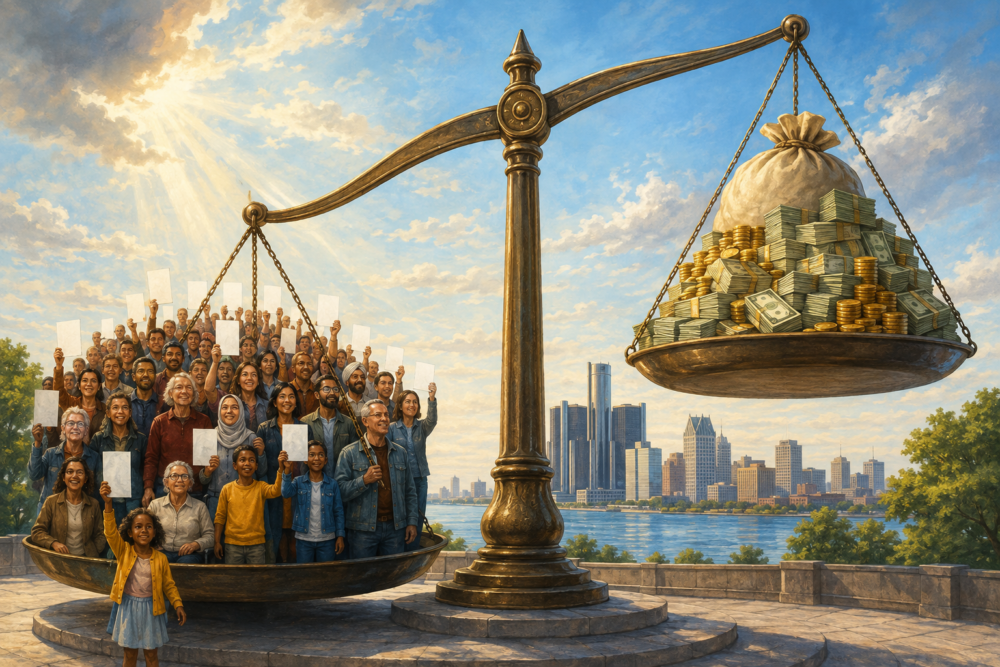
illustration – The power of money may be enormous, but when citizens stand together, the power of the many is greater.
His primary victory demonstrated that organized citizens can still overcome concentrated wealth—and that is what democracy is all about.
By: Ya Libnan Editorial Board , Opinion
Dr. Abdul El-Sayed’s narrow victory over Representative Haley Stevens in Michigan’s fiercely contested Democratic Senate primary should encourage every American who worries that democracy is being sold to the highest bidder.
“We proved that the power of our many is greater than the power of their money,” El-Sayed declared after winning.
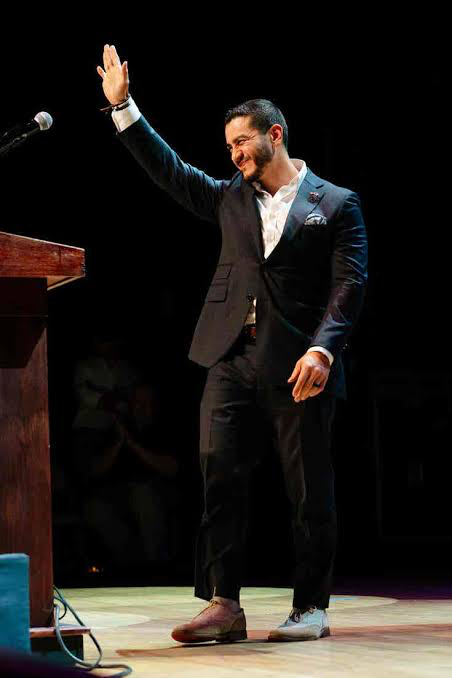
Abdul El-Sayed
That was more than a campaign slogan. It described what happened in Michigan.
El-Sayed, a physician and former Detroit public-health director, faced an extraordinary financial disadvantage. More than $60 million in outside spending poured into the primary, much of it benefiting Stevens or opposing him. At one point, pro-Stevens groups reportedly enjoyed a television-spending advantage of more than twelve to one. Yet Michigan voters refused to allow money alone to determine their choice.
El-Sayed won by fewer than 15,000 votes—less than one percentage point out of more than 1.5 million ballots cast. It was close, but unmistakable: the voters had the final word. Associated Press
They chose a candidate who campaigned on Medicare for All, removing corporate money from politics and building an economy that works for ordinary Americans. They chose someone willing to confront powerful interests rather than depend upon them.
Whether one agrees with every one of El-Sayed’s policies is almost beside the point. His victory represents something larger: the continuing ability of organized citizens to overcome concentrated financial power.
That is what democracy is supposed to be.
America needs successful corporations. They create products, provide employment, invest in innovation and help sustain economic growth. But Corporate America must not be permitted to decide the country’s political future by itself.
There is a profound difference between participating in democracy and purchasing disproportionate influence over it.
When candidates become dependent upon billionaires, corporations and special-interest organizations to finance increasingly expensive campaigns, those donors inevitably gain access and influence unavailable to ordinary citizens. Politicians become reluctant to challenge the interests financing their elections. Tax policy, regulation and government contracts can then be shaped more by contributors than constituents.
This is how economic power becomes political power.
As wealth becomes increasingly concentrated at the top, those possessing it can spend enormous sums supporting politicians who promise tax reductions, deregulation and protection from competition. Political leaders, in return, receive the money needed to remain in power.
The arrangement may be legal, but that does not make it democratic.
Its consequences are visible across the country: wages that fail to keep pace with living costs, industries dominated by a few enormous companies, weakened public institutions and millions of Americans who understandably believe that their government no longer listens to them.
The Democratic Party’s mega-donor class should therefore consider the lesson Michigan’s voters have delivered. The choice is not simply between progressives and moderates. It is between a political system responsive to its citizens and one increasingly controlled by those wealthy enough to finance it.
It is between an economy that works broadly for the American people and one designed principally for a small group at the top.
El-Sayed has won only the Democratic nomination. He must now face Republican Mike Rogers in a difficult general election, and Michigan’s voters will again have the final say in November.
But regardless of that outcome, his primary victory has already established something important: money remains powerful, but it is not invincible.
When citizens organize, participate and vote, the power of the many can still defeat the power of money.
That is not radicalism.
That is democracy.
