HERE IS THE LATEST :
- President Trump told reporters “a lot of progress had been made” on the subject of reopening the Strait of Hormuz and suggested an announcement could be made as soon as Wednesday or Thursday.
- Iran and Oman agreed Wednesday to a temporary route for ships transiting the Strait of Hormuz and are putting the final touches on arrangements for jointly managing the passage, Tehran’s foreign ministry said.
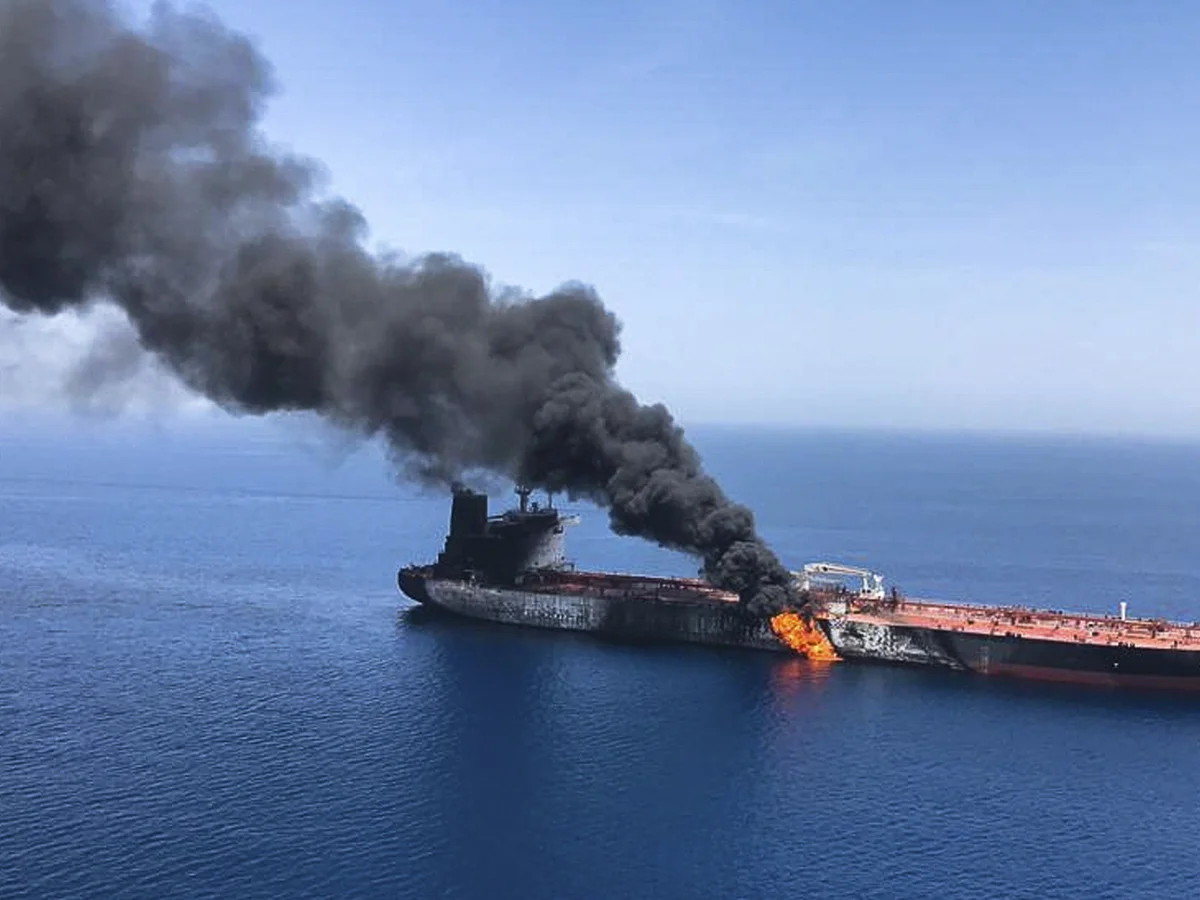
- An oil tanker reported hearing explosions while transiting the Strait of Hormuz near Oman, a British maritime agency said Thursday local time, as Tehran and Muscat hold talks to jointly manage the key waterway.
- President Trump reiterated his claim that the U.S. was set to launch heavy strikes on Iran this past weekend before he called them off and announced a new round of talks
Commercial tanker reports explosions in Strait of Hormuz, British Navy says
An oil tanker reported hearing explosions while transiting the Strait of Hormuz near Oman, a British maritime agency said Thursday local time, as Tehran and Muscat hold talks to jointly manage the key waterway.
“The Master of a tanker has reported hearing two explosions whilst transiting in the Strait of Hormuz,” an incident that occurred about 10 miles southeast of Kumzar, Oman, the United Kingdom Maritime Trade Operations said on X.
“The report confirms that crew and vessel are safe. No environmental damage has been reported,” said the UKMTO, which is an agency in the British Royal Navy.
Iran, which has seized de facto control over the strait since the war began in February, has fired on ships it said failed to follow authorized routes.
Trump says U.S. was “all set for the biggest attack since World War II” when he called off Iran strikes
President Trump on Wednesday reiterated his claim that the U.S. was set to launch heavy strikes on Iran this past weekend before he called them off and announced a new round of talks.
“We were all set for the biggest attack since World War II, and they called me, and they said, ‘Please don’t do it, let’s talk,’” Mr. Trump said while speaking at a rally at the Red Rock Casino Resort and Spa in Las Vegas.
The president claimed that the U.S. is “knocking the hell out of” Iran, but said that he would “rather make a deal, because I don’t want to kill people.”
Last week, multiple sources told CBS News that the U.S. and Israel were preparing for a new round of joint strikes on Iran.
However, CBS News learned Saturday that Saudi Crown Prince Mohammed bin Salman spoke with Mr. Trump and cautioned him against conducting the strikes.
Hours later Saturday evening, Mr. Trump announced in a social media post that he had agreed “to cancel the attack.” The president said he had received a request from “Iran, and other Middle Eastern Countries, to hold off” because the parameters of a possible peace deal had “been agreed to.”
On Tuesday night, Mr. Trump told reporters that a deal was potentially close, and could come as soon as Wednesday or Thursday.
“It’s very difficult to communicate” with Supreme Leader Mojtaba Khamenei, Iran’s president says
Iranian President Masoud Pezeshkian said Wednesday that communication with the country’s supreme leader, Mojtaba Khamenei, was very “difficult at the moment.”
Khamenei, who was wounded in the U.S.-Israeli strikes that launched the Middle East war, has not appeared in public since succeeding his father, who was killed in the same attack.
“It is very difficult to communicate with him at the moment, but in any case, his presence is a very great source of strength for us so that we can continue,” Pezeshkian said.
The younger Khamenei has communicated through written statements, but his low profile at a time when Iran is in conflict with the United States has led to speculation about his relations with other top officials.
He notably did not appear at his father’s funeral ceremonies last month.
Pezeshkian defended his leader, however, insisting he had been able to hold productive meetings with him and had been met with “kindness and very sound logic.”
“Unfortunately, the current situation allows some malicious people to describe him differently and to present a different image of him,” he said.
The President of Iran answers directly to the Supreme Leader, who holds the ultimate authority in the country’ . The Supreme Leader acts as the highest-ranking political and religious authority, controlling the military, judiciary, and major state policies.
The President of Iran functions as the highest-ranking executive official, managing day-to-day administration, the economy, and the cabinet.
While the Supreme Leader retains ultimate nominal authority, intense pressures and transitions at the top have left real tactical execution and crisis management tightly controlled by the Islamic Revolutionary Guard Corps (IRGC) as was clearly demonstrated following the signing of the MOU with the US
Houthis claim attack on another Saudi oil tanker
Yemen’s Iran-backed Houthis said Wednesday they had attacked another Saudi oil tanker, the second in a day as the rebels pressed on with their declared maritime blockade of the kingdom.
Houthi military spokesman Yahya Saree said in a statement the rebels targeted the Saudi oil tanker Daisy in the Gulf of Aden, south of the Bab el-Mandeb Strait, with a ballistic missile.
The attack appears to coincide with a tanker that reported hearing a “loud explosion in proximity to the vessel” to the U.K. Maritime Operations Centre. The UKMTO, a U.K. navy maritime security organization, fields reports of incidents from commercial vessels.
There were no crew members injured in the explosion and no environmental impacts reported, according to the UKMTO. The report was made at about 4:30 p.m. local time.
The Houthis have said they will target any Saudi oil tanker transiting through the Bab el-Mandeb Strait. They have claimed to have targeted at least six Saudi-flagged vessels since July 22.
