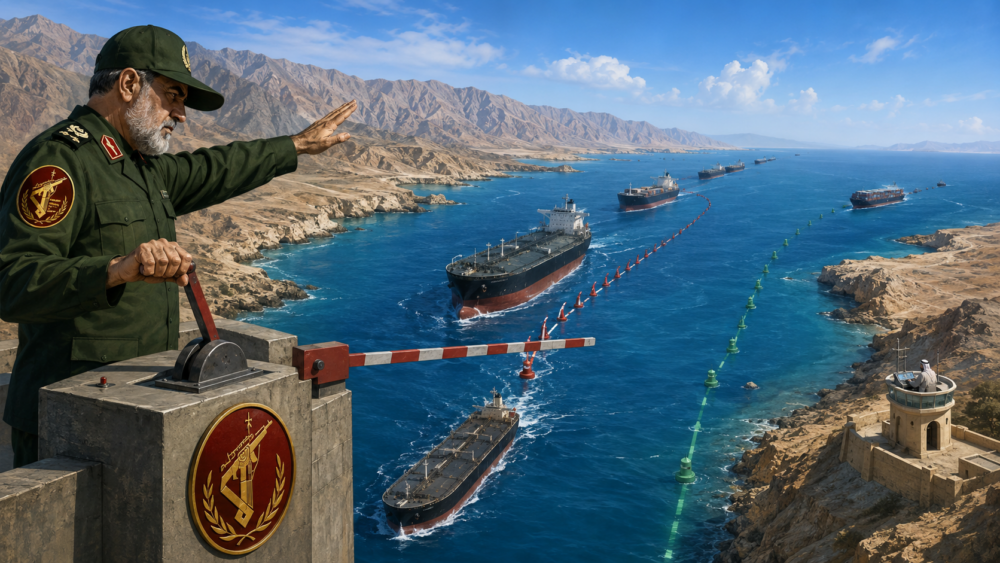
Illustration – A deal that gives Iran control over incoming ships would hand the keys of Hormuz to the IRGC—the very force that turned the strait into a weapon.
Giving Tehran authority over incoming ships would reward maritime coercion and place sensitive commercial information within reach of the IRGC
By : Ya Libnan Editorial Board, Opinion
Iran and Oman are reportedly close to a temporary 60-day arrangement intended to reopen the Strait of Hormuz. The proposal could provide immediate relief to global shipping, reduce pressure on energy markets and create an opportunity for broader negotiations.
But reopening the strait is not enough. The terms matter enormously.
Under the reported proposal, ships entering the Persian Gulf would travel through a route coordinated by Iran, while vessels leaving would use a route administered by Oman. Transit fees may be temporarily suspended, and naval mines in the central shipping lane could be cleared within 30 days.
None of these provisions has been finalized. Nevertheless, one question should be answered before Washington supports any agreement:
Who in Iran would really control inbound shipping?
The answer is unlikely to be an independent civilian maritime agency. Iran’s ports, coastal defenses, naval operations and security policies are deeply influenced—and often dominated—by the Islamic Revolutionary Guard Corps.
The IRGC is not an ordinary coast guard. It is the military power at the heart of the Iranian regime, responsible for supporting armed proxies, threatening commercial vessels and turning regional waterways into instruments of political pressure.
Giving Iran authority to coordinate incoming traffic could provide access to sensitive information about ships, cargoes, destinations, schedules and ownership. It could also give Tehran the ability to delay, inspect, intimidate or selectively obstruct vessels whenever it seeks political leverage.
Even if Iran initially exercises restraint, the precedent would be dangerous. The country that helped make navigation unsafe would be rewarded with a recognized role in managing one of the world’s most important waterways.
That is not freedom of navigation. It is maritime coercion being converted into administrative authority.
The Strait of Hormuz is an international waterway through which approximately one-fifth of the world’s oil supply passes. Its security cannot depend upon the goodwill of the same regime that has repeatedly threatened to close it.
The reported mine-clearing provision raises another serious concern. Iran should not be permitted to clear the mines and then certify by itself that the channel is safe. Any removal operation must be independently supervised and verified by qualified international maritime authorities. Otherwise, commercial captains and thousands of sailors will be asked to trust an unverifiable Iranian assurance with their lives.
The same principle must apply to transit charges. Iran cannot be allowed to impose tolls under another name. Calling a compulsory payment a “security fee” or an “environmental service fee” does not make it legitimate. No country should profit from creating a danger and then charging its victims for protection from that danger.
A temporary arrangement may be necessary to get commercial traffic moving. But Washington and its allies must establish firm conditions:
Iran must not receive inspection authority over commercial cargoes. It must not be allowed to deny passage selectively. No compulsory tolls or disguised service fees should be permitted. Mine clearance must be independently verified. And the arrangement must explicitly reaffirm that Hormuz remains an international waterway—not Iranian property.
Above all, the agreement must recognize the reality that any authority granted to Tehran may ultimately become authority exercised by the IRGC.
The world needs Hormuz reopened, but it must not purchase temporary calm by surrendering a permanent principle.
Iran cannot be rewarded for threatening international shipping. The purpose of diplomacy should be to restore freedom of navigation—not to hand the gatekeeper’s keys to the force that helped close the gate.
