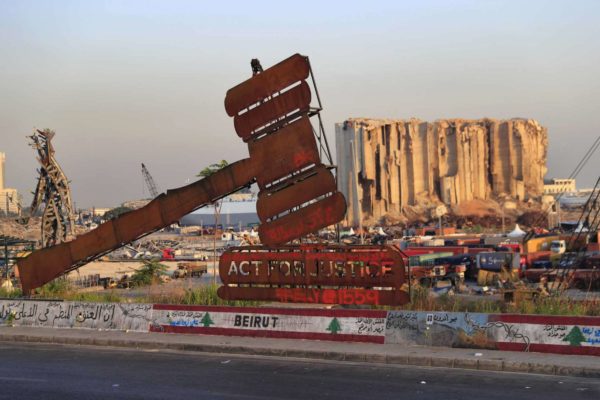
FILE – A monument that represents justice stands in front of towering grain silos that were gutted in the massive August 4, 2020 explosion at the port that killed at least 220 people , wounded over 7,000, destroyed a large section of the capital and left 300, 000 homeless in Beirut, Lebanon. Hezbollah and and its allies have been trying for years to get rid of Judge Tarek Bitar who is probing the blast and were able to suspend his investigation several times . a move that outraged the relatives of the victims of the blast . Hezbollah is reportedly concerned over being exposed for its role in acquiring, storing and using of the ammonium nitrate that exploded at the port (AP Photo/Hussein Malla, File)
Lebanon marks six years since the Beirut blast with renewed hopes an indictment will finally pave the way for justice and accountability.
For the families of those killed in the Beirut port explosion, every anniversary since 2020 has been marked by the same ritual of gathering in the streets to demand accountability while watching the investigation stall under the weight of political interference, legal obstruction and institutional paralysis.
This year, however, the sixth anniversary of the blast has been accompanied by cautious optimism that has long been absent.
Relatives of the more than 220 people killed in one of the largest non-nuclear explosions in history believe the investigation is finally approaching a decisive moment after investigative judge Tarek Bitar completed his inquiry in March and referred the case to Lebanon’s Public Prosecutor’s Office for review, the final procedural step before an indictment can be issued.
Families hope the long-awaited indictments will be released before the end of 2026, paving the way for public trials after six years in which successive legal challenges, political interventions and attempts to remove Bitar repeatedly threatened to derail the investigation and shield senior officials from accountability.
ccountability.
The renewed optimism comes as Lebanon’s political leadership has publicly backed the next phase of the judicial process.
President Joseph Aoun said on Monday that issuing the indictment was “a necessity that can no longer tolerate further delay”, describing the anniversary not simply as a day of mourning but as “a permanent reminder of the duty of truth, justice and accountability”.
Standing six years on from the catastrophe that devastated large parts of Beirut, Aoun said the country’s wounds would not heal, and public confidence in state institutions could not be restored until justice had run its full course.
“Justice does not mean revenge,” Aoun said. “It means establishing the truth, revealing it in full, and holding accountable everyone who neglected their duty, failed in their responsibilities or caused this catastrophe, regardless of their position or status.”
Aoun described the explosion as “a tragedy unparalleled in our modern history,” one that transformed the port from a lifeline for the economy into the scene of a disaster that claimed innocent lives, left hundreds killed and thousands wounded, and caused destruction that ravaged both stone and spirit.
He regarded this anniversary not merely as a moment for mourning, but as a constant reminder of the imperative of “truth, justice, and accountability,” stressing that the wound will not heal—nor will the Lebanese people’s confidence in their institutions be restored—until the pursuit of justice is carried through to the end.
“The issuing of the indictment by the investigating judge has become a necessity that can no longer be delayed,” Aoun said in a statement.
He reaffirmed that the rule of law is the “sole guarantee” against a recurrence of the tragedy, asserting that Lebanon can emerge stronger from its ordeal once full justice is achieved; he expressed the hope that the souls of the martyrs might rest in peace and that their memory would remain a driving force in the quest for truth and justice.
Nobody has been held accountable for the disaster, with victims and their families still demanding justice in a country long plagued by official impunity.
Justice “means upholding rights, revealing the whole truth without any omission, and holding accountable” all those who were negligent or caused the catastrophe “whatever their position”, Aoun said.
Prime Minister Nawaf Salam echoed that message, insisting there would be “no settlement at the expense of justice, even if justice has sometimes been delayed”.
He sought to reassure victims’ families that no official, regardless of rank, would receive political protection in the investigation, saying accountability “will exclude no one”.
Salam also reflected on the day after the explosion, recalling how volunteers from across Lebanon descended on Beirut to clear rubble, repair damaged homes and help survivors rebuild their lives. If 4 August should forever remain a day dedicated to truth, justice and accountability, he said, then 5 August should be remembered as a day symbolising Beirut’s resilience, solidarity and unity
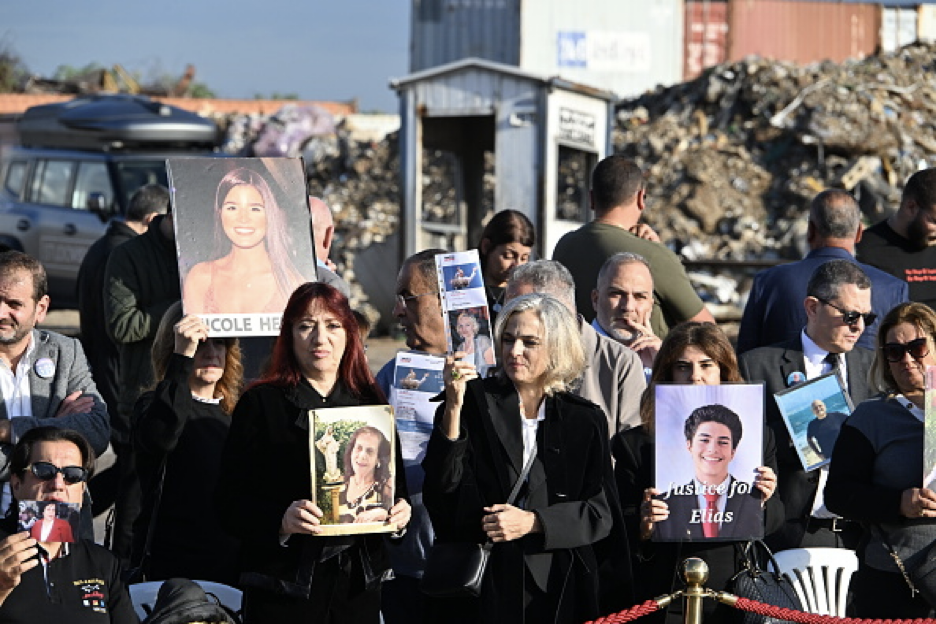
Relatives of victims of the 2020 Beirut port explosion gather at the blast site carrying photographs of their loved ones during Pope Leo XIV’s visit to Beirut on 2 December 2025. [Getty]
Won’t stop fighting
On Tuesday, families of the victims will once again march through central Beirut, insisting that August 4th should never become merely another public holiday.
For them, it remains the date on which more than 220 people were killed, thousands were injured, 300,000 became homeless They hope the case will become a rare precedent in Lebanon by exposing the full truth behind the disaster and bringing senior officials before the courts.
A turning point for the investigation
The sense that the investigation has entered a new phase is shared by legal experts, who describe 2026 as the most consequential year for the case since the explosion.
Ghida Frangieh, head of litigation at Lebanese legal watchdog The Legal Agenda, said a series of court decisions had firmly rejected attempts by defendants to use procedural challenges to obstruct the investigation, reinforcing the judiciary’s support for allowing the case to proceed.
Among the most significant rulings was the dismissal of a complaint filed by former Public Prosecutor Ghassan Oueidat accusing Bitar of usurping authority, effectively ending what Frangieh described as an attempt to overturn the investigation that had paralysed the case since 2023.
Another landmark judgment found former ministers Ali Hassan Khalil and Ghazi Zeaiter had abused their legal rights by repeatedly filing lawsuits against Bitar and other judges in an effort to halt the investigation. The court ordered the pair to pay 110 billion Lebanese pounds (around $1.2m) in damages and, for the first time, formally documented the systematic obstruction of the inquiry in an official judicial ruling.
More recently, Lebanon’s Court of Cassation rejected additional lawsuits seeking Bitar’s removal, further reinforcing the legal basis for allowing him to complete the investigation.
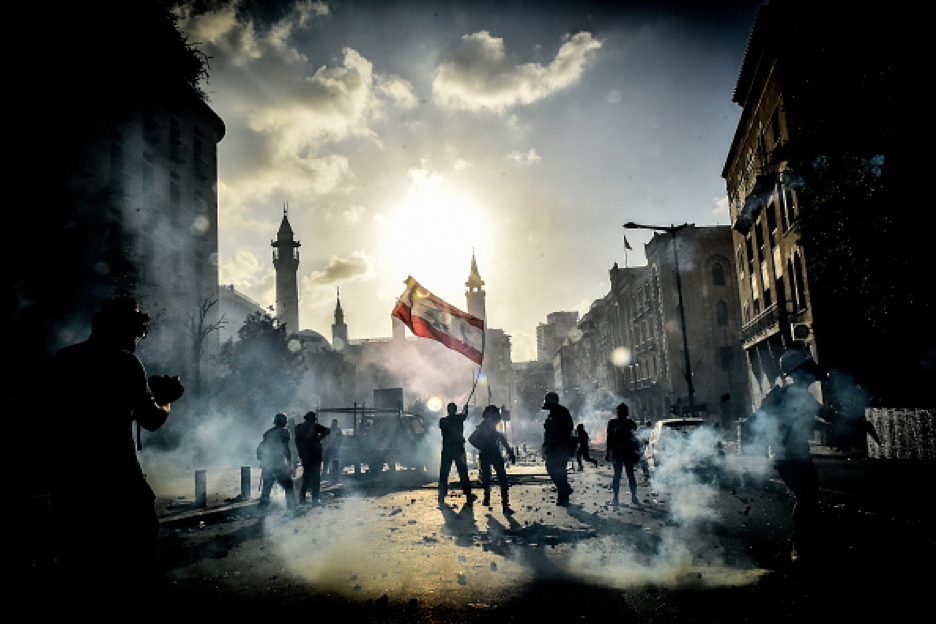
Anti-government protesters gather in central Beirut days after the 4 August 2020 port explosion, demanding accountability from Lebanon’s political leadership. Six years later, victims’ families say they hope a long-delayed indictment will finally pave the way for justice. [Getty]
Years of political and legal obstruction
For lawyer Farouk El Mograbi, who has represented victims’ families, the story of the past six years can be summed up in one sentence.
“The entire system conspired against this case and against Judge Bitar,” he told The New Arab. “But he was courageous enough to save the investigation.”
El Mograbi credited not only Bitar but also MP Melhem Khalaf and the Beirut Bar Association’s litigation office, which has represented more than 1,000 victims, including injured workers and the families of foreign labourers killed in the blast.
The next step, he said, is for the Public Prosecutor’s Office, where Judge Mohammad Saab is reviewing the case file, to submit its opinion before Bitar issues the indictment and transfers the case to the Judicial Council, where public trials would begin.
Although the contents of the indictment remain confidential, El Mograbi said possible charges could range from criminal negligence to intentional homicide.
He noted that there are currently no detainees in the case after Oueidat, while serving as Public Prosecutor in 2023, ordered the release of all detained suspects, filed charges against Bitar and instructed judicial and security authorities to cease cooperating with the investigative judge after Bitar attempted to revive the investigation following a two-year suspension.
Looking back, El Mograbi divided the investigation into four defining phases: the removal of Bitar’s predecessor, Judge Fadi Sawan, in late 2020 after legal challenges by former ministers Khalil and Zeaiter; the more than 50 lawsuits filed against Bitar after he took over the investigation in February 2021; the sustained political, judicial and security campaign against him, including the October 2021 Tayouneh clashes that erupted during protests organised by Hezbollah and Amal demanding his removal; and finally, the current phase, which he hopes will culminate in an indictment before the end of the year.
One of the few international developments in the case came in September 2025, when Bulgarian authorities arrested Igor Grechushkin, the Russian owner of the cargo ship Rhosus, which transported the ammonium nitrate that exploded in Beirut. Bulgarian courts later rejected Lebanon’s request to extradite him, and he is no longer in custody.
Pressure grows for accountability
Human rights organizations have welcomed the recent progress but warn that meaningful accountability remains elusive.
“Six years after the Beirut port explosion, victims’ families and survivors are still waiting for truth and justice,” Reina Wehbi, Lebanon campaigner at Amnesty International, told The New Arab.
While acknowledging important progress over the past 18 months after years of obstruction, Wehbi warned that delayed justice had remained incomplete justice.
She urged Lebanese authorities to ensure the investigation proceeds independently and without political interference, establishes the full chain of responsibility, including whether criminal acts or human rights violations resulted from the authorities’ failure to protect lives, and ultimately delivers accountability, reparations and justice for victims and their families.
For those preparing to march through Beirut once again on Tuesday, however, the message has remained unchanged for six years.
They are no longer simply demanding that the investigation survive. They are demanding that, for the first time in Lebanon’s modern history, it finally reaches its conclusion.
The New Arab/ YL
