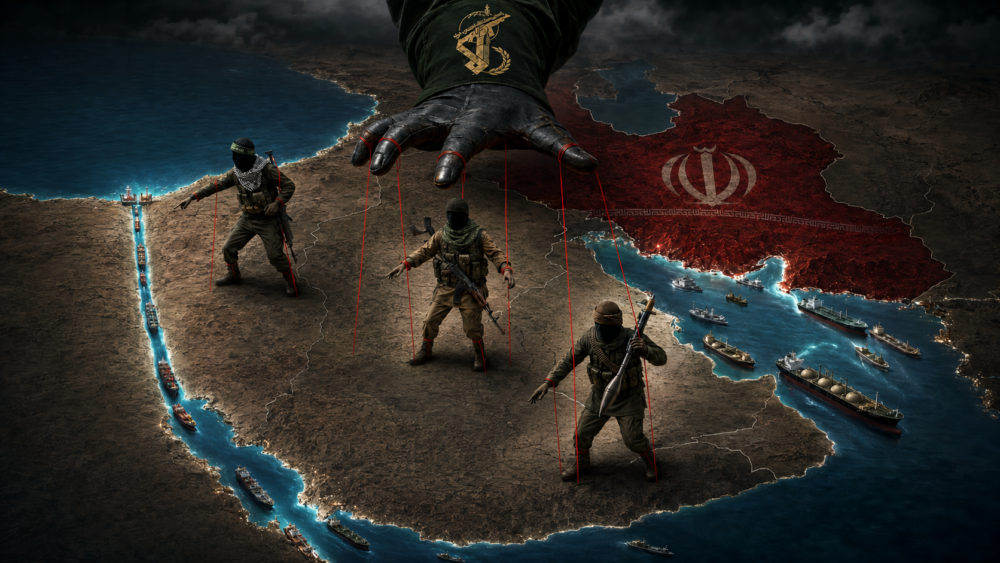
Illustration: Three chokepoints, one war machine: Iran uses its proxy network to extend its reach from Hormuz and Bab el-Mandeb to the gateway of the Suez Cana
The drone strike at Egypt’s Damietta Port may expose Tehran’s wider strategy: Using its proxy network to threaten the three maritime gateways connecting the Gulf, the Red Sea and the Mediterranean.
By: The Editorial Board , Opinion
The drone that struck Egypt’s Damietta Port on July 29 did more than ignite a fire aboard two gas vessels. It delivered a warning to the world: Iran’s regional war machine may now be extending its reach toward the Suez Canal—one of the most important arteries of global commerce.
Egyptian authorities confirmed that a drone caused the fire aboard the American-owned floating gas-storage vessel Energos Winter. The blaze subsequently spread to the nearby GasLog Salem. Fortunately, no fatalities were reported, and Egyptian emergency crews brought the fire under control.
But the limited damage should not obscure the enormous strategic significance of the attack.
No organization has claimed responsibility, and Egypt has not publicly identified the drone’s model, launch site or flight path. Iran, the Houthis and Yemen’s internationally recognized government have all denied involvement.
Those denials do not resolve the central question: Was the attack carried out by one of Iran’s proxies as part of a coordinated strategy to threaten the three maritime gateways connecting the Middle East to the world economy?
A strategic triangle of maritime pressure
Iran already exercises direct military pressure over the Strait of Hormuz, through which a substantial share of the world’s petroleum trade passes.
At the opposite end of the Arabian Peninsula, Iran-backed Houthi forces in Yemen have repeatedly attacked commercial vessels and threatened navigation through Bab el-Mandeb, the narrow gateway connecting the Red Sea to the Gulf of Aden.
Now a drone has struck an American-owned energy vessel at Damietta, on Egypt’s Mediterranean coast near the northern entrance to the Suez Canal.
The strategic triangle is difficult to ignore:
- Iran threatens Hormuz directly.
- The Houthis threaten Bab el-Mandeb.
- Hezbollah or an Iran-backed Iraqi militia may possess the ability to threaten the Suez–Mediterranean corridor.
These are not merely regional waterways. Together, they form the maritime architecture connecting the Gulf and Asia to Europe. Disrupting any one of them can shake energy markets and international shipping. Threatening all three could give Tehran extraordinary coercive leverage over global commerce.
Did the drone come from Lebanon or Iraq?
The drone’s precise model will be crucial to identifying its possible origin. Reports that it may have been a Samad-3 or comparable Iranian-designed attack drone have not been officially confirmed by Egypt and must therefore be treated cautiously.
Nevertheless, two possible launch areas deserve especially close investigation: Lebanon and Iraq.
Hezbollah cannot be excluded
Damietta lies only approximately 440 to 500 kilometers from the Lebanese coast. That is well within the reported range of several drone systems available to Hezbollah.
A drone launched from Lebanon could travel southwest largely over the Mediterranean, avoiding the difficult overland routes and multiple air-defense zones that a drone launched from more distant territory might encounter. Flying low over the sea could also reduce detection and allow the aircraft to approach Damietta from an unexpected direction.
The target was stationary, large and located at a known port. Such an operation would not require the most sophisticated targeting system in Iran’s arsenal.
Hezbollah also had a clear political motive. Its leaders have repeatedly declared their ideological and strategic allegiance to Iran’s supreme leadership. Hezbollah Secretary-General Naim Qassem explicitly said the organization would not remain neutral if Iran or its supreme leader were threatened.
Hezbollah’s latest war with Israel was not fought to defend Lebanon. It dragged Lebanon into another devastating confrontation in defense of Iran and Iran’s regional project.
Reports also indicated that Hezbollah launched an explosive drone against an Israeli military vehicle in southern Lebanon on July 29—the same day as the Damietta attack. That does not connect the two incidents, but it demonstrates that Hezbollah’s drone units remained operational and active at the relevant time.
None of this proves that Hezbollah launched the Damietta drone. But the combination of range, capability, flight geometry and allegiance to Tehran makes Hezbollah one of the first organizations investigators should examine.
An Iraqi militia is equally plausible
Iran-aligned militias operating in Iraq also deserve close scrutiny.
Damietta lies approximately 1,200 kilometers from Baghdad and potentially less than 1,000 kilometers from parts of western Iraq. That places the port within the reported operational range of several Iranian-designed one-way attack drones.
The timing is also suspicious. The Damietta attack followed U.S.–Saudi strikes against Iran-backed armed factions in Iraq. Those groups therefore possessed both a motive for retaliation and access to Iranian drone technology.
Targeting the American-owned Energos Winter would have allowed an Iraqi militia to retaliate against a U.S.-linked asset while simultaneously threatening the Suez route that has grown more important as conflict endangers shipping through Hormuz and Bab el-Mandeb.
An Iraqi launch would require a longer and more complicated flight than one from Lebanon. But Iran-backed militias have repeatedly demonstrated an ability to conduct long-range drone attacks while concealing which group—or which country—was responsible.
The attack may therefore have been carried out by an Iraqi faction, possibly with direct technical or operational assistance from the Islamic Revolutionary Guard Corps.
Different proxies, one command structure
For decades, Iran has perfected a method of warfare designed to expand its reach while obscuring its responsibility.
Tehran arms, finances and trains allied groups across the region. These organizations carry local names and claim local causes, but many employ similar Iranian weapons, operational doctrines and targeting strategies.
When a proxy attacks, Iran denies responsibility. When the operation succeeds, Tehran gains strategic leverage. When retaliation follows, the proxy’s host country—not Iran—often pays the price.
Lebanon has experienced this through Hezbollah. Yemen has experienced it through the Houthis. Iraq has experienced it through militias operating beyond effective government control.
Iran’s proxy network is therefore not simply a loose collection of sympathetic armed groups. It is a distributed regional war machine capable of striking from several countries while preserving plausible deniability for Tehran.
Whether the Damietta drone came from Lebanon or Iraq, the controlling hand may ultimately have been the same.
Iran does not need to close the waterways
Iran does not have to shut down Hormuz, Bab el-Mandeb or Suez completely to damage the global economy. It only has to make passage through them dangerous and unpredictable.
A small number of successful attacks can increase maritime-insurance premiums, force vessels onto longer routes, delay energy deliveries and raise transportation costs. Those costs eventually reach factories, businesses and consumers thousands of miles away.
In effect, Iran can impose a geopolitical risk tax on international commerce without formally declaring a blockade.
The objective may not be permanent physical control of the waterways. It may be the ability to threaten them whenever Tehran wants sanctions relief, military restraint or political concessions.
Egypt must release the evidence
Egypt should release the results of its investigation as soon as national-security considerations permit.
The drone’s engine, guidance system, explosive material and surviving airframe components could identify its manufacturing family. Radar records could reveal its direction of approach. Satellite and intelligence data might determine whether it arrived from the eastern Mediterranean, from the direction of Lebanon and Syria, or after a longer flight originating in Iraq.
This is not merely an Egyptian investigation. Every country that depends on the Suez Canal and stable energy markets has an interest in establishing who carried out the attack.
Whether the drone came from Lebanon or Iraq, its message was unmistakable: Iran wants the world to believe that no maritime route beyond Hormuz is safe from its regional war machine.
If the drone came from Lebanon, Hezbollah must not be permitted to turn Lebanese territory into a platform for Iran’s war against international shipping. If it came from Iraq, Baghdad must dismantle the militia infrastructure that allowed Iraqi territory to be used to attack another Arab country.
Sovereignty cannot coexist with armed groups conducting foreign wars from inside national borders.
The international community must also recognize that Hormuz, Bab el-Mandeb and Suez now form one interconnected security challenge. Protecting one waterway while allowing Iran’s proxies to threaten the others will not work.
The fire at Damietta was extinguished quickly. The warning behind it should not be.
