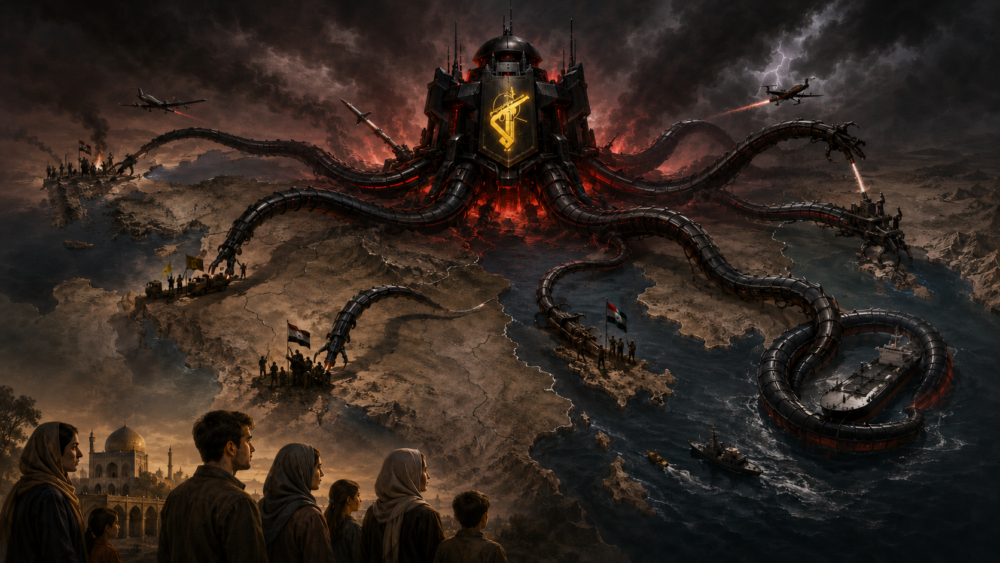
Illustration: The IRGC’s tentacles have brought missiles, militias and instability across the Middle East—while holding Iran and its people hostage.
Saudi Arabia’s entry into direct military action exposes a reality the Middle East has resisted for decades: lasting peace will remain impossible while Tehran’s revolutionary system survives by exporting war.
By : The Editorial Board, Opinion
Saudi Arabia has crossed an important threshold. After enduring repeated Iranian and proxy attacks, the kingdom joined the United States in striking Iran-backed militias in Iraq.
This should not yet be described as Saudi Arabia formally entering the entire war against Iran. But it is unmistakably a direct Saudi military response against Tehran’s regional network—and a warning that the Gulf states may no longer remain passive while Iran attacks them through supposedly independent militias.
U.S. Central Command said American and Saudi aircraft struck weapons and logistics sites after more than 30 drone attacks directed by Iran’s Islamic Revolutionary Guard Corps against U.S. forces and Saudi energy infrastructure. Iraq’s Popular Mobilization Forces, an umbrella organization that includes powerful Iran-backed militias, said at least 20 of its members were killed. CENTCOM described the operation as a response to attacks ordered by the IRGC.
Saudi Arabia said drones launched from Iraqi territory had targeted oil facilities in its Eastern and Riyadh regions. Although Riyadh insisted that it did not seek escalation, it also declared that it would respond decisively to aggression.
That distinction is important. Saudi Arabia did not choose this confrontation. Iran and its proxies brought the confrontation to Saudi territory.
Tehran also launched missiles toward American forces in Jordan in what CENTCOM called an “attempted surprise attack.” Jordanian defenses reportedly intercepted the missiles. The IRGC then claimed attacks on ships in the Strait of Hormuz because they had ignored Iranian warnings and traveled along a route Tehran unilaterally declared illegal.
The pattern is unmistakable: when Iran cannot impose its demands through negotiations, it turns international waterways, neighboring countries and nominally independent militias into instruments of coercion.
Oman’s attempt to resolve the Hormuz crisis offered Tehran a reasonable alternative. The Gulf-backed proposal called for a regional mechanism modeled in part on the cooperative system used around the Strait of Malacca. Iran and Oman would share responsibility, while contributions from shipping companies would be voluntary rather than compulsory.
Iran rejected that arrangement and proposed one granting Tehran substantially greater control. Its objective was not merely safe navigation or compensation for maritime services. It was political domination of a waterway through which roughly one-fifth of the world’s oil and liquefied natural gas once passed. Reuters reported that Gulf states supported Oman’s cooperative framework.
This is the same strategy Iran has pursued since the Islamic Republic was established in 1979.
Through the IRGC, Tehran built armed organizations in Lebanon, Iraq, Yemen, Syria and elsewhere. Hezbollah weakened the Lebanese state. Iraqi militias penetrated official institutions while retaining loyalty to Iran. The Houthis turned Yemen and the Red Sea into another front in Tehran’s regional struggle.
Every country that permitted an Iranian proxy to grow eventually lost some measure of sovereignty.
The restoration of diplomatic relations between Saudi Arabia and Iran in 2023 did not change the regime’s underlying behavior. Diplomacy may temporarily reduce tensions, but it cannot succeed when one party regards negotiation as another battlefield and proxy violence as a permanent instrument of state policy.
The conclusion should be stated clearly but responsibly: the problem is not Iran, its ancient civilization or its people. The problem is the revolutionary regime, the IRGC and the system of armed proxies through which they export instability.
Nor should eliminating that threat mean indiscriminate war or the destruction of Iran. The objective must be to dismantle the regime’s machinery of external aggression, sever the IRGC’s command and financing networks, disarm its proxies and help the Iranian people reclaim their country.
Military strikes alone cannot accomplish that. The United States and its allies need a coherent strategy:
- Destroy the IRGC’s capacity to direct attacks beyond Iran’s borders.
- Target the financing, weapons routes and command structures sustaining its proxies.
- Protect international shipping and reject Iran’s claim to exclusive control over Hormuz.
- Support sovereign governments in Iraq, Lebanon and Yemen against parallel armies.
- Help Iranians communicate, organize and obtain uncensored information.
- Make clear that Iran’s political future must ultimately be decided by the Iranian people.
For nearly five decades, the Middle East has tried deterrence, accommodation, sanctions, diplomatic engagement and temporary ceasefires. Each pause allowed Tehran to regroup while its proxies remained armed.
Saudi Arabia’s decision to strike back demonstrates that the old policy has reached its limit. The region cannot coexist indefinitely with a revolutionary system that requires permanent conflict to justify its power.
The Iranian people deserve liberation from that system. Iran’s neighbors deserve sovereignty without missiles, drones and militias. And the world deserves a Strait of Hormuz governed by international law—not by maritime blackmail.
The regime’s regional war machine must be dismantled. Only then can Iran return to the region as a nation rather than dominate it through fear.
