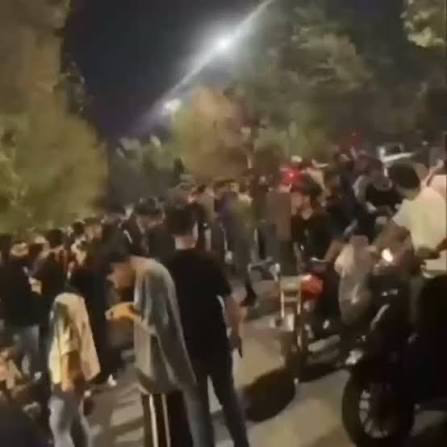
Two protesters were executed early Tuesday amid heavy security deployment around Isfahan’s Alikhani Square, where an scaffold had been erected and witnesses reported clashes between guards and people who gathered overnight amid fears of further executions.
The Islamic Republic publicly executed two Iranian protesters in Isfahan at dawn on July 28. Several hundred people gathered near a stage set up in the city’s Alikhani Square, but instead of cheering the execution, they chanted slogans against the police, prompting anti-riot units to disperse the crowd.

In a rare public execution, the Iranian regime hanged two protesters, Abolfazl Sepahi and Amir Safari, in the central Iranian city of Isfahan on July 28. They were among at least 12 young men sentenced to death for the killing of four police officers during anti-regime protests in Isfahan in January 2026. Two of the other men were executed in prison on July 19.
The regime had prepared for the public executions the evening before, erecting a makeshift stage in Alikhani Square, where authorities claim the four police officers were killed by protesters during the anti-regime demonstrations in January 2026.
Iran’s last politically motivated public execution took place in 2022, when Majidreza Rahnavard was put to death. He was charged with killing a member of the security forces in Mashhad during the “Woman, Life, Freedom” movement. At least 88 people were publicly executed in Iranbetween 2011 and 2023, according to the independent Shargh newspaper.
Despite the risks, Iranians continue to demand the abolition of the death penalty. Prisoners are also protesting peacefully through the recently launched ‘No to Executions’ campaign, holding a sit-in and hunger strike at Ghezel Hesar prison in Karaj, northwest of Tehran. According to Amnesty International, Iran has executed at least 2,159 people in 2025, mostly related to drug trafficking cases.
‘After decades of mass and public executions, people are still protesting’
‘Kaveh’ is a lawyer and human rights activist in Iran. We have withheld his identity for security reasons.
Regarding this specific case, we know nothing beyond what has been reported by official news agencies. They claimed that on January 8, 2026, four police officers were killed by protesters in Alikhani Square in Isfahan.
Over the following days, police arrested several people who they claimed were involved in the incident. Several months later, the courts sentenced 12 of them to death. Two other men had already been executed on July 19 in connection with the case.
We do not even know whether they were directly involved in the incident or were simply present at the protest.
We also do not know whether they were allowed to choose their own lawyers, whether they were represented by court-appointed lawyers, or whether those lawyers defended them effectively.
State television channels aired purported confessions of the four young men after their executions on July 19 and 28, in which they appeared to admit involvement in the killing of the four security officers. A group of UN human rights experts said on July 27: “Confessions obtained under coercion must never be admitted as evidence, and broadcasting them before trial violates the presumption of innocence.”
‘Trump factor accelerated the executions’
Iranian human rights activists say a “Trump factor” may have encouraged the regime to accelerate its political executions. Kaveh continues:
The Islamic Republic passed a special law during the 12-day war in June 2025 and has since adopted a new strategy for repressing protesters, particularly those involved in the January 2026 protests. Two other factors are also at play: the killing of police officers during the protests and the Trump factor.
After Trump claimed that he had stopped executions in Iran and that the Iranians had promised him they would halt them, the Islamic Republic instead accelerated the executions. It treats participation in the January 2026 anti-regime protests as direct cooperation with an enemy of the state.
In January 2026, Trump claimed that Iran had stopped the executions of hundreds of protesters at his request and thanked the Iranian leadership.
Heba Morayef, Amnesty International’s regional director for the Middle Eastand North Africa, made a related point, saying that the Iranian authorities were seeking to project strength amid war and instability:
“The Iranian authorities are unleashing a horrifying wave of executions and death sentences to punish and suppress dissent and project an image of strength and absolute control in the wake of the January popular uprising and amid ongoing attacks by US and Israeli forces,” Morayef said.
‘Soon people find the courage to protest again’
Kaveh continued:
The way they organised this public execution raises questions. By holding it in public, they clearly wanted people to witness what they were doing. Yet they then began pushing people away, preventing them from recording the execution and beating them.
This reveals the deep divide between what the state wants to project and how people perceive its actions. What the state considers normal is not what society wants, believes or accepts as the norm.
Ultimately, the main goal is to frighten the public and protesters, while responding to demands for revenge from the regime’s support base.
France24/AFP
