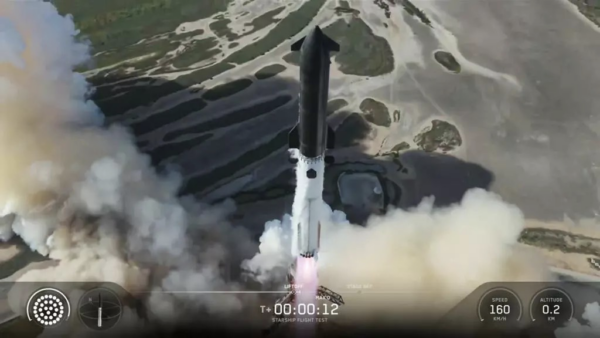
This still image taken from a SpaceX broadcast shows the SpaceX Starship launching from SpaceX Starbase in Starbase, Texas, on July 24, 2026. © SpaceX via AFP
US aerospace company SpaceX carried out a successful test flight of its 14-story Starship rocket Friday, blasting off from Texas to land gently in the waters of the Indian Ocean. It’s the first such success since US tech billionaire Elon Musk’s SpaceX went public in June.
SpaceX‘s Starship on Friday sailed through its first test flight since the company went public.
“Starship is intact, floating in the ocean and transmitting telemetry!” company head Elon Musk said on X.
As the craft flew over a shadowed Earth, a camera fixed to the rocket and streamed live by SpaceX showed thunderstorms with flashes of lightning in the background 190 kilometres below.
The 122-metre-tall ship splashed into the Indian Ocean to wild cheers from SpaceX employees, who were watching live footage from the company’s Starbase.
“I’m losing my mind right now,” spokesperson Dan Huot said on the livestream. “This is the first time we’ve put an intact Starship in the water.”
“This is a dream scenario for the team that’s trying to get this heat shield data.”
The flight aims were similar to those of a mostly successful voyage carried out in May, which debuted the latest edition of the powerful Starship, its third-generation model.
The primary goals of this 13th test launch were to once again demonstrate those redesigns in flight – this time without any hiccups.
During the mission, the rocket launched 20 of Starlink’s V3 satellites, a much more powerful version with greater bandwidth and internet speeds. They briefly connected with SpaceX’s existing network of some 10,000 orbiting satellites. Then, as planned, they followed the ship’s suborbital trajectory into Earth’s atmosphere and burned up.
The approximately one-hour flight also tested upgrades to the mammoth ship’s heat shield.
The company had said after its May test that it had made “several modifications to hardware and software to address issues seen on the previous flight”.
The landing burn of the booster was still a bit harder than the company hoped.
“Just looking at the booster real quick, it didn’t look like we lit all 13 engines that we were planning for that initial land and burn,” said Huot.
“We were targeting a softer splash on it, and as you saw, it came in with quite a bit of velocity.”
Moon-bound?
A previous attempt at launch was abruptly scrubbed just as the booster began to ignite, in an automatic stoppage that occurred after some engines did not start.
The launch was then further delayed over weather and visibility concerns.
Friday’s flight was the first after Musk’s SpaceX went public on Wall Street in June, with a record initial public offering.
The rocket company has rapidly expanded its satellite internet service and voiced lofty ambitions for AI data centres in space.
There’s a lot riding on SpaceX’s progress: The company is under contract with NASA to produce a modified version of Starship to serve as a lunar landing system.
Sharing an image of the Starship rocket passing the Moon, NASA Administrator Jared Isaacman commented that it was “pretty clear from this shot that SpaceX knows where we are going!”
“When Starship comes online, its capabilities will be game-changing, not least of which will be ensuring we never give up the Moon again!”
(FRANCE 24 with AFP and Reuters)
