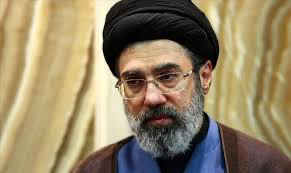
Iran’s new supreme leader, Mojtaba Khamenei, the second son of late Iran’s Supreme Leader Ayatollah Ali Khamenei. He has never been seen in public ever since he was appointed to succeed his father.
By: Dr. Azza Hashem
Some ghosts rule from behind the curtain, and there are leaders whose names become little more than signatures affixed to decisions whose true authors remain unknown. That is precisely what the Iranian political landscape has become since the assassination of Supreme Leader Ali Khamenei on 28 February 2026 during the US-Israeli strikes on Tehran, followed by the installation of his son, Mojtaba Khamenei, as his successor just one week later.
From the moment he assumed office until today, Mojtaba Khamenei has not appeared even once in an independently verifiable audio-visual broadcast. Instead, he has confined himself to a series of written statements read out on his behalf or attributed to him.
This absence, now stretching beyond four full months, is not merely a matter of protocol. It is a symptom of a far deeper malaise affecting the very structure of the Iranian state. The question this article poses is not simply, “Is he alive or dead?” Such a binary question is misleading in its simplicity. Rather, it asks a broader one: who, in practice, holds the authority to speak on Iran’s behalf today? And why has the crisis surrounding a single individual exposed the fragility of an entire political system? As will become clear, the answer lies not in a single definitive image or a conclusive leak, but in the accumulation of indirect indicators that, when considered together, point more convincingly in one direction than any other.
The situation became still more inflammatory when US President Donald Trump stated on 13 July 2026 that he believed there was a “90% chance” that Mojtaba Khamenei had been killed. The claim was unsupported by a single piece of evidence and came amid renewed military escalation and US threats to seize control of the Strait of Hormuz. Yet, as I will discuss later, this statement should not be read as a fact but as a political position that requires scrutiny rather than unquestioning acceptance.
Zero Hour: When the Entire Pyramid Collapsed
On the first day of the war, Khamenei’s residential compound was not merely a military target. It was the very heart of the Iranian regime. In broad daylight, Israeli aircraft dropped dozens of bombs on the complex, killing four of the people closest to Mojtaba in a single moment: his father, Ali Khamenei; his mother, Mansoureh Khojasteh Bagherzadeh; his wife, Zahra Haddad-Adel; and one of his sons.
According to accounts attributed to no clearly identified source, Mojtaba survived after leaving the site only minutes before the bombs fell. One week later, Iranian television announced his election as Supreme Leader in an exceptionally swift move intended to close the power vacuum before it widened. Yet, as we shall see, rather than closing that vacuum, the move merely shifted it from the apex of the pyramid to its base.
Shadow Leader: Converging Evidence Without a Common Source
The account that Mojtaba is alive, albeit injured, is less a single coherent narrative than a collection of overlapping leaks, all pointing in the same direction without converging on a single credible source. Trump himself suggested in March that he was “alive and injured”. US sources spoke of a fractured foot and burns to the face and torso, while an Iranian official described his injuries as “minor” and claimed that he was continuing to perform his duties as normal.
This stark disparity in descriptions of the same injury, ranging from “minor” to severe burns across four areas of the body, is itself an initial indication that none of these sources possesses reliable first-hand knowledge, and that what reaches us is speculation expressed in the language of certainty.
The same applies to the written statements issued in his name, from pledges to close the Strait of Hormuz to vows to avenge his father’s death. These statements establish only that someone is speaking on Mojtaba’s behalf, not that Mojtaba himself is the one speaking.
The distinction between those two possibilities lies at the very heart of this investigation. Even his father’s funeral, which seemed to offer the definitive opportunity to settle the question, resolved nothing. Videos circulated claiming to show Mojtaba Khamenei moving through the mourners in disguise. They were later challenged when the cleric Reza Mousavi Vaez identified himself as the man seen in the footage, explicitly denying that it was Mojtaba Khamenei.
At the same time, separate videos circulated that had been generated entirely using artificial intelligence, likewise purporting to show him alive among the mourners. Thus, the controversy surrounding his father’s funeral produced not a single credible piece of evidence, but three conflicting narratives at once: authentic footage that was ultimately shown to depict someone else, entirely fabricated AI-generated footage, and the documented absence of Mojtaba himself.
This proliferation of conflicting and fabricated claims is perhaps not evidence of his presence at all, but rather evidence of an information vacuum that every side has rushed to fill with its own narrative.
More revealing than any individual detail is the fact that the US position itself, from what one would expect to be the party with the most comprehensive intelligence, has not remained consistent over the past four months. Instead, it, too, has appeared uncertain: shifting from “alive and injured” in March to “almost certainly dead” in July, without any new evidence to explain such a complete reversal in its assessment.
A shift of this magnitude, coming from the party that claims the greatest intelligence advantage, suggests less a gradual refinement of information than the repeated political use of uncertainty itself as an instrument of pressure, sharpened whenever negotiations with Tehran require it.
Absence as an Admission: What the Missed Opportunity Reveals
By contrast, a growing body of indicators points in the opposite direction. Joint US-Israeli intelligence reports in April stated that Mojtaba was “unconscious” and undergoing treatment for a critical condition in the city of Qom. Such a description goes well beyond mere “injury”, suggesting a state of complete incapacity that would prevent him from exercising any meaningful role, regardless of whether he remained biologically alive.
This distinction is crucial. The more precise question is not simply, “Is his heart still beating?” but rather, “Is there still a person capable of exercising power behind that name?” These are two entirely different questions, and the answer to both may well be “no”.
In my view, the most telling evidence is not any of these scattered leaks, but his absence from his father’s funeral itself. This was not a routine occasion that could plausibly be missed on straightforward security grounds. It was the first and last comparable political opportunity to consolidate his legitimacy before an entire nation looking to its new leader for reassurance and direction at a moment of collective trauma.
Yet for a newly appointed Supreme Leader, only recently elevated to power, to forgo such an occasion cannot be dismissed as an ordinary security decision. Security concerns could have been addressed through far less extreme measures: a heavily fortified venue, a brief public appearance, or even a pre-recorded address. It is the complete absence, rather than a limited appearance, that invites scrutiny.
The Silence That Speaks: When Neither Illness nor Security Can Explain the Missing Voice
Here, I arrive at what I consider the strongest indicator in this entire case, one that has received far less attention than it deserves in most reporting. Since assuming office, Mojtaba Khamenei has not delivered a single direct audio address to the Iranian people, despite the extraordinary circumstances. Iran had just emerged from a devastating war in which it lost its Supreme Leader along with several of its most senior military and political figures in a single blow. If ever there were a moment that demanded such an address, it was this one.
That is because, at moments such as these, a unifying address is not a matter of protocol but an essential instrument of governance, one that no political system, whatever its nature, can forgo without paying a heavy political price.
The security argument, commonly advanced to explain this absence, collapses under a simple technical reality. Recording an audio message, or even a video address, from a secure, undisclosed location requires no public appearance that could expose him to attack. Security precautions can plausibly explain the disappearance of the body from public view. They are far less capable of explaining the complete disappearance of the voice.
This leads to what I regard as the unavoidable logical implication of that silence. If Mojtaba Khamenei is ill rather than dead, what prevents his inner circle from recording even a brief audio message from him, if only a few trembling words from his sickbed, to settle the speculation and reassure an entire nation?
Nothing, technically or from a security standpoint, prevents such a message. Only one possibility does: that he is simply incapable of speaking, either because he is unconscious or because he is in a state of complete incapacitation that renders any communication with him impossible.
Here lies the real turning point in this investigation. As the nature of the statements issued in his name makes clear, Mojtaba does not ordinarily write his own speeches, nor does he deliver them in his own voice. His role is simply to approve their content or authorise their release.
If even this minimum level of communication, expressing a view, approving a text, or authorising the recording of a brief audio message, has remained impossible for his inner circle for five consecutive months, the practical implication is that no one can reach him: not to consult him, nor even to obtain his silent approval for a single word.
From both a practical and a political standpoint, that is not materially different from being dead. The distinction between “dead” and “alive but entirely unreachable” is purely medical and does not alter the essence of the political crisis. In either case, the system is being governed without an effective Supreme Leader, while speaking in the name of a man who himself cannot speak.
In other words, either he has in fact died, or he is in a coma or a state of incapacitation that is functionally equivalent to death, even if only temporarily in strictly medical terms. Either possibility leads to the same political outcome: a Supreme Leader without a voice or a judgement of his own, in a system whose very structure depends on both for every consequential decision.
Yet the regime continued to rely exclusively on written statements, even at the most emotionally and politically charged moments. He did not appear to mourn his wife and son. He did not appear at his father’s funeral. Even at the height of calls to avenge his father’s death, no more than written words, read aloud by others, were issued in his name.
Five months of complete silence in a country whose people have long been accustomed to regular, direct communication from their Supreme Leader cannot be explained away by partial security justifications. Rather, it points to a structural reality: the person expected to fill that silence is unable to do so, whether because he is in fact dead or because he is wholly incapable of communication. Politically, the outcome is the same.
Power Without an Owner: The Centre Unravels
The final thread, and perhaps the one that reveals the true nature of the crisis more clearly than any other, concerns not Mojtaba himself but the political environment surrounding him. What the available reporting suggests is a system fracturing at its very centre. Iran’s Vice President for Executive Affairs openly acknowledged that the new Supreme Leader’s view “is no longer the sole decisive word”, but is now subject to discussion within state institutions. Such an admission would have been almost inconceivable under Ali Khamenei, whose word stood above all debate.
Other reports suggest that effective power has passed to a small council led by the Islamic Revolutionary Guard Corps. A member of Iran’s own parliament has even spoken publicly of a “soft political coup” unfolding against Mojtaba’s leadership. This is not a leak originating in the foreign press, but an admission from within the regime’s own institutions that the conflict is no longer merely theoretical.
This fragmentation has a clear structural explanation. The opening strike of the war did not target Mojtaba and his father alone. On the same day, it also killed the secretary of the Defence Council, the head of the Supreme National Security Council, and the commander of the Islamic Revolutionary Guard Corps. In other words, the entire pyramid, not merely its apex, was emptied of its long-standing incumbents in a single day.
This brings me to what I regard as the most important conclusion of this analysis. Regardless of the ultimate answer to the question, “Is Mojtaba alive?”, power in Tehran is, in practical terms, no longer concentrated in a single individual. Even if he is alive and in relatively good health, his continued absence from public view and from direct communication has created a vacuum that rival factions have moved to fill.
It is this very vacuum that explains why the question of his personal fate has evolved into one of existential importance to the regime’s future, rather than remaining a matter of media speculation about an absent individual.
The Balance of Doubt: A Verdict That Remains Incomplete
When I weigh these strands of evidence together, beginning with the contradictory accounts of his injuries, the shifting US assessment, his complete absence from every occasion that would ordinarily have required his presence, the inability of security considerations alone to explain the disappearance of his voice, the near-logical impossibility of a “patient” who can neither be consulted nor express an opinion, and finally the publicly acknowledged divisions within the regime itself, I conclude that, up to early July, the balance of the evidence pointed towards Mojtaba being biologically alive, but most likely in a state of incapacitation or coma that rendered him, in functional and political terms, closer to complete absence than to effective leadership. He could therefore be described as “temporarily functionally dead”, rather than alive in the sense of being capable of speaking, acting, or making decisions.
However, Trump’s statement on 13 July introduced a new variable that cannot be ignored. It marked the first high-level official US assessment to lean unequivocally towards the hypothesis that Mojtaba had in fact died, rather than merely being incapacitated, after months in which the prevailing assessment had pointed in the opposite direction.
Even if we approach that statement with the caution it warrants, given that it is unsupported by independent evidence and emerged in an exceptionally high-pressure negotiating environment, its mere issuance, when considered alongside Mojtaba’s complete absence from his father’s funeral, his failure to deliver a single direct address in five months, the inability to explain that silence through any plausible medical or security rationale, and the deepening divisions within Tehran, is sufficient to shift the balance of probability further towards the possibility that he has in fact died than it stood only a few weeks earlier, without elevating that conclusion to the level of certainty.
The most faithful judgement, therefore, is neither that “he is alive” nor that “he is dead”. Rather, this case has moved beyond the stage where the most likely conclusion was “alive but injured” to a darker and more precise assessment: “functionally absent, regardless of whether his heart is still beating”, with a growing balance of probability that this functional absence is merely a delayed prelude, in the information domain, to the announcement of a death that has yet to be officially confirmed.
That ambiguity, in all likelihood, will not be resolved any time soon, so long as both Tehran and Washington have an interest in preserving it, each for its own reasons. The Iranian regime benefits from sustaining the “virtual presence” of a legitimate Supreme Leader, regardless of the underlying reality, while the US administration benefits from using that uncertainty as a renewable source of leverage in its negotiations with Tehran.
Caught between these intersecting interests, Mojtaba Khamenei remains, whether alive, dead, or somewhere in between, with no clear name, a prisoner of a narrative in which he himself has no voice.
HABTOOR RESEARCH
