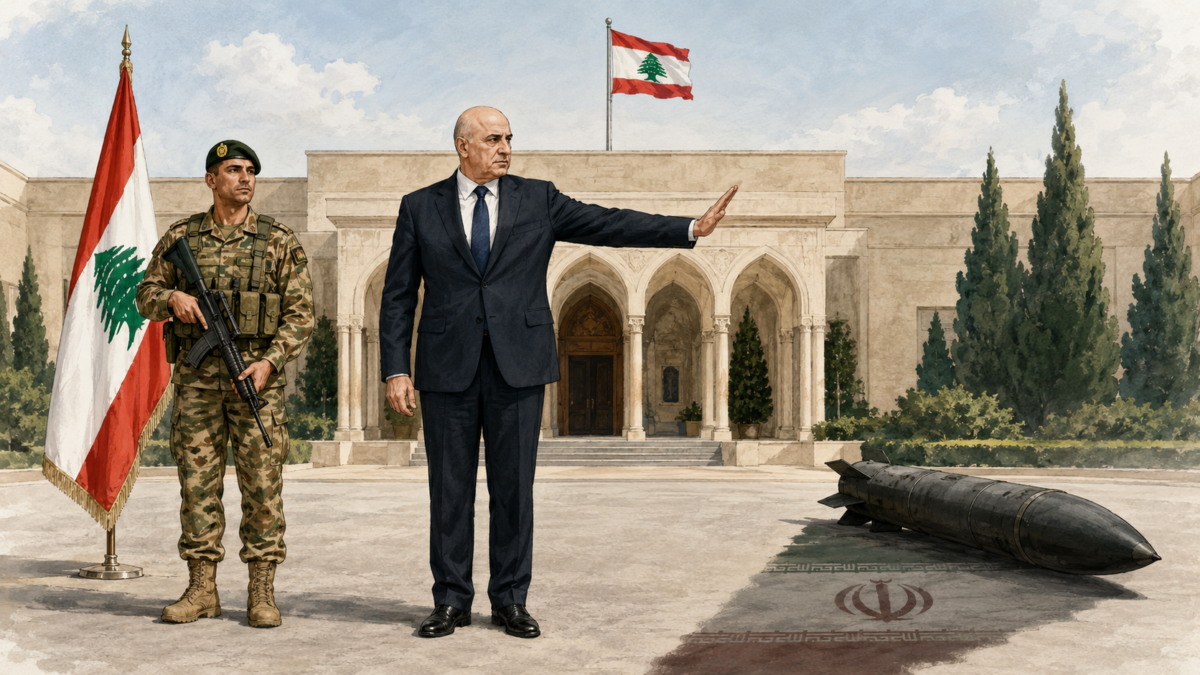
Illustration- President Aoun’s oath was to protect Lebanon—not Iran and Hezbollah’s weapons.
Hezbollah cannot invent a promise to protect its weapons when President Aoun publicly promised to restore the authority of the state.
By The Editorial Board , Opinion
Hezbollah MP Hassan Fadlallah’s attack on President Joseph Aoun is not merely criticism of a president. It is an attempt to rewrite what Aoun promised the Lebanese people and to preserve Hezbollah’s armed privileges by presenting them as constitutional rights.
Fadlallah accused Aoun of fueling division, turning Baabda Palace into a partisan platform and breaking a supposed “word of honor” to protect the Lebanese people’s right to resist. Yet he produced no text, recording or public statement establishing such a promise.
What Aoun said publicly was precisely the opposite.
In his inaugural address, Aoun pledged to affirm the state’s exclusive right to bear arms. He did not promise to protect an autonomous military organization operating outside the authority of the government. His commitment was to the Lebanese state, its constitution and its national army.
That public oath carries far greater constitutional weight than an alleged private understanding invoked only after Hezbollah found itself politically isolated.
Fadlallah is also rewriting the circumstances of Aoun’s election. Hezbollah and Amal did vote for him—but only in the second round. Aoun had already emerged with 71 votes in the first round, while Hezbollah and Amal largely withheld their support. Their later votes broadened his victory; they did not create his mandate or purchase ownership of his presidency. He ultimately won with 99 votes. Contemporary election reporting confirms that Aoun’s central challenge was restoring the authority of the Lebanese Army and addressing Hezbollah’s weapons.
Nor has Aoun transformed Baabda Palace into a partisan headquarters. Its doors remain open to Lebanon’s political factions. Parliament Speaker Nabih Berri—Hezbollah’s closest political ally—has been a regular visitor. Disagreeing with Hezbollah does not make a president partisan. Refusing to submit to it makes him a president.
Fadlallah also called the cabinet’s decision to disarm Hezbollah unconstitutional. But where in Lebanon’s Constitution is a political party granted the right to possess missiles, wage war or conduct foreign policy?
The Constitution gives the Council of Ministers responsibility for national policy, security and the implementation of the law. It does not give Hezbollah a permanent veto simply because it labels its arsenal “resistance.” Consensus is a desirable political practice, but it cannot mean that every constitutional decision requires Hezbollah’s permission.
The greater violation of sovereignty occurred when Hezbollah independently opened a war with Israel on March 2 in support of Iran following the killing of Iran’s supreme leader. No Lebanese president authorized that war. No cabinet approved it. No parliament voted for it. Lebanon was once again forced to bear the cost of a decision made by an armed organization serving a foreign agenda.
Fadlallah’s rejection of the framework agreement with Israel is equally revealing. Hezbollah opposes the agreement because peace threatens the justification for its weapons. The framework is not the final destination; it is the first step toward ending the conflict, restoring Lebanese territory and establishing a permanent peace agreement.
Once Lebanon and Israel are at peace, Hezbollah’s claim that its weapons are necessary for “resistance” collapses.
Hezbollah also condemned the suspension of Iranian flights and the expulsion of Iran’s ambassador. But Iranian aviation had become a serious security issue amid accusations that flights were being used to move funds and military assistance to Hezbollah. Israel threatened to strike Beirut airport if those transfers continued. No responsible Lebanese government could ignore the danger to the country’s only functioning international airport.
The ambassador was declared persona non grata and ordered to leave after interfering in Lebanon’s internal affairs. Iran’s refusal to comply—and Hezbollah’s reported protection of an expelled diplomat—does not defend Lebanese sovereignty. It openly defies it. Reuters reported that Tehran announced the ambassador would remain despite Lebanon’s order.
For decades, Hezbollah has presented itself as a Lebanese resistance movement. But a resistance movement should defend its country—not subordinate it to another state. It should not decide when Lebanon goes to war, maintain a military stronger than the national army or threaten civil conflict whenever elected institutions challenge its authority.
Whatever role Hezbollah may claim to have played against Israeli occupation in the past, today it functions as an armed extension of Iran’s regional strategy. Like other organizations supported by the Islamic Revolutionary Guard Corps, its purpose extends far beyond defending Lebanese territory.
President Aoun is not dividing Lebanon. He is confronting the division that has existed for decades: one country, but two armies; one constitution, but two sources of authority; one government, but an armed organization that reserves the power to overrule it.
Lebanon cannot remain sovereign in name while Hezbollah controls the decisions of war and peace.
Aoun did not promise to protect Hezbollah’s “resistance.” He promised something far more important: to protect Lebanon by restoring the authority of its state.
That is not a betrayal of the presidency. It is the fulfillment of its oath.
