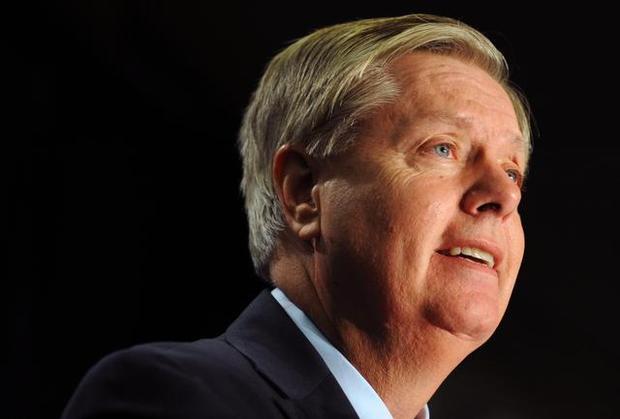
WASHINGTON — Sen. Lindsey Graham, R-S.C., who was first elected to the Senate in 2002 and was a close political ally of President Donald Trump’s, has died, his office confirmed early Sunday. He was 71.
Graham died Saturday night “from a brief and sudden illness,” his office said in a statement.
“Senator Graham’s family appreciates prayers at this time and asks for privacy during this incredibly difficult period,” the statement said.
President Donald Trump led tributes Sunday to “one of the greatest people and Senators I have ever known,” describing Graham as a “true American Patriot” in a Truth Social post.
At the White House, flags were lowered to half-staff.
Graham was chairman of the Senate Budget Committee and was seeking a fifth six-year Senate term in November. He was one of the most well-known members of the chamber and a key voice within the party on defense and foreign policy.
Emergency personnel responded to a call for “cardiac arrest” at Graham’s Capitol Hill home on Saturday night, according to police scanner audio obtained by NBC News. EMS audio later indicated CPR was in progress.
Photographs from the scene reviewed by NBC News show paramedics carrying a person on a stretcher from Graham’s home to an awaiting ambulance. Police cars and fire trucks were also on site.
A top staffer to Graham told NBC News early Sunday that there was no indication the lawmaker was feeling unwell prior to his death. He had been scheduled to appear on NBC News’ “Meet the Press” on Sunday. Graham was a frequent guest on the broadcast, appearing a total of 63 times over the years.
Senate Majority Leader John Thune, R-S.D., paid tribute to a “strong advocate for the United States and a strong ally to freedom-loving countries across the globe,” while South Carolina Gov. Henry McMaster said Graham had been “the fiercest of fighters for South Carolina and America — and a loyal and steadfast friend.”
Former President George W. Bush said Graham “understood how the world works and how important America’s international engagement is to resist tyranny.”
According to South Carolina law, McMaster will appoint someone to fill Graham’s seat until Jan. 3 of next year.
In June, Graham defeated multiple primary challengers to secure the nomination for a fifth term, with the election set for November. South Carolina Republicans must now find a replacement nominee for that race, with a special primary expected by Aug. 11 under the state’s election laws.
Graham was fresh off a trip to Kyiv, Ukraine, where he met with Ukrainian President Volodymyr Zelenskyy on Friday. “Lindsey was a true defender of freedom and of the values that make our world safer,” Zelenskyy said in a statement, noting that he had visited Ukraine 10 times during the war.
“We were in constant dialogue, which I will miss,” he said, adding that “in recent weeks he worked on important initiatives that could help bring peace closer, including strengthening sanctions against Russia.”
“He was a powerful advocate for America who believed strongly in the NATO Alliance and was actively working to bring an end to Russia’s war against Ukraine,” NATO Secretary-General Mark Rutte said.
Graham first arrived in Congress as a member of the House of Representatives, where he served from 1995 to 2003.
He ran for Senate in 2002, winning the South Carolina seat previously held by the retiring Strom Thurmond.
Graham made a name for himself with his work on foreign policy. In recent years, he pressed both the Trump and Biden administrations to back Kyiv’s fight against Russia’s invasion, and pressed the Trump administration for a hawkish stance on Iran.
He found allies for his foreign policy positions in the upper chamber, befriending Sens. John McCain, R-Ariz., and Joe Lieberman, I-Conn., dubbed the “Three Amigos” for their shared hawkish stances.
Graham was the Republicans’ “last highly effective advocate for the idea that American power must shape events before hostile powers reshape them,” Michael A. Horowitz, a geopolitical and security analyst, told NBC News.
In the Trump era, Horowitz added, “his foreign‑policy leverage shifted from shaping broad Senate consensus to shaping Trump’s own instincts, using loyalty and flattery to keep hard‑line positions on Iran, Ukraine and Syria in the room even as the party’s base turned more inward.”
Graham chaired the Senate Judiciary Committee from 2019 to 2021. He most recently served as chairman of the Senate Budget Committee, where he helped shepherd through a major tax cut and spending package during Trump’s second term.
Graham was initially a critic of Trump’s, whom he briefly ran against during the 2016 Republican presidential primary, warning: “If we nominate Trump, we will get destroyed.” Graham even voted for a third-party candidate for president in 2016, saying he could not support either Trump or Hillary Clinton.
The pair’s relationship had evolved in the intervening decade, with Graham frequently praising Trump while sometimes pressing him on policy decisions. In an interview with NBC News in February, he called himself the president’s “North Star.”
“We disagree, but he knows where I am coming from,” Graham said of the president. “He sees me helping him as much as anybody in the Senate.”
NBC
