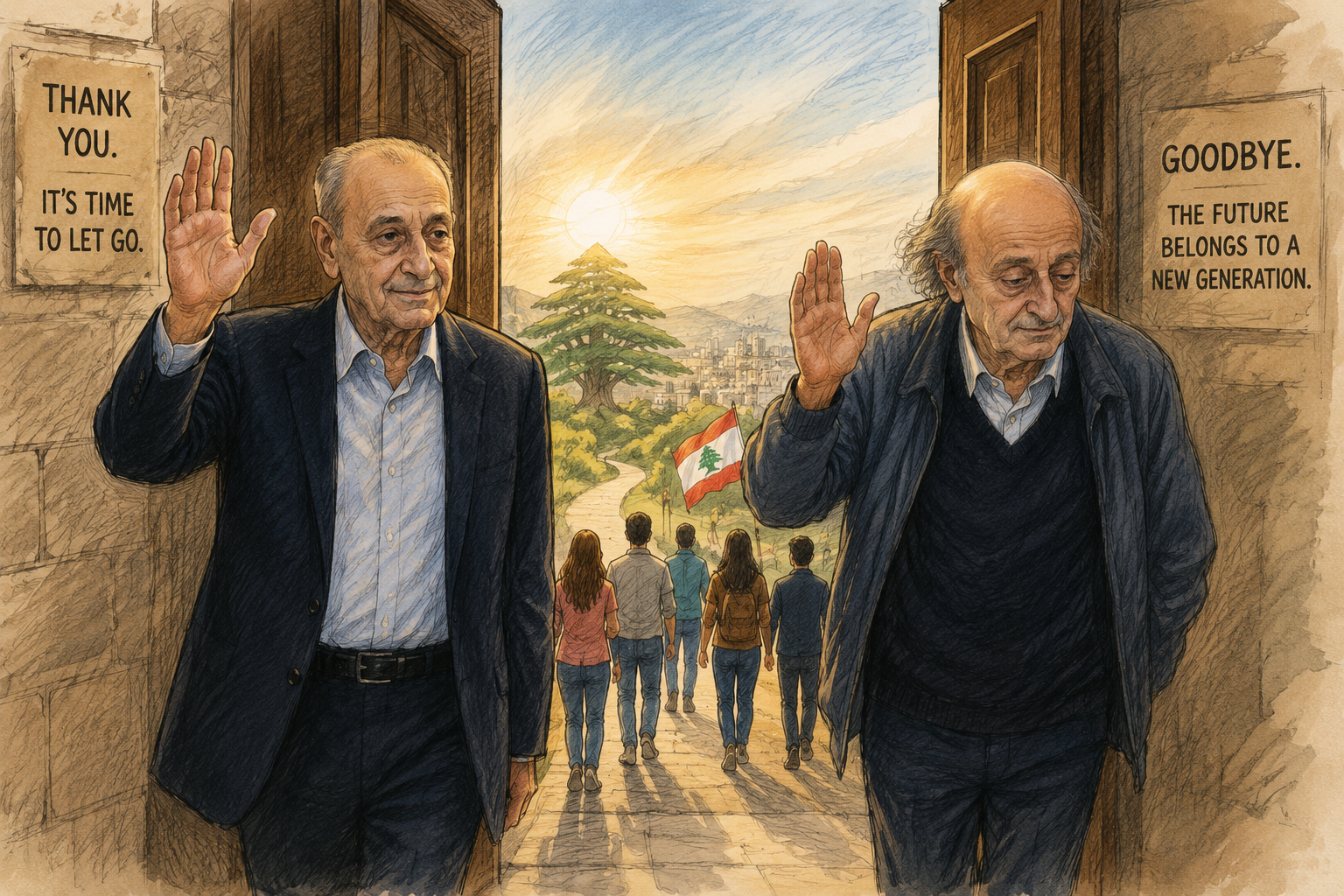
Illustration : Lebanon parliament Speaker Nabih Berri and former PSP leader Walid Jumblatt . Time to bid farewell and let go. The greatest service Lebanon’s old guard can now render is to make room for those who will build its future.
Leadership is measured not by how long one holds power, but by knowing when it is time to pass the torch.
By: The Editorial Board, Opinion
Many Lebanese believed that Walid Jumblatt had retired from frontline politics after passing the leadership of the Progressive Socialist Party to his son, Taymour. His latest intervention, however, suggests otherwise.
Jumblatt launched a scathing attack on President Joseph Aoun and Prime Minister Nawaf Salam over the framework agreement signed in Washington between Lebanon, Israel and the United States. He described it as a unilateral arrangement imposed by Israel on an inexperienced Lebanese negotiating team whose only concern, he claimed, was political power. He further argued that the agreement made no commitment to an Israeli withdrawal from Lebanese territory.
Yet the agreement itself says otherwise.
Paragraph two states that the Lebanese Armed Forces (LAF) will restore effective sovereign authority throughout all Lebanese territory through a verified process that includes the disarmament of non-state armed groups. As that process advances, the Israel Defense Forces (IDF) will progressively redeploy from Lebanese territory under security arrangements and verification mechanisms developed with U.S. support.
In other words, Israeli withdrawal is not absent from the agreement. It is linked to the restoration of Lebanon’s sovereignty over its entire territory—a principle that should unite all Lebanese regardless of political affiliation.
The agreement is also fully consistent with President Joseph Aoun’s inaugural address on January 9, 2025. In his oath before Parliament, Aoun pledged to uphold the state’s exclusive right to bear arms, declaring that only the Lebanese state and its armed forces should defend Lebanon’s sovereignty.
For that reason, Jumblatt’s criticism appears directed not only at the framework agreement but also at the very principle upon which President Aoun was elected.
According to numerous political analysts, Jumblatt’s position reflects the same political reality that has shaped many of his decisions over the past two decades: the overwhelming military dominance of Hezbollah.
During Hezbollah’s armed takeover of western Beirut in 2008, Jumblatt urged the Druze not to confront the organization as it moved toward the Chouf. Many Druze fighters ignored those calls and fiercely defended their mountain villages, ultimately forcing Hezbollah to retreat after suffering significant losses.
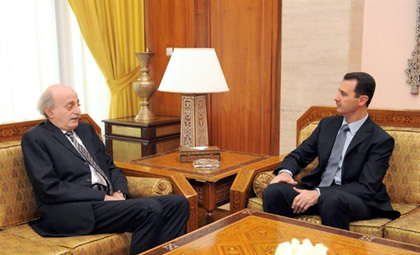
His decision in 2009 to abandon the March 14 Alliance shocked much of Lebanon’s political establishment. Later, he sought reconciliation with Syrian President Bashar al-Assad, despite having previously denounced him in the aftermath of former Prime Minister Rafik Hariri’s assassination. Many observers attributed those reversals to the political reality created by Hezbollah’s military power and the wave of assassinations that reshaped Lebanese politics.
Today, analysts argue that the same reality continues to influence Lebanon’s traditional political leadership.
Hezbollah’s rejection of the framework agreement is far easier to understand.
A lasting peace between Lebanon and Israel would fundamentally undermine Hezbollah’s justification for maintaining an independent military force outside the authority of the Lebanese state.
For decades, Hezbollah has portrayed itself as a “resistance movement.” In reality, its critics argue, it has functioned primarily as the military arm of Iran’s Islamic Revolutionary Guard Corps. Iran finances the organization, trains its fighters, supplies its weapons—or the technology to manufacture them locally—and its leaders have repeatedly pledged allegiance to Iran’s Supreme Leader rather than to the Lebanese state.
Its wars with Israel have consistently reflected Iran’s regional strategy far more than Lebanon’s national interests.
The current conflict illustrates that reality.
Prime Minister Nawaf Salam has publicly stated that Hezbollah, together with Iran’s Islamic Revolutionary Guard Corps, initiated the current round of hostilities by firing the first rockets into Israel on March 2 following the assassination of Iran’s Supreme Leader, Ali Khamenei. Lebanon itself was not under attack when those rockets were launched.
That distinction is critical.
If the decision to go to war is made outside the institutions of the Lebanese state, then Lebanon cannot truly claim to be sovereign.
Nabih Berri faces a similar dilemma.
As Speaker of Parliament for more than three decades, his political survival has depended heavily on the alliance between the Amal Movement and Hezbollah. Without Hezbollah’s parliamentary support, it is difficult to imagine Berri maintaining his unprecedented tenure. Iran has long encouraged that alliance to preserve unified Shiite political leadership.
Ironically, the Shiite community has paid the highest price for Hezbollah’s repeated confrontations with Israel.
Recent polling by Information International reflects a Lebanon that is changing.
The survey found that 84 percent of Druze support a peace agreement with Israel. Support among Maronite and Orthodox Christians ranges between 72 and 77 percent, while a slight majority of Sunni Muslims also favor such an agreement.
Shiites remain the only major community where a majority opposes peace with Israel. Yet analysts argue that Hezbollah’s overwhelming military power has created an atmosphere in which many Shiites fear openly expressing political views that differ from those of the organization.
Whether that assessment is entirely correct or not, one fact is beyond dispute: no community has suffered more from Hezbollah’s wars than Lebanon’s own Shiite community.
The Washington framework is not a final peace treaty.
It is a preliminary agreement designed to create the conditions for one.
Rejecting the first step guarantees that Lebanon never reaches the second.
For the first time in decades, Lebanon has both a president and a prime minister whose stated objective is to restore the authority of the Lebanese state, strengthen its institutions and ensure that all weapons are under government control.
They deserve the support of every Lebanese.
Walid Jumblatt, Nabih Berri and Hezbollah have all played defining roles in Lebanon’s modern history. They have also shaped the political system that brought Lebanon to its deepest national crisis.
It is time to allow a new generation of leaders to shape the country’s future.
Lebanon deserves leaders whose allegiance is to Lebanon alone—not to militias, sectarian interests or foreign capitals.
The choice before the country is becoming increasingly clear.
It is no longer between war and peace.
It is between the politics of fear and the politics of sovereignty.
