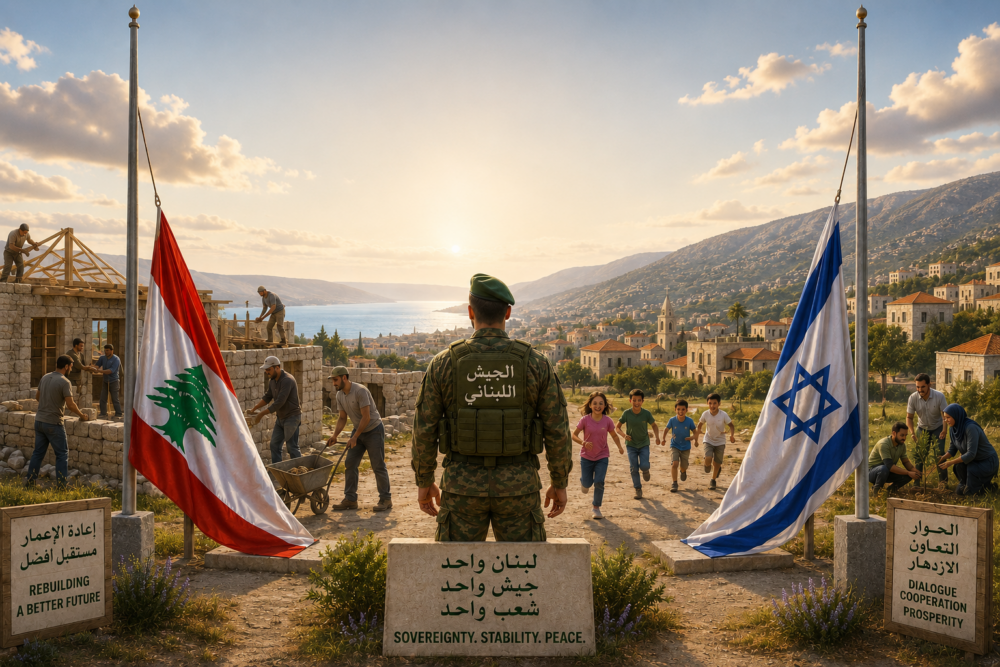
iLLUSTRATION When the Lebanese Army protects the border, peace has a chance to protect the future
A durable peace between Lebanon and Israel would restore Lebanon’s sovereignty, strengthen the Lebanese Army, and create the conditions for Hezbollah’s military role to fade naturally
By: The Editorial Board , Opinion
The framework agreement between Israel and Lebanon risks perpetuating the conflict rather than ending it.
By linking Israel’s full withdrawal from southern Lebanon to Hezbollah’s disarmament, the agreement creates a condition that is, under Lebanon’s current political realities, virtually impossible to fulfill.
Hezbollah has repeatedly rejected disarmament, and no Lebanese government has the political or military capacity to force it to surrender its weapons without risking another civil war. As a result, Israel can argue that the conditions for withdrawal have not been met, while Lebanon remains unable to regain full sovereignty over its territory. Both sides become trapped in a permanent stalemate.
A better path exists.
Israel has repeatedly stated that it has no territorial ambitions in Lebanon. Hezbollah and its allies, meanwhile, continue to demand a complete Israeli withdrawal while insisting that the Lebanese Army should ultimately deploy throughout southern Lebanon.
Those two positions provide a practical starting point.
Israel should withdraw gradually from the occupied areas, transferring responsibility directly to the Lebanese Army. If the army successfully maintains security and prevents attacks across the border, Lebanon and Israel can move toward negotiating a permanent peace treaty.
Once peace is established and Lebanon regains full sovereignty over its territory, Hezbollah’s justification for maintaining an independent military force largely disappears. The Lebanese state—not any political faction—would become solely responsible for defending the country’s borders.
Whether Hezbollah chooses to retain weapons after that would become primarily a domestic political issue rather than a regional security threat. An armed organization has little strategic relevance when the state controls its borders and peace governs relations with its neighbor.
History offers an important lesson.
After the 1948 Arab-Israeli war, Lebanon and Israel signed the 1949 Armistice Agreement. For decades afterward, the Lebanese state itself did not initiate war against Israel. The conflict returned only after Palestinian armed organizations established military control in southern Lebanon during the 1970s, followed later by Hezbollah, effectively removing decisions of war and peace from the authority of the Lebanese state.
That experience demonstrates why restoring the state’s exclusive authority over its territory matters more than demanding immediate disarmament.
The greatest beneficiaries of peace would be Lebanon’s Shiite community.
No Lebanese community has paid a higher price for decades of conflict. Villages have been repeatedly destroyed, families displaced, businesses devastated, and generations forced to live with instability and uncertainty.
A durable peace would allow displaced families to return home permanently. Lebanon’s international partners would almost certainly support a major reconstruction effort, helping rebuild homes, infrastructure, schools, and local economies. Even Iran should welcome an outcome in which the Lebanese community closest to it can finally live in safety and prosperity instead of perpetual war.
Peace would not solve every political dispute inside Lebanon overnight.
But it would remove the principal justification for continued conflict, restore the authority of the Lebanese state over its own territory, and create the political conditions under which difficult internal questions—including Hezbollah’s future role—can eventually be resolved peacefully.
For nearly eighty years, Lebanon’s greatest tragedy has been allowing others to decide when it goes to war.
A peace agreement between Lebanon and Israel would allow Lebanon, for the first time in generations, to make that decision for itself.
That would transform not only Lebanon and Israel, but the entire Middle East.
