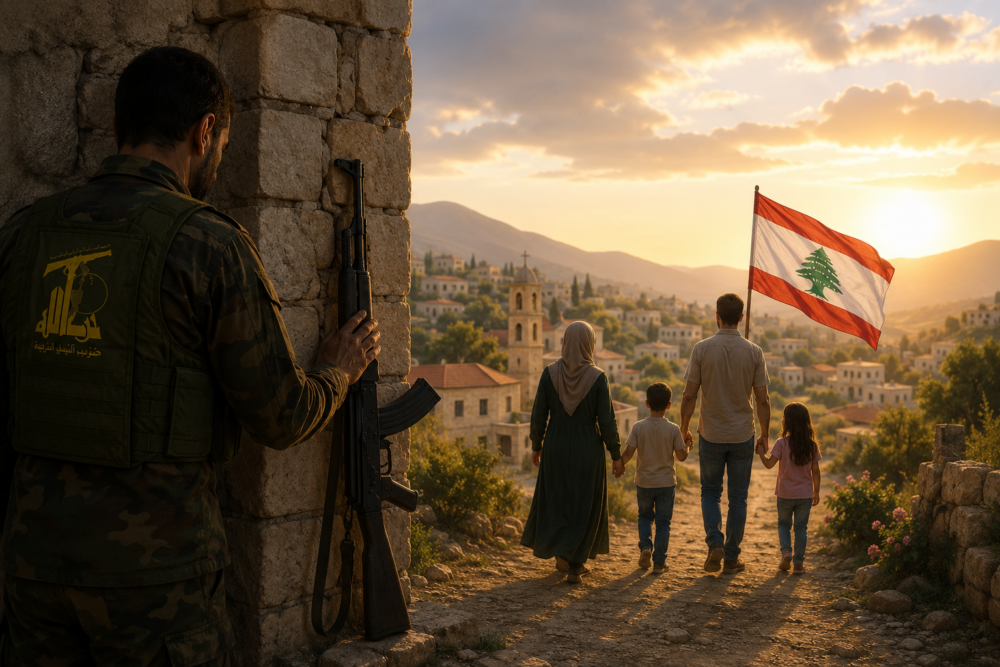
Photo illustration- No community has more to gain from peace than the one that has suffered the most from war.
Peace offers Hezbollah something decades of war never could: a future for the people it claims to represent.
By: Ali Hussein, Lebanese Political analyst , Opinion
Hezbollah’s secretary-general, Naim Qassem, denounced the new Israel-Lebanon framework agreement signed in Washington as “null and void,” calling it a surrender of Lebanon’s sovereignty. At the same time, one of Hezbollah’s closest parliamentary allies warned that the agreement could lead to civil war.
The framework, signed after five rounds of negotiations in Washington, is designed to lead toward a permanent peace agreement between Lebanon and Israel. It includes a pilot program allowing the Lebanese Army to gradually assume control of areas still occupied by Israeli forces, followed by Israel’s complete withdrawal and the restoration of Lebanese sovereignty over all of its territory.
Hezbollah views the agreement as an existential threat—not because it weakens Lebanon, but because it weakens Hezbollah’s dual identity as both Iran’s proxy and a self-proclaimed resistance movement.
On one point, Hezbollah is correct: if implemented, this agreement could finally bring peace between the two neighboring countries.
The greatest beneficiary of that peace would be Hezbollah’s own base—the Shiite community.
Since Hezbollah was created by Iran’s Islamic Revolutionary Guard Corps as part of its regional strategy, Lebanon’s Shiites have carried the heaviest burden of every confrontation with Israel. Their villages became battlefields. Their homes were destroyed. Hundreds of thousands were repeatedly displaced. Their children grew up amid wars that served regional ambitions far more than Lebanon’s national interests.
Peace would finally remove the Shiite community from the front line.
If Hezbollah truly represents its people, it should welcome that opportunity rather than reject it.
Qassem has argued that the Washington agreement should instead be replaced by the U.S.-Iran memorandum of understanding signed in Switzerland, which linked the ceasefire in Lebanon to the broader truce between Washington and Tehran.
But both Lebanon and Israel rejected any attempt to make their future dependent on U.S.-Iran negotiations. President Joseph Aoun made Lebanon’s position unmistakably clear: no foreign country—including Iran—will negotiate Lebanon’s future.
That principle should not be controversial. Lebanon should decide Lebanon’s future.
Hezbollah should also recognize another reality.
Iran’s priorities have always been Iran’s national interests. Iran did not rebuild southern Lebanon after previous wars, and it will not rebuild the hundreds of thousands of homes destroyed in the latest conflict. Meanwhile, Lebanon’s traditional friends have made equally clear that meaningful reconstruction assistance will not come while Hezbollah remains an armed force operating outside the authority of the Lebanese state.
If Hezbollah rejects peace and instead chooses confrontation or even civil conflict, what exactly does its community gain?
More destruction.
More displacement.
More grieving families.
More young Lebanese killed.
And once again, the only assistance likely to arrive from Iran will be weapons—not reconstruction funds.
Eventually, reality prevails over ideology.
It is time for Hezbollah to shed its military identity and fully embrace its political one.
As a political movement, Hezbollah can continue representing its supporters through democratic institutions while allowing the Lebanese Army alone to defend the country’s borders. Whether Hezbollah eventually hands over its weapons or simply stores them becomes increasingly irrelevant if lasting peace replaces perpetual conflict.
The Lebanese Army will not need Hezbollah’s arsenal if Lebanon no longer lives under the constant threat of war.
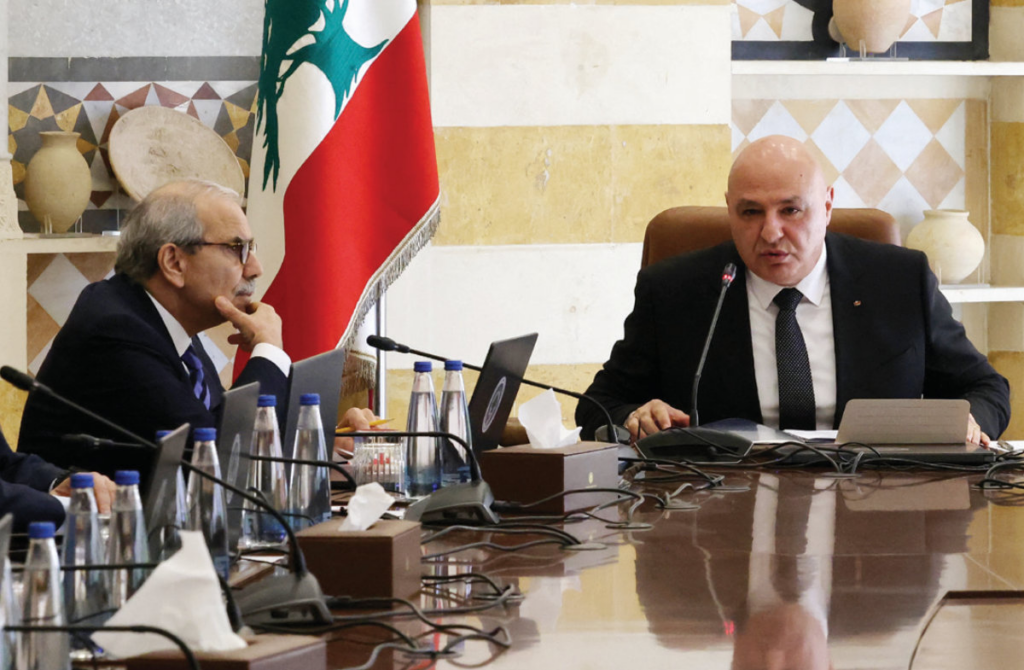
For the first time in decades, Lebanon has a president and prime minister who appear genuinely committed to rebuilding the country rather than serving competing regional agendas. They deserve the support of every Lebanese, including Hezbollah’s own supporters.
Enough wars.
Enough destruction.
Enough displacement.
Enough funerals.
It is time for Hezbollah to let go—not for Israel, not for America, not even for Iran.
For Lebanon.
And above all, for its own community.
