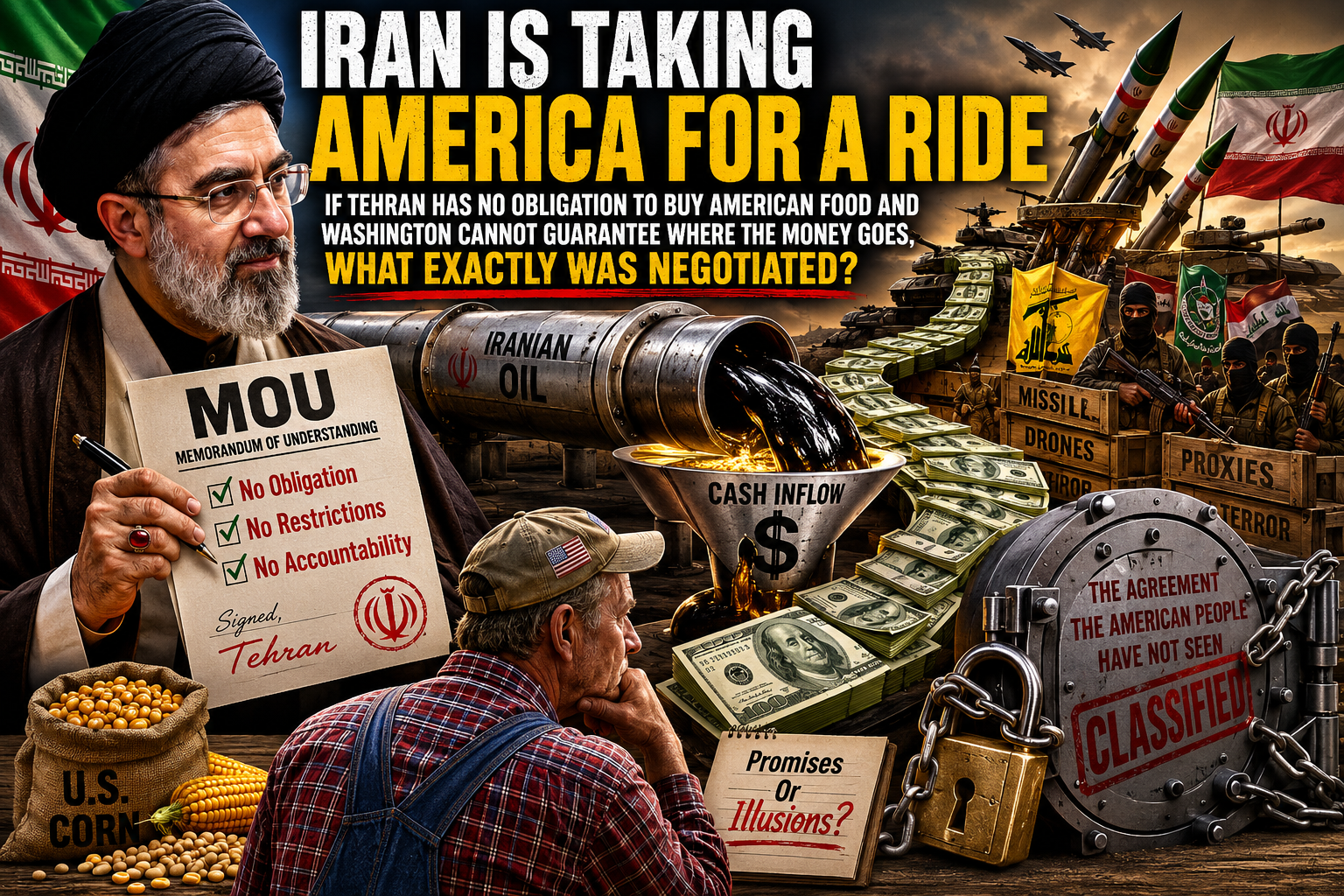
Photo illustration- “If nobody can explain where the money will go, the public deserves to see the agreement for itself.”
If Tehran has no obligation to buy American food and Washington cannot guarantee where the money goes, what exactly was negotiated?
By: The Editorial Board, Opinion
President Donald Trump recently defended the memorandum of understanding reached with Iran by arguing that money being unfrozen for Tehran would be used to purchase food from American farmers.
“They’re supposed to use money to buy food for their people,” Trump said. “Corn, soybeans, all of the things they need are going to be bought from our farmers.”
The statement may have reassured some Americans who fear that billions of dollars could flow back into the hands of a regime that has spent decades funding armed groups across the Middle East.
There is only one problem.
Iran says that is not what the agreement says.
Abdolnaser Hemmati, governor of Iran’s central bank, quickly rejected the claim, stating that under the signed notes there is “no obligation” to purchase agricultural products from the United States.
If Iran’s interpretation is correct, then one of the administration’s principal defenses of the agreement has already fallen apart.
The contradiction raises a larger question.
What exactly did the United States obtain in return for lifting restrictions and allowing Iran greater access to international markets?
When asked whether he could guarantee that Iran would not use increased oil revenues to rebuild its military capabilities, Trump offered a remarkably candid response.
“Well, they’re not supposed to be doing that, so we’ll see.”
But international agreements are not judged by what countries are “supposed” to do. They are judged by what countries are permitted to do, what verification mechanisms exist, and what consequences follow if violations occur.
History offers little reason for confidence.
Iran’s leaders have never hidden their belief that military strength, missile development, and support for regional allies are essential components of national security. Expecting Tehran to abandon those priorities simply because money is available for other purposes is not a strategy. It is a hope.
There is another issue that deserves far more attention.
Even if every dollar released under the agreement were spent exactly as Washington hopes, the United States would still have to explain why it is rewarding a regime whose behavior has destabilized much of the Middle East since its creation in 1979.
Iran did not become controversial because of its food imports. It became controversial because of the policies it pursued across the region through a network of armed proxies and allied militias.
In Lebanon, Iran built and financed Hezbollah, an organization that has repeatedly dragged the country into conflicts and helped create a state within a state. In Gaza, Iran has long supported Hamas and Palestinian Islamic Jihad. In Yemen, it has armed and financed the Houthis, whose attacks have threatened international shipping and regional stability. In Iraq, Tehran has backed powerful militias that often operate outside the authority of the elected government.
For decades, American administrations of both parties condemned these activities and imposed sanctions designed to change Iran’s behavior. Yet the current agreement appears to provide economic relief before any meaningful change in that behavior has been demonstrated.
Diplomacy is often necessary, and peace is always preferable to war. But successful diplomacy should reward positive actions, not merely promises. Before offering Iran access to billions of dollars and expanded oil revenues, Washington should have secured clear evidence that Tehran was prepared to abandon the policies that made sanctions necessary in the first place.
Otherwise, the United States risks sending a dangerous message: that decades of destabilizing behavior carry no lasting consequences and may ultimately be rewarded.
The administration’s argument becomes even harder to understand when it comes to oil.
Treasury Secretary Scott Bessent has reportedly authorized the import of Iranian oil and refined petroleum products into the United States. Yet America is already one of the world’s largest oil producers and a major energy exporter.
If the United States does not need Iranian oil, why permit its entry?
If the objective is economic relief for Tehran, Americans deserve to know why that relief is being granted.
If the objective is peace, Americans deserve to know how the agreement advances it.
And if the objective is preventing Iran from rebuilding military capabilities, Americans deserve to know what safeguards are in place to ensure that happens.
So far, the answers remain vague.
Meanwhile, Iranian officials appear increasingly confident. They insist they are not obligated to buy American agricultural products. They have not accepted Washington’s interpretation of the agreement. And they continue to maintain that decisions regarding military spending remain a sovereign matter.
The result is an uncomfortable perception that Washington and Tehran are not describing the same agreement.
That is why the administration should release the full text of the memorandum of understanding.
The world is debating the deal. Financial markets are reacting to it. America’s allies are adjusting their policies because of it. Yet very few people have actually seen it.
Transparency is not a threat to diplomacy. It is a prerequisite for public trust.
The question is no longer whether Iran deserves economic relief. The question is whether Iran has earned it. Before rewarding a regime that has spent decades projecting influence through Hezbollah, Hamas, the Houthis, and allied militias in Iraq, the American people deserve to know what has changed.
If the answer is very little, then Washington may be rewarding the very behavior it once sought to discourage.
Until the full agreement is released, speculation will continue, doubts will grow, and many Americans will conclude that Iran is taking America for a ride.
