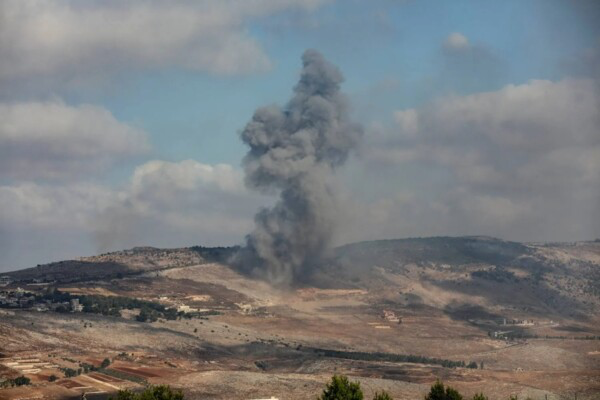
Photo- Smoke billows from southern Lebanon, following Israeli strikes, as seen from Nabatieh, Lebanon, June 19, 2026 El Nashra
By Nandita Bose, Yomna Ehab and Humeyra Pamuk
WASHINGTON/DC /BEIRUT – Planned U.S.-Iran talks in Switzerland on Friday were cancelled as fighting flared in Lebanon, creating new uncertainty about the timing of negotiations on turning an interim agreement into a more permanent Middle East peace deal.
The flareup in Lebanon, in which 18 people were killed in airstrikes and four Israeli soldiers were killed by Hezbollah militants, could weigh heavily on negotiations because ending fighting there is a condition for the broader U.S.-Iran accord.
A senior Hezbollah lawmaker said Iran had told the group that talks with the United States could not continue without a comprehensive ceasefire and that Washington was responsible for ensuring Israel halts its attacks.
ISRAEL SAYS IT IS NOT PARTY TO THE DEAL
A memorandum of understanding signed this week by the Iranian and U.S. presidents left discussionof Iran’s nuclear programme and other tough issues until later, giving the sides 60 days to reach a lasting agreement or extend the interim deal.
Preparations for technical talks to start in the Swiss mountaintop resort of Buergenstock were far advanced when U.S. Vice President JD Vance said on Thursday he had dropped plans to attend, two people familiar with the matter told Reuters.
Earlier on Thursday, a source familiar with Tehran’s thinking had said Iran’s lead negotiator Mohammad Baqer Qalibaf was not planning to attend.
A Swiss foreign ministry statement said the talks had been postponed and that Switzerland remained ready to facilitate the talks and the relevant preparatory work was continuing.
Iranian leaders did not immediately comment on the postponement of the meeting in Switzerland.
But Hezbollah lawmaker Hassan Fadlallah cited Iran as saying further talks depended on a comprehensive ceasefire being in place and said Lebanon’s government should reject direct negotiations with Israel as long as Israeli attacks continue.
The interim deal requires the United States, Iran and their allies to declare an immediate and permanent termination of military operations on all fronts, including in Lebanon.
Israel, left out of the talks, says it is not party to the deal. Violence abated in Lebanon earlier this week, but has since picked up.
Lebanon was sucked into the regional war when Hezbollah opened fire at Israel on March 2, in support of Iran , prompting Israel to launch an offensive against the group and invade the south of the country.
Lebanon’s health ministry said 18 people had been killed and 33 wounded in heavy airstrikes in 11 southern towns since midnight, and that bombardment was preventing rescue and evacuation efforts. It said the toll was expected to rise.
The Israeli military said four soldiers had been killed in an incident in Lebanon, without giving further details.
It said it had carried out strikes targeting what it described as Hezbollah operatives and infrastructure across several areas of the south, saying these were in response to repeated ceasefire violations by the Iran-backed group.
Lebanese President Joseph Aoun condemned the Israeli attacks but said the escalation would not hinder efforts to reach a comprehensive ceasefire.
CRITICS SAY GOALS FELL SHORT
The war, which began on February 28 with U.S. and Israeli air attacks on Iran, has killed at least 7,000 people, mostly in Iran and Lebanon. It also pushed up energy prices, stoking inflation worldwide.
Oil prices have dipped since the interim deal was signed as prospects have brightened for more oil supply, with tankers again moving through the Strait of Hormuz, which carried nearly a fifth of global crude oil and liquefied natural gas supplies before it was effectively blockaded by Iran during the war.
The body set up by Iran to manage the Strait of Hormuz said on Friday it would waive planned fees to use the strait during the 60-day negotiation period under the interim deal.
Ships seeking passage through during this period would have to submit transit requests at least 48 hours before arrival, and fees would be waived for security, safety, environmental services and related insurance, it said.
In Washington, some of U.S. President Donald Trump’s Republican allies in Congress questioned whether he had conceded too much in order to end the conflict, unpopular with most Americans in the run-up to midterm elections in November.
In March, Trump had sworn to end the war only with Iran’s “UNCONDITIONAL SURRENDER.”
But the memorandum signed with Iran instead foresees relief from economic sanctions, the unfreezing of assets worth tens of billions of dollars and immediate U.S. waivers for its exports of oil.
The deal gives negotiators 60 days to agree on the status of Iran’s nuclear program, unless an extension is agreed, and to set up a $300 billion reconstruction fund for Iran and other financial incentives.
Vance said Washington would also seek to limit Iran’s long-range missiles.
The growing cost of the war also drew the spotlight, as the U.S. defense department told lawmakers it needed $80 billion to cover the costs and some unrelated bills, the Wall Street Journal said.
U.S. officials say the negotiations could still yield a strong agreement on Iran’s nuclear program , aiming to better one dating from 2015 between Iran, the U.S. and other countries that Trump tore up in his first term.
But critics say Iran is in a stronger position now, having withstood a superpower attack, demonstrated its control of the Strait of Hormuz and gained valuable waivers to financial sanctions.
(Reuters)
