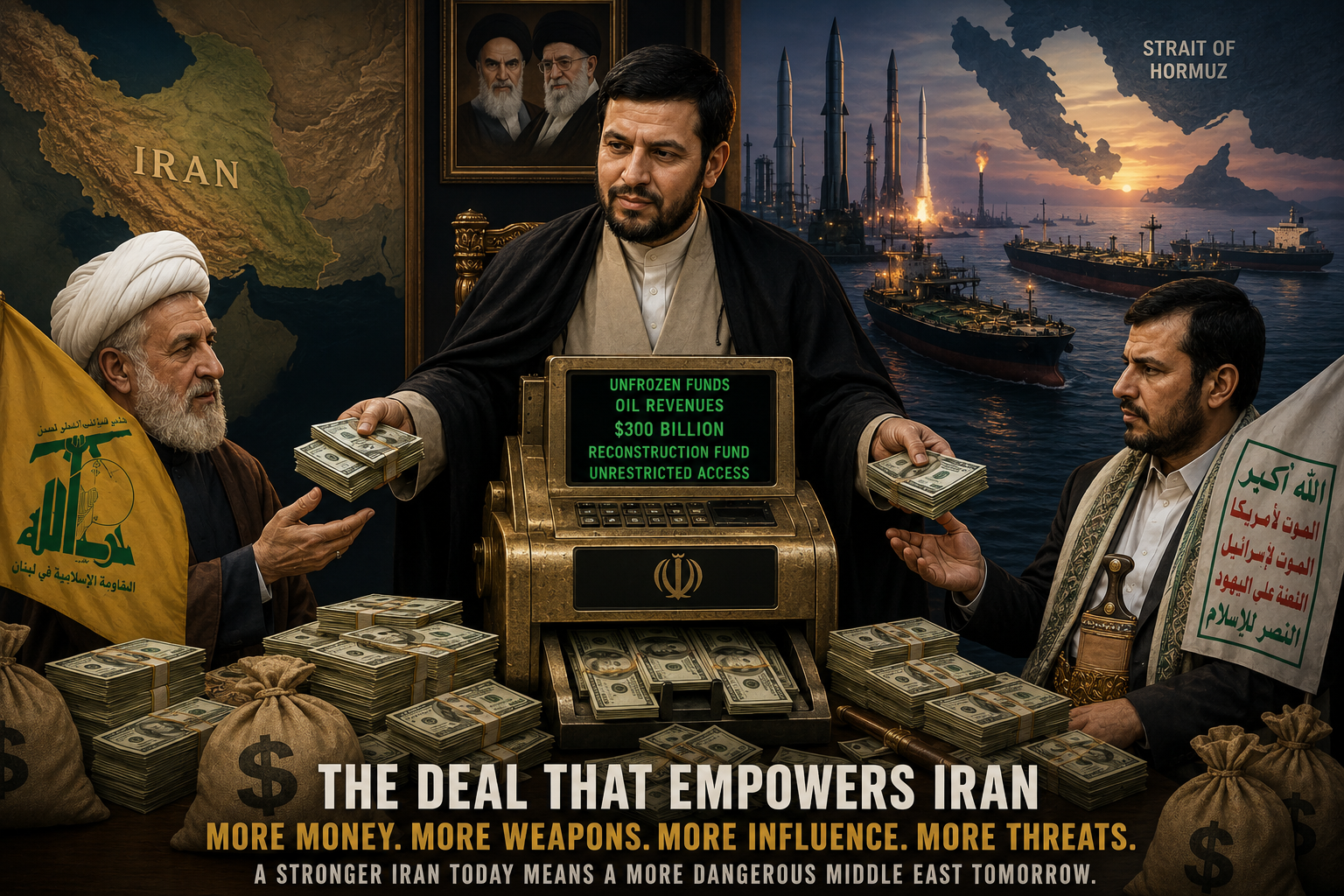
Illustration- The US-Iran deal that makes Iran richer. We already know where some of the money will go. God help the Middle East
The missiles remain. The proxies remain. The money returns. More money is on the way. What exactly was achieved?
By: The Editorial Board, Opinion
For months, Americans were told that the war against Iran was necessary to stop a dangerous regime, eliminate threats to international security, protect freedom of navigation, and prevent Iran from using its missile and nuclear programs to intimidate the region.
If the reported terms of the agreement are accurate, Americans have every right to ask a simple question:
What exactly was achieved?
Iranian leaders are celebrating the agreement as a victory. Their chief negotiators have openly portrayed it as proof that American pressure failed. Tehran is already signaling that the Strait of Hormuz will not return to pre-war conditions and that commercial shipping may eventually face new fees and restrictions.
If that happens, the world will learn a dangerous lesson: create a crisis, threaten a strategic chokepoint, and eventually the international community may reward you for restoring what should never have been disrupted in the first place.
The economic provisions are even more troubling.
Iran would regain the ability to export its oil freely. Frozen assets would be released. Hundreds of billions of dollars in reconstruction assistance could flow into the country. Instead of emerging weakened, Tehran could emerge wealthier than it was before the war.
Money matters.
Money buys influence.
Money buys missiles.
Money finances militias.
Money expands regional power.
Perhaps the most surprising development is the apparent shift in Washington’s position on Iran’s missile program. One of the principal justifications for military action was the argument that Iran’s growing missile capabilities threatened the region and potentially beyond. Yet President Trump now argues that it would be unfair for Iran not to possess ballistic missiles if other countries in the region have them. If Iran retains its missile arsenal, restores its oil revenues, regains access to frozen assets, and receives massive economic relief, critics are justified in asking whether the agreement solved the problem or merely postponed it.
The agreement also appears to leave unresolved the issue of Iran’s regional proxy network. The United States and its allies are expected to cease military operations immediately, yet there appears to be no comparable mechanism requiring Hezbollah, the Houthis, and other Iranian-backed groups to permanently disarm or cease operations.
Peace agreements should reduce future threats.
This agreement may instead finance them.
History teaches that conflicts rarely end when the shooting stops. They end when the underlying causes of conflict are removed. A deal that leaves Iran richer, allows it to maintain missile capabilities, preserves its regional influence, and rewards brinkmanship risks creating the conditions for the next crisis.
If the United States does not know how to negotiate from a position of strength, it should think carefully before launching wars that depend on successful negotiations to justify their costs.
This agreement may bring temporary calm.
But temporary calm is not the same thing as lasting peace.
And a deal that strengthens the very forces that helped create the crisis is not peace at all.
It is surrender disguised as peace.
