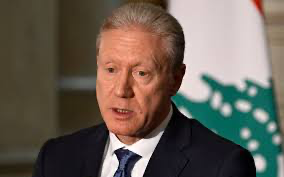
Foreign Minister Youssef Rajji affirmed that Lebanon is capable of resolving the issue of Hezbollah’s weapons even without the fall of the Iranian regime; however, this requires making appropriate decisions with the support of the international community. In an exclusive interview with the French newspaper Le Figaro, Rjei noted that while the Lebanese government has taken courageous decisions, it is compelled to proceed cautiously to avoid internal friction.
Addressing whether such internal friction implies what some term “civil war,” Rajji argued that anyone making such a claim misunderstands the legal reality. He explained that civil war entails conflict between Christians and Muslims or between Lebanese political parties; one cannot speak of civil war when the state is attempting to reclaim its authority, or when the government seeks to uphold the constitution and the rule of law against an armed organization—Hezbollah—that has rebelled against the state and dragged it into wars it did not choose.
In response to a question, Rjei described the Iranian regime—established in 1979—as an absolute regime based on divine right. The system grants the Supreme Leader absolute, divinely mandated power over the state. He stated that the regime has created and funded groups within the Shiite communities to destabilize the region, noting that Tehran’s priorities—alongside the destruction of Israel—are maintaining its power and hegemony over Lebanon. He criticized the international community’s leniency toward the Iranian regime, citing the wars waged by Iran’s proxies, the hostage-takings, assassinations, and attacks on embassies and peacekeeping forces—including the terrorist attack that killed approximately fifty French paratroopers in the “Drakkar” incident.
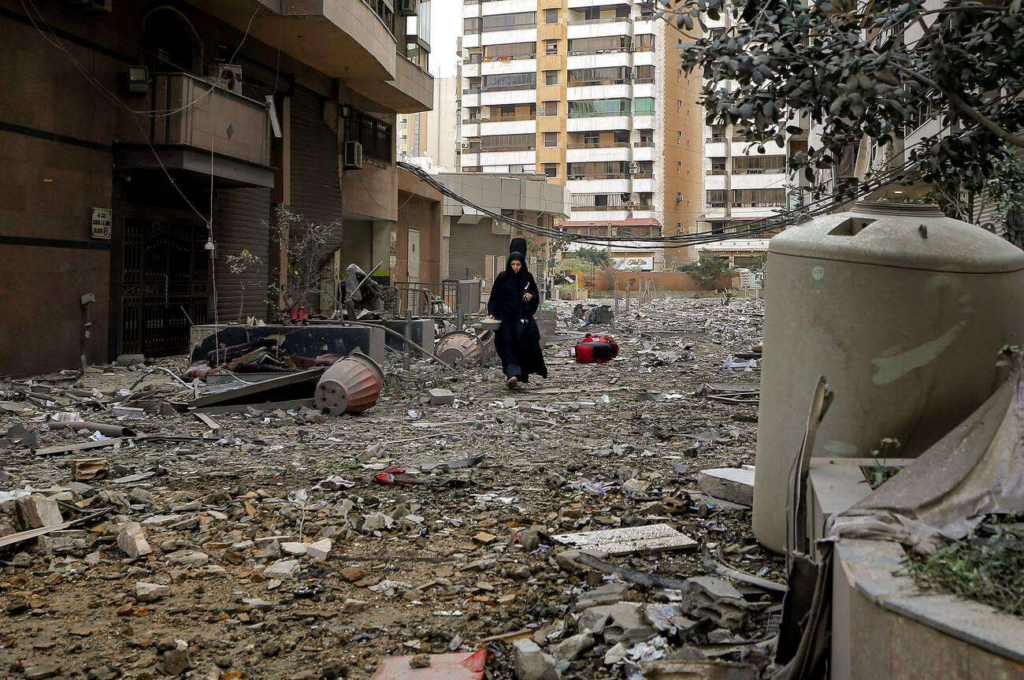
A southern Lebanese lady walks among debris as she leaves her destroyed apartment following heavy Israeli air strikes on Beirut’s southern suburb. March 7, 2026. Over 1.2 million Shiites have been displaced after Hezbollah entered the war on March 2 in support of Iran. The Shiite community suffered the most as a result of Hezbollah’s decision to attack Israel . Shiite dissent against Hezbollah invites treason accusations, social exile, and economic punishment. Marwan Naamani/ZUMA Press Wire)
Regarding the status of Hezbollah, Rjei pointed out that the party has been defeated both strategically and militarily, yet it continues to control a significant portion of the so-called “deep state,” retaining its weaponry and influence within government administrations and at the executive level. Emphasizing that the call to disarm Hezbollah is not intended to appease Israel, the United States, or the international community—but rather stems from the simple desire of most Lebanese people to live in a normal country—Rajji added: “For the first time in a long while, Lebanon has a president, a prime minister, and a government that are aligned, and they are determined to do everything in their power to restore the country’s sovereignty.” He further argued that Hezbollah’s military operations hinder the economy, stifle tourism, deter investment, and drag the country into wars in which it has no stake.
Source Lebanon Files , translated from Arabic
