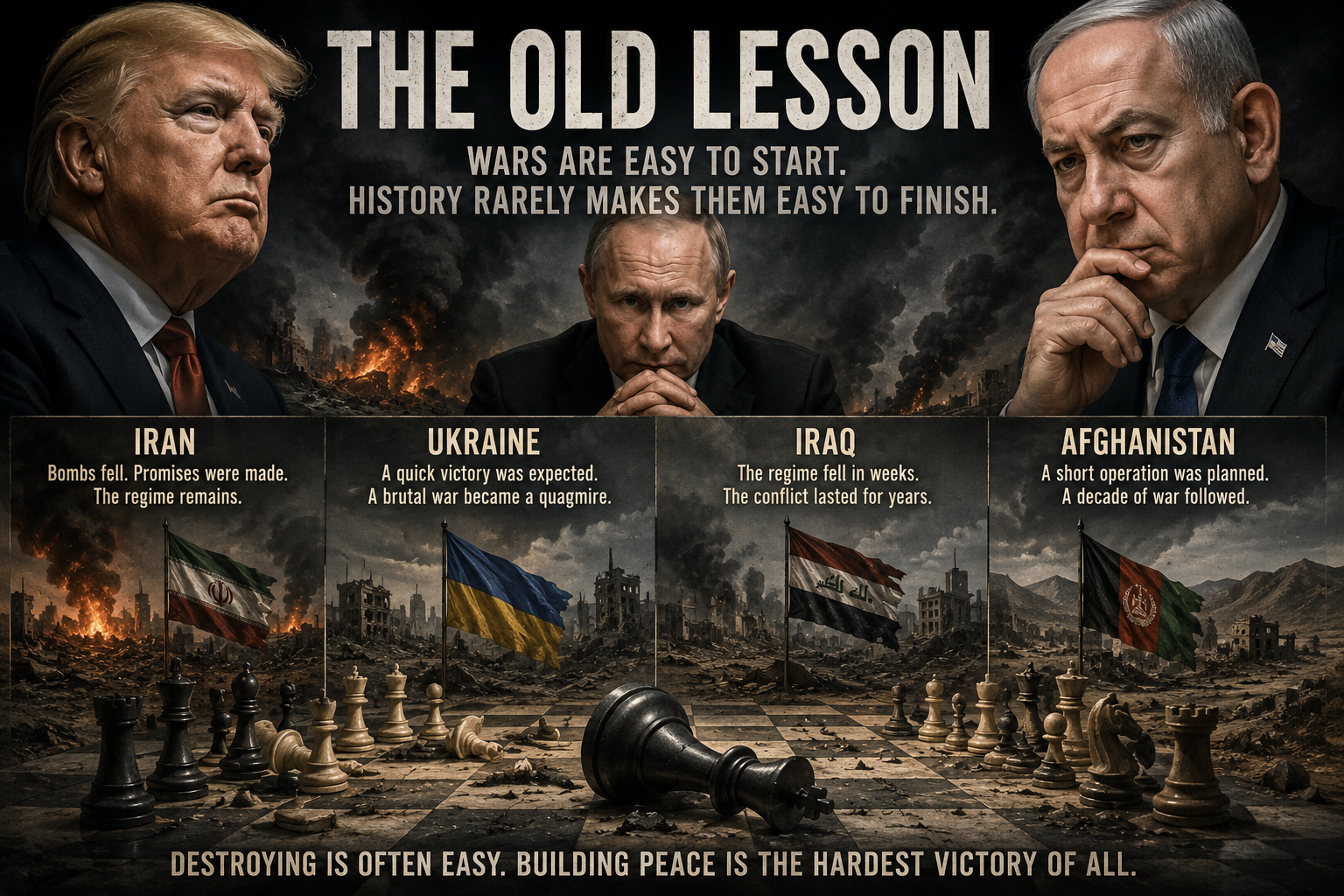
Illustration- Wars begin with certainty. They end with reality
Wars are easy to start. History rarely makes them easy to finish.
By: The Editorial Board, Opinion
When President Donald Trump and Prime Minister Benjamin Netanyahu led their countries into war with Iran on the last day of February, both spoke as if history was about to turn a page.
Their message was not merely that Iran’s military capabilities would be weakened. It was that the regime itself was nearing its end.
Trump addressed the Iranian people with words that suggested liberation was imminent. He spoke of freedom, of opportunity, and of a moment that might never come again. The implication was unmistakable: once the bombs stopped falling, the Iranian people would rise and take back their country.
The following morning, Netanyahu delivered his own message from the rooftop of Israel’s defense ministry in Tel Aviv. Like Trump, he projected confidence. The regime that had ruled Iran since the 1979 revolution appeared vulnerable. The possibility of historic change seemed within reach.
Four months later, reality looks very different.
The regime remains in power.
The security apparatus remains intact.
The Islamic Revolutionary Guard Corps continues to wield influence.
And instead of discussions about a post-regime Iran, attention has shifted toward ceasefires, negotiations, sanctions relief, and the possible release of billions of dollars in frozen Iranian assets.
History has seen this movie before.
Military power can destroy infrastructure. It can cripple armies. It can eliminate commanders and degrade capabilities. What it cannot easily do is determine what happens politically after the shooting stops.
Four years ago, Vladimir Putin launched his invasion of Ukraine expecting a rapid victory. Many believed Kyiv would fall within days and that Ukraine’s government would collapse shortly
thereafter. Instead, the war became a grinding conflict that reshaped Europe, drained Russian resources, and demonstrated that military superiority does not automatically produce political success.
The United States removed Saddam Hussein’s government in a matter of weeks. What followed was years of instability and conflict.
The Soviet Union entered Afghanistan expecting a quick operation and found itself trapped in a decade-long war.
Israel’s 1982 invasion of Lebanon began with limited objectives but evolved into a far longer and more complicated conflict than its planners imagined.
The problem is that regime change has always been more difficult than military victory.
Governments do not collapse simply because outside powers wish them to. Political transformation requires organized opposition, alternative leadership, functioning institutions, and a population willing and able to seize the moment. Air strikes alone cannot create those conditions.
This is not merely a lesson about Iran. It is a lesson about the limits of military power itself.
Wars are often launched with visions of decisive victory and political transformation. They frequently end with negotiations, compromises, and outcomes that look very different from the promises made at the beginning.
That is why the most important question is not who won the battlefield exchanges. The more important question is whether the political objectives that justified the war were achieved.
If the conflict began with promises of regime change but ends with the same regime still governing Iran, then history will inevitably ask whether expectations exceeded reality.
The answer may not be known for years. But one thing is already clear.
Trump , Netanyahu and Putin have joined a long line of leaders who discovered that winning battles is often the easy part.
Winning the peace is where history delivers its harshest verdict.
