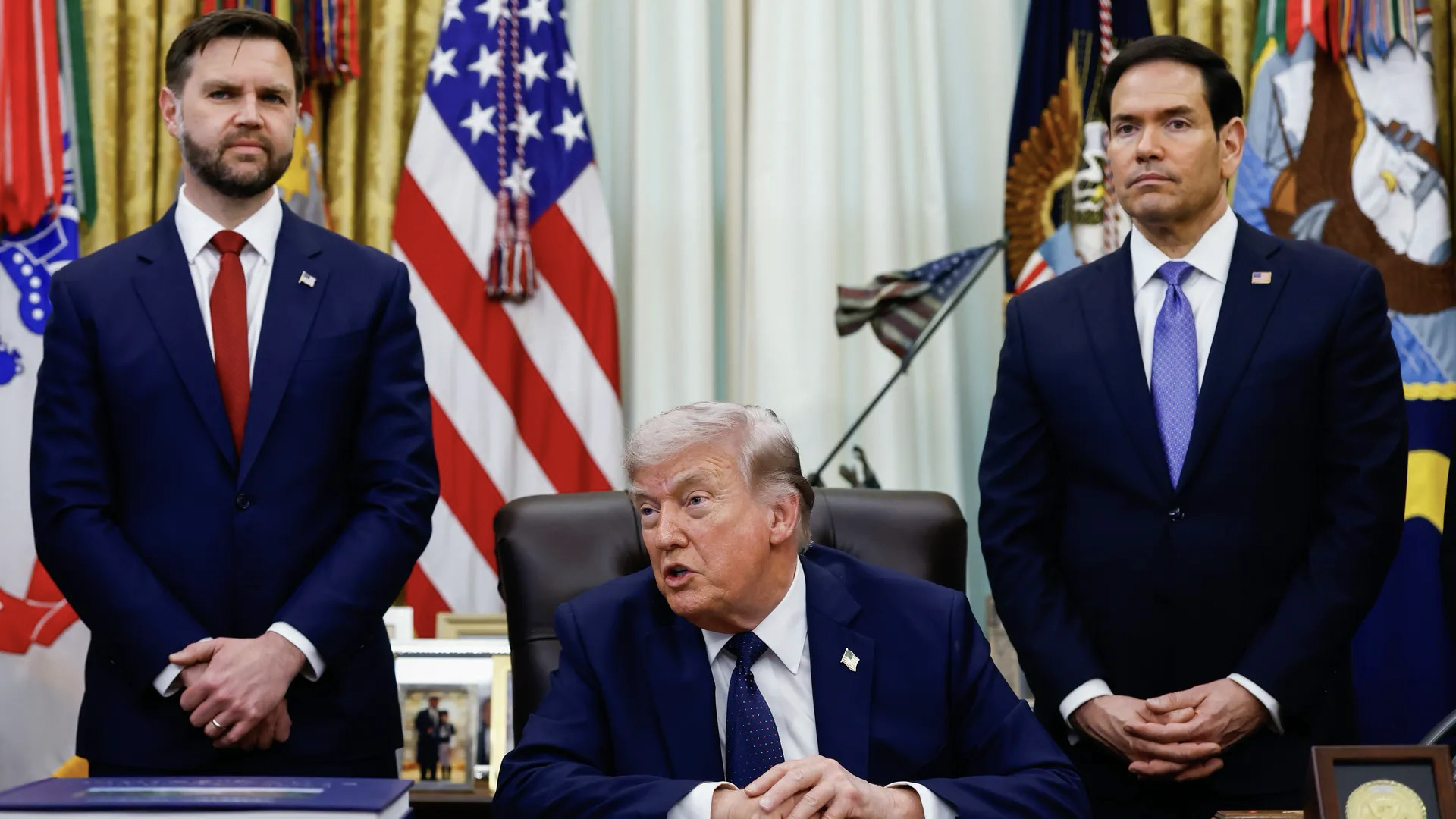
PHOTO- Vice President JD Vance, President Trump and Secretary Marco Rubio in the Oval Office on April 23. Photo: Will Oliver/EPA/Bloomberg via Getty
The U.S.-Iran memorandum of understanding President Trump claims will soon be signed calls for the Strait of Hormuz to reopen immediately without tolls and for Iran to receive sanctions relief based on compliance, according to a diplomat from one of the mediating countries and a U.S. official.
Why it matters: The MOU would extend the ceasefire for 60 days, including in Lebanon, during which time nuclear negotiations would be held. The text includes a framework for addressing Iran’s enriched uranium stockpile, though any action on Iran’s nuclear program would depend on a second, more detailed accord.
The diplomat from one of the mediating countries, who walked Axios through the latest text, said “the U.S. and Iran have agreed on the text of a deal,” but acknowledged the deal still needed final sign-off.
- As of Thursday evening, the deal had been approved on the Iranian side at high levels but likely not by Supreme Leader Mojtaba Khamenei, two sources with knowledge said.
- Trump said he expected a signing ceremony over the weekend. A spokesperson for Iran’s foreign ministry said Tehran had “not yet reached a final decision.”
- The White House has thought a deal was close several times over the past two months, only for talks to fall through. The diplomat expressed optimism that, this time, the text would stick.
- Four U.S. Air Force C-17 planes departed to Europe on Thursday, moving equipment for possible travel by Vice President Vance to a signing ceremony in Geneva in the coming days.
- According to two diplomats from two mediating countries and two U.S. officials, the tentative agreement was reached on Wednesday night after hours of negotiations between Qatari mediator Ali Al-Thawadi and Iranian Foreign Minister Abbas Araghchi.
- During the talks in Tehran, Al-Thawadi spoke on the phone multiple times with Trump’s envoys, Steve Witkoff and Jared Kushner, two sources said.
- Trump’s announcement that a deal had been finalized came as a surprise to Israeli Prime Minister Benjamin Netanyahu.
- In recent days, Netanyahu found himself in the dark, calling allies close to the Trump administration to try and gather information, according to a U.S. source with direct knowledge.
- Under the MOU, Iran would make certain commitments on its nuclear program — first and foremost to never acquire a nuclear weapon and to resolve the standoff around its enriched uranium.
- A senior U.S. official said Trump agreed that one of the options for resolving the issue could be down-blending Iran’s highly enriched uranium inside the country under the supervision of UN inspectors.
- Any steps on Iran’s nuclear program would only take place if a second deal is reached — an uncertain prospect given how difficult the far less technical negotiations over the MOU have been.
- The diplomat claimed the MOU “goes into details on all the nuclear issues” and “satisfies all U.S. requirements.”
- The MOU calls for the strait to be reopened immediately without tolls, with a return to pre-war shipping volumes within 30 days. In return, the U.S. blockade would also be lifted
- U.S. officials previously told Axios that after reopening the strait, Iran would be given temporary sanctions waivers to allow it to sell oil for 60 days. That would generate precious revenue for Tehran.
- The sanctions relief would increase if Iran complies with the initial agreement and shows “good faith” in subsequent negotiations.
- “There is no set date for sanctions relief and it will be tied to the implementation of the deal,” the diplomat said.
- The intrigue: It’s unclear whether the text includes any detailed explanation of what will happen with the billions of Iranian dollars frozen overseas.
- Iran has insisted that it must receive some money immediately upon signing any initial deal, while the U.S. has said it would be released in tranches based on compliance.
- A U.S. source outside the administration expressed concern that the issue of the frozen funds may be addressed in a secret side agreement. A U.S. official recently denied that possibility to Axios.
- The U.S., Iran and Qatar in recent days discussed a mechanism by which Iran would gain access to some of its frozen funds in Qatar for purchasing humanitarian goods, according to a U.S. official and a source from one of the mediating countries.
- What’s next: The deal, which was mediated jointly by Qatar and Pakistan, will be called the Islamabad agreement — if, that is, both sides ultimately agree to sign.
- “We are working with the parties to put the final touches on the deal and set a date for the signing ceremony,” the diplomat from one of the mediating countries said.
AXIOS
