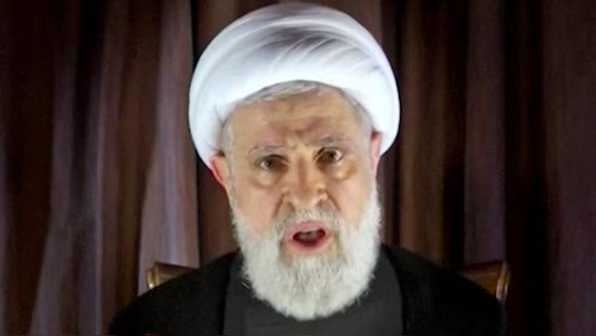
File : Hezbollah SG Naim Qassem
Israel and Lebanon agreed Wednesday to a full ceasefire, contingent on Hezbollah halting attacks and withdrawing its operatives from the area south of the Litani River in Lebanon, according to a joint statement from the U.S., Israel and Lebanon.
Hezbollah rejected the terms Thursday after the Shiite militia had initially said it would agree to a full ceasefire. Without Hezbollah’s agreement, the ceasefire could stay “on paper.”
- A full ceasefire in Lebanon is one of the key demands Iranian officials have made as part of their negotiations with the Trump administration on an agreement for ending the war.
On Monday, President Trump put the brakes on Israel’s plan to launch massive strikes on Beirut in retaliation for Hezbollah’s drone and missile strikes.
- Trump lashed out at Israeli Prime Minister Benjamin Netanyahu in an expletive-laden call.
- After the call, Trump announced a new partial ceasefire in Lebanon that included an Israeli commitment not to attack Beirut in return for Hezbollah stopping attacks on Israeli towns along the border.
- Despite the announcement, Hezbollah has conducted several drone attacks against targets inside Israel over the past 48 hours.
The latest: On Thursday, Lebanese President Joseph Aoun told reporters Lebanon will inform the Trump administration of Hezbollah’s position and said the ceasefire will take effect 24 hours after the U.S. receives guarantees from the parties.
- But several hours later, Hezbollah leader Naim Qassem rejected the agreement and called it “a roadmap to annihilate part of the Lebanese people.”
- Qassem said a ceasefire must include a full withdrawal of Israeli forces from southern Lebanon and pledged to continue attacks as long as Israeli troops occupy parts of the country.
- “As long as our villages are being bombed and our people killed, northern Israel will not be safe,” he warned.
If Hezbollah indeed rejects the agreement and continues launching missiles and drones at northern Israel, it could push Trump to give Netanyahu a “green light” for escalating the military campaign in Lebanon.
The new agreement between Israeli and Lebanese officials was reached after two days of negotiations between the two countries at the U.S. State Department, mediated by Trump officials.
- As part of this understanding, the two sides agreed to create “pilot zones” in southern Lebanon in which the Lebanese Armed Forces will take exclusive control and make sure there is no Hezbollah or any other militia presence. In return, the Israel Defense Forces will withdraw from the area.
- “These steps will enable progress towards a comprehensive peace and security agreement,” the parties said in a joint statement.
“All countries reaffirmed that the future of the relationship between Israel and Lebanon must be decided by the two sovereign governments,” the joint statement said.
- “They rejected any attempt, by any state or non-state actor, to hold Lebanon’s future hostage.”
- In the joint statement, Israel and Lebanon “reaffirmed that they have no hostile intent toward one another and committed to continuing direct negotiations to build confidence, resolve all outstanding issues, and work toward a comprehensive agreement between the two countries.”
- The parties agreed to hold another round of negotiations over a comprehensive agreement on June 22 in Washington, D.C.
