HERE IS THE LATEST
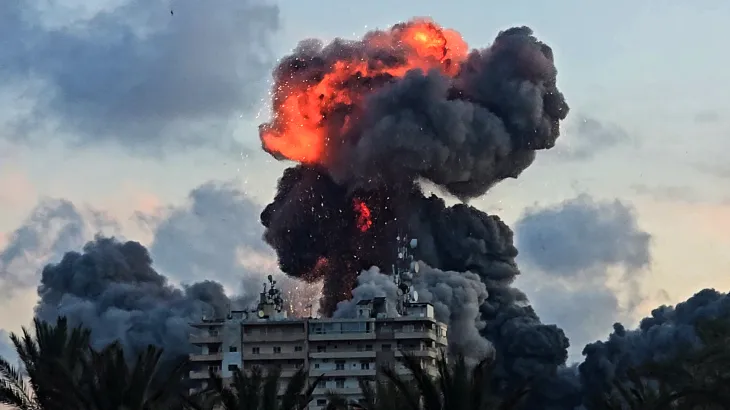
- Iran accused the U.S. on Thursday of another ceasefire violation and said it retaliated by targeting an American base after a second round of what the Pentagon calls “purely defensive” strikes against drone operations. CENTCOM said Kuwait intercepted an incoming Iranian missile, and there were no reports of a U.S. base being hit.
- President Trump said Iran was “negotiating on fumes” and he left open the possibility of ordering U.S. forces to “go back and finish it,” as diplomatic efforts toward an agreement to extend the current ceasefire and reopen the Strait of Hormuz were challenged by the latest exchange of fire.
- Iran insists it’s ready to keep fighting, but the Trump administration says it’s “desperate for cash.” Treasury chief Scott Bessent pointed to Tehran’s efforts to charge ships to transit the Strait of Hormuz as evidence, and he warned other nations that paying Iran would violate U.S. sanctions.
Pakistan says its top diplomat will meet Rubio in D.C. Friday to “exchange views” on the latest developments
Pakistan’s Foreign Minister Ishaq Dar will visit Washington on Friday and meet with Secretary of State Marco Rubio, the Pakistani foreign ministry said Thursday.
Pakistan has led efforts to broker a peace agreement between Iran and the U.S., and Dar has been among the senior figures leading that diplomacy.
Dar was to meet Rubio, “to review bilateral relations and exchange views on regional and global developments of mutual interest,” the ministry said in its statement.
Pakistani officials have served as conduits for multiple iterations of a proposed framework for renewed negotiations between the U.S. and Iranian governments for many weeks. According to both U.S. and Iranian officials, that framework would, if agreed, see the Strait of Hormuz reopened and direct talks resumed on contentious issues, including Iran’s nuclear program.
But major hurdles remain, and President Trump said during a meeting of his Cabinet on Wednesday that he was not satisfied with the most recent Iranian offers.
“They want very much to make a deal,” he said. “So far, they haven’t gotten there, we’re not satisfied with it, but we will be. We will be. Either that or we’ll have to just finish the job. Their navy is gone, as I’ve said a thousand times, their navy is gone, their air force is gone, everything’s gone. And they’re negotiating on fumes. But we’ll see what happens. Maybe we have to go back and finish it, maybe we don’t.”
Gulf Cooperation Council condemns “criminal Iranian attacks” on Kuwait as Tehran claims retaliation for U.S. strikes
The Secretary-General of the Gulf Cooperation Council for Arab States, Jasem Mohamed Albudaiwi, strongly condemned continued “criminal Iranian attacks” on Kuwait in a statement shared by the bloc Thursday.
He called the continuation of Iranian “treacherous attacks” a blatant violation of the principles of international law, the United Nations charter, and “the principles of good neighborliness,” and reaffirmed the GCC states’ full support for Kuwait “in all measures it takes to maintain its security and stability, as well as the safety of its citizens and residents.”
U.S. Central Command said Kuwaiti forces intercepted an Iranian ballistic missile Thursday.
Iran’s Islamic Revolutionary Guard said it had launched retaliatory fire at a U.S. base used in overnight attacks that the American military described as “purely defensive.”
There are a couple U.S. air bases in Kuwait, along with other military installations, but there were no reports of any weapons impacting American facilities Thursday.
Iran-linked vessels now account for half of Strait of Hormuz traffic, Lloyd’s analysis finds
Ships with connections to Iran have made up 50% of known traffic in and out of the Persian Gulf recently, despite the ongoing U.S. blockade of Iranian ports and associated vessels, according to a new assessment from Lloyd’s List Intelligence.
Transits through the Strait of Hormuz in both directions fell 46% last week after a spike the week before, the company said Thursday in a weekly briefing. The numbers remained significantly lower than the pre-war average of 138 vessels per week, but traffic was evenly split between ships with links to Iran — vessels coming to or from Iranian ports or carrying Iranian cargo — and all other traffic.
Iran-linked ships have regularly made up half of shipping traffic since the U.S. naval blockade was announced on April 13, but so-called “dark transits,” during which ships turn off their location broadcast systems, spiked toward the end of last week as the security situation deteriorated, the firm said.
Senior Iranian official says Mideast would be “most stable and best region in the world” if U.S. leaves
“There is no problem between the Islamic Republic of Iran and its neighboring countries, and this region without the United States will be the most stable and best region in the world,” a senior Iranian official declared Thursday during a visit to Russia.
Ali Bagheri, Deputy for Foreign Policy and International Security at Iran’s Supreme National Security Council, told Russia’s state-run RT network that regional stability was dependent on the U.S. abandoning what he called “excessive demands.”
Bagheri accused the U.S. of acting with belligerence, having twice launched attacks on Iran during active negotiations, adding that American foreign policy was based on a world view that “is obsolete and belongs to the era of barbarism.”
Iran, “like other independent countries, believes in creating peace through dialogue, cooperation and diplomacy,” he said.
Joke of the century
Ali Hussein a Lebanese political analyst commented on Bagheri ‘s claim by saying . “What he said should be called the joke of the century. The Iranian regime never believed in peace , dialogue , cooperation or diplomacy. ” He added: “Ever since it was created in 1979 it has been trying to bully the region and destabilize it . Cannot count on any of its Arab neighbors as a friend “
CBS
