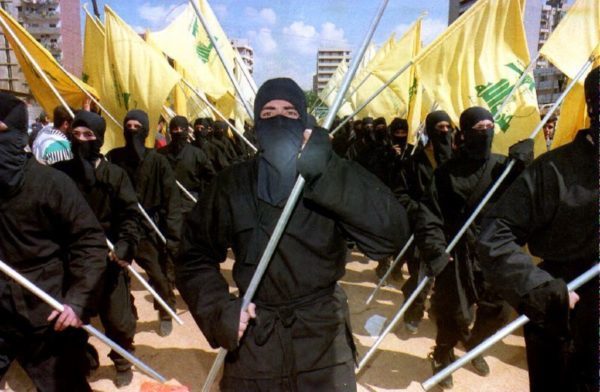
File : Masked Hezbollah fighters as they march through a suburb of Beirut in May 2008 , when the party occupied a large section of Beirut . and tried but failed to occupy Mount Lebanon. The majority of the Lebanese now consider the heavily armed and Iran backed militia as the biggest threat to Lebanon’s sovereignty
The remarks made by Hezbollah Secretary-General Sheikh Naim Qassem—specifically his assertion regarding “the people’s right to take to the streets and bring down the government”—will not pass unnoticed, nor will their implications be overlooked. This is particularly true given the current context, in which the U.S. and Iran are laying the groundwork for a potential understanding—an agreement that, among other provisions, includes a cessation of hostilities in Lebanon.
The Saudis, in particular, will be the first to scrutinize this threat to topple the government—a government around which they have previously drawn a “red line.” They will likely question Parliament Speaker Nabih Berri regarding the seriousness of this proposition: Is it merely populist rhetoric intended to mobilize the masses and deflect attention from the catastrophic repercussions currently unfolding in the South as a result of Israeli aggression? Or does it represent a concrete plan the Party intends to execute in order to obstruct the implementation of government resolutions regarding the state’s exclusive monopoly on arms—even if doing so necessitates a coup d’état? Informed sources tell *Al-Nashra* that Qassem’s remarks serve a dual purpose: first, to issue a threat to the executive branch should it persist in pursuing an agenda aimed at disarming the Party; and second, to signal a readiness to surrender its weaponry once the Lebanese state is fully prepared to assume the responsibility of defending the South.
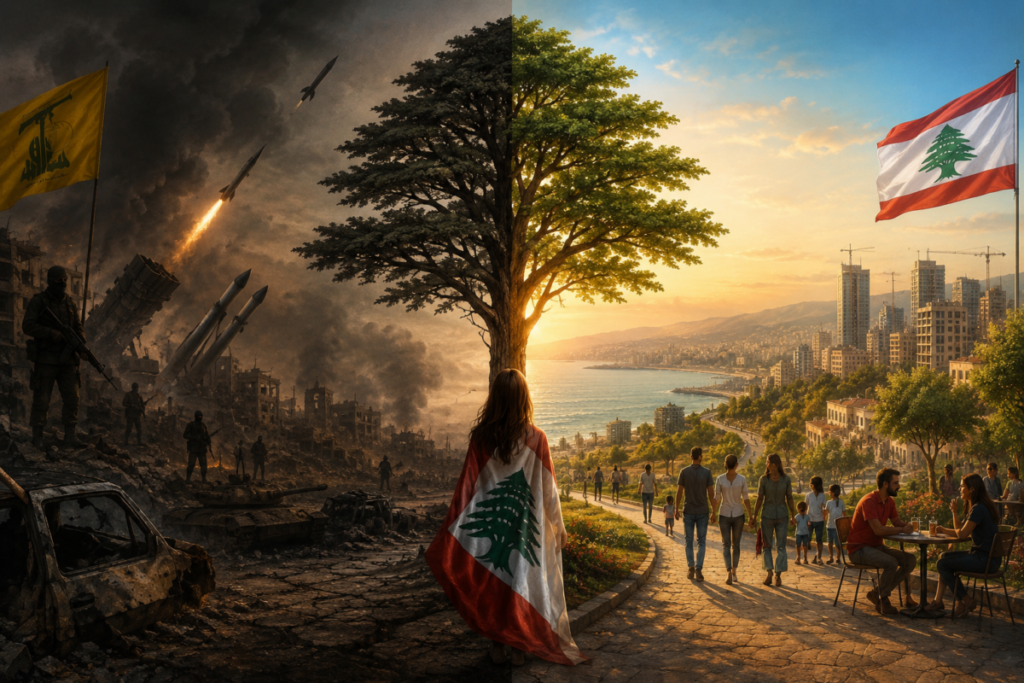
Our artist wanted to show the contrast between the Lebanon of today ( L) and the Lebanon of the future as peace talks in Washington bring hope to the Lebanese that finally we can live in peace with our neighbors. The majority of the Lebanese want Hezbollah’s military wing banned and declared a terrorist organization
This latter point, however, opens the door to a broader debate regarding the divergence between the Party’s vision for national defense and the proposals put forth by other Lebanese political factions. The sources further add that the Party’s underlying strategy is predicated upon the principle of “first imposing its own military and political vision.” The same sources observe that the Party “is not aligned with the stance taken by Speaker Berri,” who categorically opposes any recourse to street protests. Indeed, Berri has previously issued stern warnings to this effect—going so far as to signal his readiness to personally confront and quell any such street mobilization. Berri harbors deep fears regarding the potential for unrest to spiral out of control in Lebanon—particularly given the tendency for such movements to assume a sectarian and confessional character—thereby exacerbating the country’s already deepening crises.
The speech delivered by the Party’s Secretary-General is not directed against Berri; however, the threat it contained struck at the very core of the Speaker of Parliament’s strategic formula—namely, prioritizing internal Lebanese cohesion above all else, and, secondly, preventing the government from being toppled through street protests.
It is precisely in this context that informed sources view Berri’s pragmatism as stemming from his deep understanding of the magnitude of the internal Lebanese rift—a rift the Speaker refused to allow to infiltrate the legislative session dedicated to the general amnesty; how, then, could he possibly allow the Lebanese streets to be engulfed by it? The Secretary-General of Hezbollah issued his threats—threats expected to trigger a chain reaction of counter-threats and rival street mobilizations—based on the premise that every political faction in Lebanon commands a presence in the streets, particularly amidst the prevailing division regarding the issues of war and negotiation. These same sources do not rule out the possibility that Berri may once again intervene to defuse the threat of street mobilization, driven by his unwavering commitment to safeguarding internal stability and fulfilling his obligations to the Lebanese people, as well as to his Saudi and American counterparts.
Al Nashra- translated from Arabic
