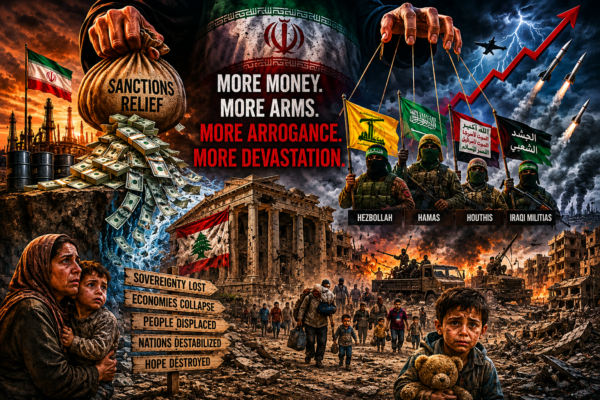
Illustration: Sanctions relief for Iran could mean more destruction, more displacement, and more arrogance from stronger and better-armed proxies. When Iran’s proxies grow stronger, host nations grow weaker
The real victims of empowering Iran’s proxies are not Washington or Tehran — but the nations and people forced to live under their growing shadow.
By: The Editorial Board, Opinion
As reports emerge about possible sanctions relief and financial concessions to Iran under a temporary framework agreement, the debate in Washington has once again focused primarily on nuclear timelines, oil markets, and diplomacy.
But the world is overlooking the most dangerous question of all:
What happens to the countries already struggling under the weight of Iran’s proxies if those proxies become richer, stronger, more arrogant, and more heavily armed?
This is not a theoretical concern. The Middle East has already lived through this experiment.
Following earlier sanctions relief and financial openings to Tehran, Iran’s regional proxy network expanded dramatically. Hezbollah tightened its grip over Lebanon. The Houthis escalated attacks across Yemen and the Red Sea. Hamas strengthened its military capabilities in Gaza. Iranian-backed militias in Iraq grew increasingly powerful and difficult to control.
The result was not regional moderation.
The result was deeper instability.
The countries that paid the highest price were not Iran’s leaders sitting safely in Tehran. The real victims were the host nations whose sovereignty, economies, and security were slowly consumed from within.
Lebanon stands as perhaps the clearest example.
For years, Hezbollah operated as a state within a state, gradually overpowering national institutions while dragging Lebanon into conflicts the Lebanese people never chose. The consequences were catastrophic: economic collapse, political paralysis, international isolation, destruction of infrastructure, capital flight, loss of tourism, currency collapse, and the weakening of the Lebanese army and state authority.
Even worse, the very community Hezbollah claimed to defend suffered the most. Large parts of Lebanon’s Shiite population paid the highest human and economic price for Hezbollah’s endless confrontations and regional adventures.
Yemen tells a similar story.
The Houthis transformed from a local insurgency into a heavily armed regional force capable of threatening international shipping lanes and destabilizing one of the world’s most critical maritime corridors. The Yemeni people paid with famine, destruction, displacement, and decades of lost development.
Iraq has also struggled under the growing influence of armed factions operating outside full state control, weakening national sovereignty and complicating governance and economic stability.
This is why many critics fear that massive financial relief for Tehran before permanent strategic changes are secured could repeat the same cycle all over again.
Money is fungible.
Even if sanctions relief is officially intended for economic recovery, increased oil revenues and financial breathing room inevitably strengthen the broader ecosystem surrounding the regime. More resources for Tehran often translate into more resources, weapons, training, influence, and confidence for the proxy networks tied to it.
And with greater power comes greater arrogance.
History shows that heavily armed non-state actors rarely become more moderate after gaining leverage. They usually become more entrenched politically, more difficult to challenge domestically, and more willing to impose their agendas on already fragile states.
The long-term damage to host nations can be devastating.
Investors flee uncertainty. Tourism collapses. Skilled professionals emigrate. Governments weaken. National armies lose authority. Sectarian tensions deepen. Young generations lose hope. Entire countries become battlefields for larger geopolitical struggles.
This is why the current debate about Iran cannot focus only on centrifuges, enrichment percentages, or temporary maritime calm in the Strait of Hormuz.
The broader strategic question is far bigger:
Will the world once again prioritize short-term stability while ignoring the long-term destruction caused by empowered proxy networks across the region?
Temporary calm is important. Avoiding war matters. Diplomacy matters.
But real peace cannot coexist with endlessly expanding armed proxies operating above the authority of sovereign states.
The world must stop treating proxy destabilization as a secondary issue. For millions of people living in Lebanon, Yemen, Iraq, Gaza, and elsewhere, it is the issue.
Because when proxies grow stronger, host nations grow weaker. And eventually, entire societies pay the price.
