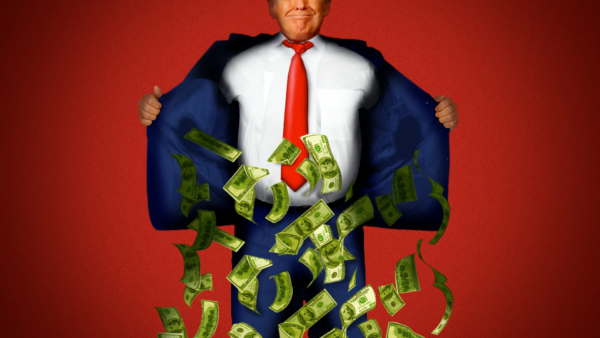
Photo illustration: Sarah Grillo/Axios. Photo: Ethan Miller/Getty Images
Never in 250 years has America witnessed a sitting president shield himself and his family from tax scrutiny, after leveraging policies that benefit his own businesses and personal portfolios, as Donald J. Trump has done.
Why it matters: This isn’t a hidden scandal. Trump has done this publicly and proudly. Last year, we called it the “most unprecedented presidency in 250 years.”
In doing so, he has set a precedent — once so unfathomable as to be laughable — that it’s OK for presidents and family members to make billions off deals affected by government decisions, then use the Justice Department to secure lifetime protection from scrutiny of their past tax returns.
Trump’s crypto venture alone has been a windfall unlike anything in the history of presidential business, generating more cash for the Trump family in 16 months than the entire Trump real estate empire produced from 2010 through 2017, according to The Wall Street Journal.
“I let my kids … do business,” Trump said in a January interview with The New York Times. “I prohibited them from doing business in my first term, and I got absolutely no credit for it.”
We were debating how to capture just how unprecedented Trump’s actions are, when every week of every year seems filled with unprecedented words and actions. Let’s try this. Imagine America put these questions to a public referendum:
Presidents, while in office, can maintain massive personal crypto and stock portfolios that buy and sell hundreds of millions of dollars in industries directly regulated by their own administration.
Presidents and their family members, unlike other U.S. citizens, shall be granted lifetime immunity from federal audits and criminal investigations of their past tax returns.
Presidents and their family members can maintain active ownership of global business empires, profiting when government decisions directly benefit those specific businesses.
How would you vote?
- It’s hard to imagine more than single-digit support for any of these. Yet Trump is doing all three and paving the way for future presidents to do the same. That’s why precedents by presidents often matter as much as laws themselves.
- This is more than just a Trump problem. Look at the astonishing number of lawmakers trading and making money off stocks, often with insider knowledge of looming congressional action.
- Pollsters have asked how Americans feel about officials trading stocks while in office, and it’s one of the rare genuinely bipartisan issues in politics today.
- Flashback: After Watergate, modern presidents from both parties built elaborate legal and ethical structures designed to separate public office from private enrichment.
- Jimmy Carter placed his peanut farm into a blind trust. Ronald Reagan, both Bushes and Bill Clinton followed suit. Barack Obama held only diversified assets like Treasury bonds and index funds. Even wealthy businessmen entering politics generally treated direct entanglements as toxic.
- Over the same decades, congressional stock trading and post-Citizens United money normalized self-enrichment around political power. Trump pushed that trajectory into terrain previous presidents viewed as untouchable.
- Let’s dig deeper on each of our three questions:
- 1. Tax audit immunity clause: The Justice Department quietly added a sweeping addendum to a settlement resolving Trump’s $10 billion lawsuit against the IRS over past tax leaks — a case in which Trump was effectively both plaintiff and defendant, suing his own administration in his personal capacity.
- Signed by acting Attorney General Todd Blanche, Trump’s former personal attorney, the directive states the federal government is “FOREVER BARRED and PRECLUDED” from pursuing or examining tax returns filed prior to the May 2026 agreement by Trump, his family and the Trump Organization.
- 2. Business entanglements and global branding: Ongoing domestic and international operations by the Trump Organization have repeatedly collided with active administration policies.
- The Trump Organization has 25 Trump-branded real estate projects under development in 12 foreign countries — more than triple the number of Trump properties operating abroad before he returned to office, according to a CREW analysis. They include a $1 billion Trump Plaza in Jeddah, Saudi Arabia, and a $500 million Trump International in Oman. Vietnam’s government has moved to fast-track a Trump project despite legal objections.
Current federal ethics laws don’t explicitly mandate that a sitting president divest from personal business entities. That’s why precedents matter.- The Trump Organization says management of the family business has been handed over to the president’s adult sons, Don Jr. and Eric. The Trump Organization maintains that foreign leaders and private entities patronize Trump properties based on quality and brand prestige.
- 3. Crypto and stock trading: Trump last year signed the GENIUS Act, a regulatory framework for stablecoins that legitimized and expanded the crypto market at the same time that he and his family actively profited from it.
- Among World Liberty Financial’s most lucrative foreign dealings was a secret $500 million investment backed by the UAE’s national security adviser, signed four days before Trump’s inauguration, The Wall Street Journal reported. Two months later, the administration approved UAE access to roughly 500,000 of the most advanced AI chips a year — a sale the Biden administration had stymied over fears the technology could reach China.
- At the same time, Trump has become the most active stock trader in presidential history, executing roughly 3,700 trades via independently managed accounts during the first quarter of 2026. His stock trades included Nvidia, whose advanced chips the Trump administration approved for sale to China. His portfolio also bought stock in Palantir weeks before he praised the company on Truth Social, and in Pentagon contractors helping supply the Iran war, including Lockheed Martin, General Dynamics and Northrop Grumman.
- Vice President Vance said during a White House briefing this week: “The president doesn’t sit at the Oval Office on his computer on his, like, Robinhood account, buying and selling stocks — that’s absurd. He has independent wealth advisers who manage his money. … He’s not making these stock trades himself.”
- The bottom line: Trump’s net worth today is $6.1 billion, Forbes estimates, up from $5.1 billion last year, $4.3 billion in 2024 and $2.4 billion in 2021.
AXIOS
