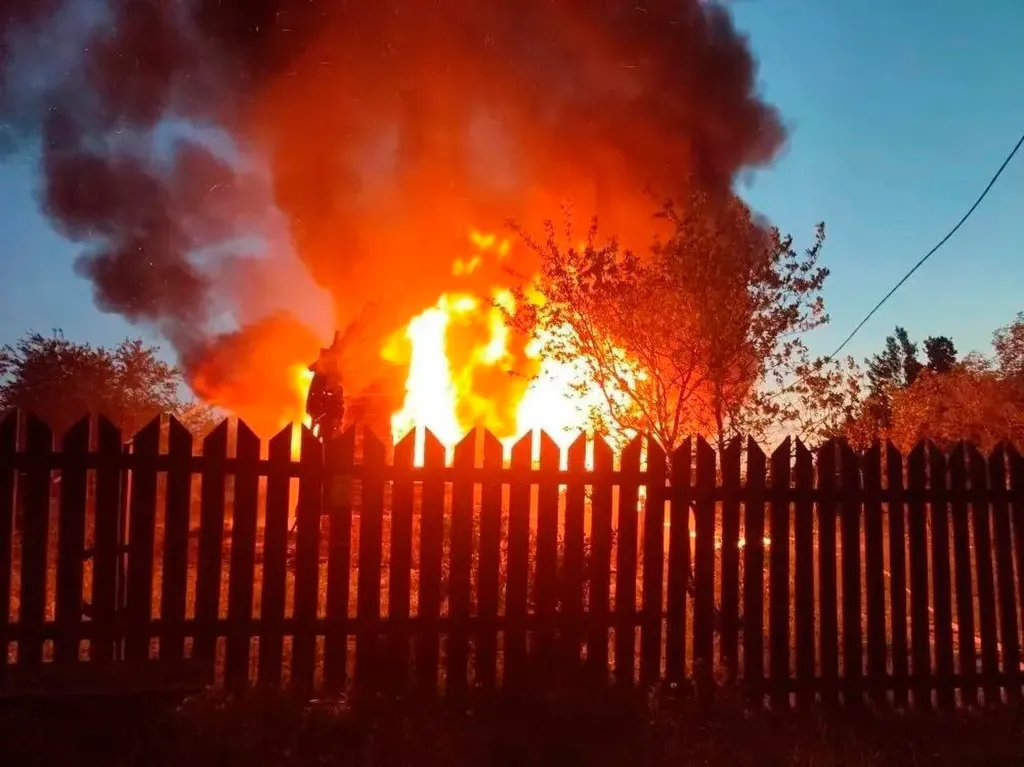
This photo released by Moscow Region Governor Andrei Vorobyev’s official telegram channel shows a house on fire after a Ukrainian attack in Khimki, just outside Moscow, Russia, on Sunday, May 17, 2026. Shortly after midday local time, iRussian media reported that more than 1,000 drones had been shot down or jammed in the past 24 hours. MOSCOW REGION GOVERNOR ANDREI VOROBYEV’S OFFICIAL TELEGRAM CHANNEL VIA AP
Vladimir Putin is facing mounting pressure over Ukraine’s escalating attacks on Moscow, which he has been able to largely insulate from the war until now.
Residents of the city describe widespread alarm and criticism of authorities after a series of damaging strikes over recent weeks that the regime has appeared helpless to prevent. Even loyalist media are joining a rising chorus of dissent. The rising threat could force the Russian President to consider exit strategies from the war, analysts believe.
The strikes are a blow to the Kremlin, which has sought to protect Moscow from more than four years of war. Army recruitment and casualties have disproportionately fallen on provinces, prisons and foreign fighters to spare the capital.
Ukraine fired more than 500 drones at Moscow over Saturday night in its largest assault on the city of the war, following a deadly Russian attack on Kyiv. The barrage killed three and injured 12, according to Russian authorities, as well as shutting down airports and hitting oil facilities.
Ukrainian President Volodymyr Zelensky hailed the attack as a sign that Ukraine’s rapidly advancing drones can now pierce the strongest enemy defences and even the balance of power after years of Russian strikes on Kyiv.
“The Moscow region is the most heavily saturated with Russian air defence systems,” he said. “Our long-range capabilities are significantly changing the situation.”
Attacks on Moscow continued this week with local authorities issuing drone alerts on Monday and Tuesday, and the threat is likely to escalate.
Kyiv says it will produce seven million drones this year, including dozens of long-range designs, and attacks could soon include home-made ballistic missiles. Ukrainian defence firm Fire Point said on Tuesday that its “Flamingo” model will be capable of striking Moscow within months.
Putin has sought to maintain a sense of normality in the capital despite the growing impact of the war, with public and cultural events continuing and no curfew imposed in Moscow. But the Russian leader signalled his concern about Ukraine’s long-range threat by seeking a ceasefire during a pared-down Victory Day parade earlier this month.
Andrei Soldatov, a Russian investigative journalist in exile, who covered the Kremlin and its security services, suggested the Russian leader had broken an unspoken contract with the urban elite. “The deal was, ‘We do not talk about the war and you keep us safe’. Obviously now this deal is broken,” he said. “This has an effect on public opinion.”
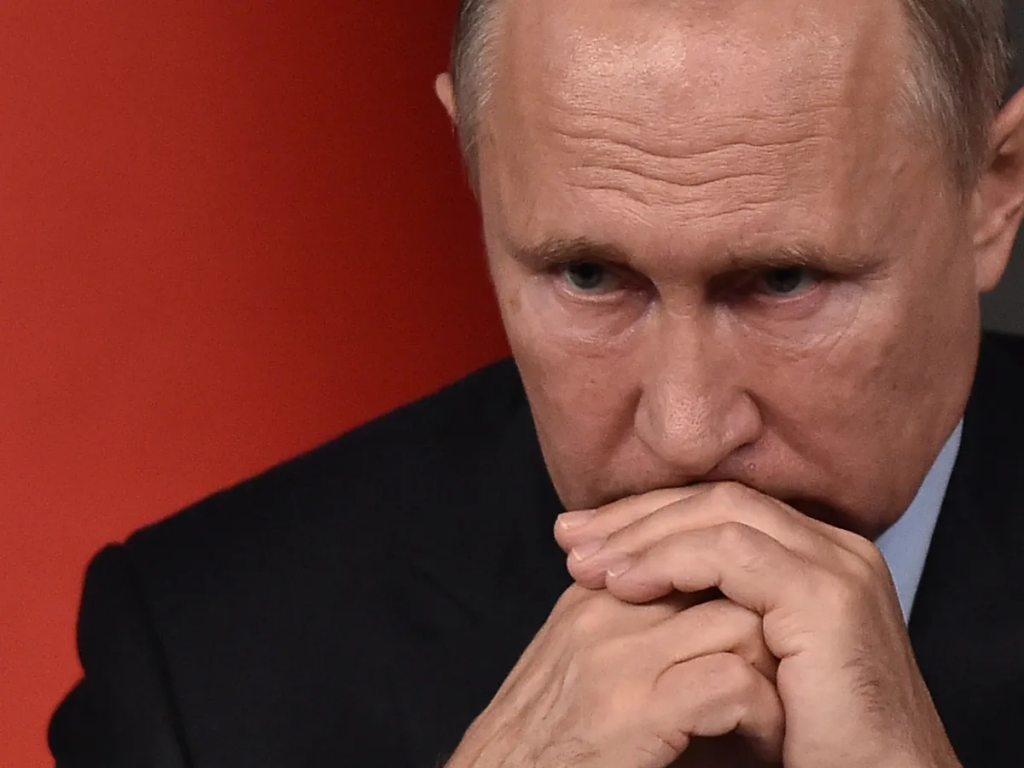
Ukraine’s successful counterattack means that for the first time in Russian President Vladimir Putin’s 26 years in power, he has to deal with elites who disagree with him—on strategic decisions over Russia’s war in Ukraine and how the war may end.
Moscow residents approached by The i Paper described mounting unease over the attacks. They spoke anonymously for safety reasons. A businessman who lives in the city suburbs, said there has been a “different atmosphere” over the past weeks, with many Muscovites “unsettled” by the threat. “For sure, people blame the authorities but it’s not often spoken about in public for obvious reasons,” he said.
Local authorities introduced an app warning of incoming fire last month, said one resident. But they added that air raid sirens often fail to function, adding to the sense of alarm. “Numerous drones have been in my area but no sirens.”
Another resident, who works in logistics, said fear is greatest on the outskirts of the city where air defences are weakest. “People are worried,” he said. “Drones are falling on their land and may kill.”
Residents report that Moscow’s main airports, which also serve as connectors for locations across the country, are being shut down on a daily basis for hours at a time. Measures introduced to thwart attacks, such as internet blackouts and jamming of mobile signals, have proved unpopular and disruptive. One resident described long queues at cash points as mobile payment services failed.
Making the capital pay a price is key to Ukraine’s strategy to pressure Putin to end the war, said Ukrainian MP Oleksii Goncharenko. “For more than four years, Putin has worked hard to keep this war invisible to Muscovites. That bubble is central to his political model: the provinces fight and die, while the capital lives as if nothing is happening,” he said.
“Every Ukrainian drone that forces Sheremetyevo or Vnukovo [airports] to shut down cracks that model a little further and shifts the cost-benefit calculation inside the Kremlin.
“The surest way to make Putin reconsider his aggressive plans is to ensure that continuing the war becomes more dangerous for him than ending it.”
Kremlin-friendly media members have broken ranks to highlight the failure to deal with the drone threat.
After the attack on Saturday, journalist Pavel Zarubin asked Putin’s spokesperson Dmitry Peskov: “We have these powerful bombs…But so what? It seems that a nuclear power can be bitten.”
The Two Majors Telegram channel, one of Russia’s most popular military news outlets, accused the defence ministry of trying to cover up drone attacks by “only reporting successes”.
Soldatov notes that Putin is not accountable to his public and has the option to increase repression in the short term. But growing signs of domestic discontent, from declining approval ratings to criticism from fashion bloggers, questions from his inner circle and limited progress on the battlefield, could force him to ponder exit strategies from the war.
“I think not immediately, because right now the sentiment is humiliation after 9 May [Victory Day] and the drone attacks on Moscow, so he needs to show he is responding to Ukraine,” he said. “It might take two or three months to realise it’s probably a good time to start thinking seriously about a ceasefire.”
Max Hess, a Eurasia analyst at the Foreign Policy Research Institute, said Putin was unlikely to change his strategy in the near-term. But the growing Ukrainian threat, particularly to Moscow airports, could create openings for diplomacy.
“It increases Ukraine’s leverage in securing potential future energy or long-range weapon ceasefires, something Trump has pushed for but which have never held,” he said.
That leverage will only increase as Ukraine’s long-range weapons improve, said former Nato official Edward Hunter Christie, predicting this will impact Moscow’s ability to continue the war within a year. “Ukraine is increasingly developing new, long-range strike systems that are going to be more potent with stronger payloads, and harder to intercept than the long-range drones that Ukraine is currently using,” he said.
“One year from now, if the war is still ongoing, we will see much more decisive Ukrainian long-range strikes on targets across Western Russia. Strikes that cause considerably more material damage, and higher costs on the Russian economy and ability to conduct its war effort.”
MSN
