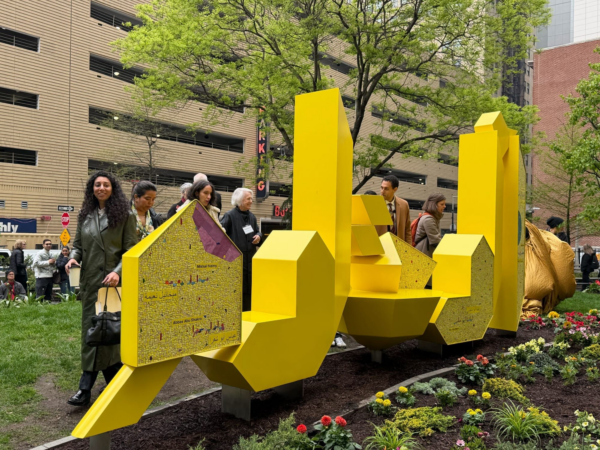
New York City Mayor Zohran Mamdani’s administration unveiled its very first commemorative public artwork on Thursday, April 30, in recognition of Manhattan’s first Arabic-speaking enclave, “Little Syria.”
“Al Qalam (The Pen): Poets in the Park,” a mosaic installation and sculpture created by French-Moroccan artist Sara Ouhaddou over the past decade, honors nine members of the neighborhood’s once flourishing literary community. Among the most recognizable figures named in the work is Lebanese-American poet Khalil Gibran, who co-founded the neighborhood’s local writers’ association, Pen Bond (al Rabitah al Qalamiyyah), in 1920.
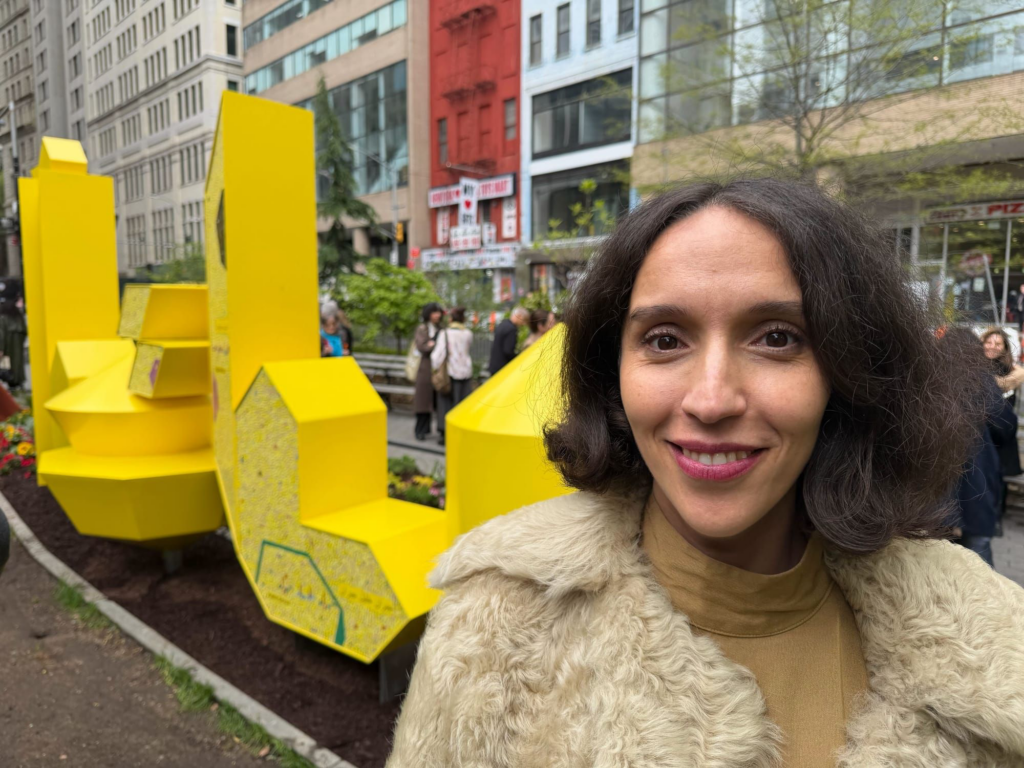
Sara Ouhaddou in front of her new monument “Al Qalam (The Pen): Poets in the Park” in Manhattan’s Financial District (photo Hrag Vartanian/Hyperallergic)
Situated in the Financial District’s Elizabeth H. Berger Plaza, the $1.6 million monument sits within the few blocks where immigrants from Greater Syria, including modern-day Syria, Lebanon, and Palestine, first settled in the late 19th century. By 1900, around 1,500 individuals resided in the enclave, but were abruptly displaced when construction began on the Brooklyn-Battery Tunnel in the 1940s.
Little Syria was the first major Arab-American community in the United States, established in Lower Manhattan between the late 1880s and the 1940s. Located along Washington Street, stretching from Battery Park to above Rector Street in the Financial District, it served as a cultural and economic hub for immigrants, primarily from Ottoman-controlled Greater Syria (modern-day Syria, Lebanon, Palestine, and Jordan)
Hyperallegic
