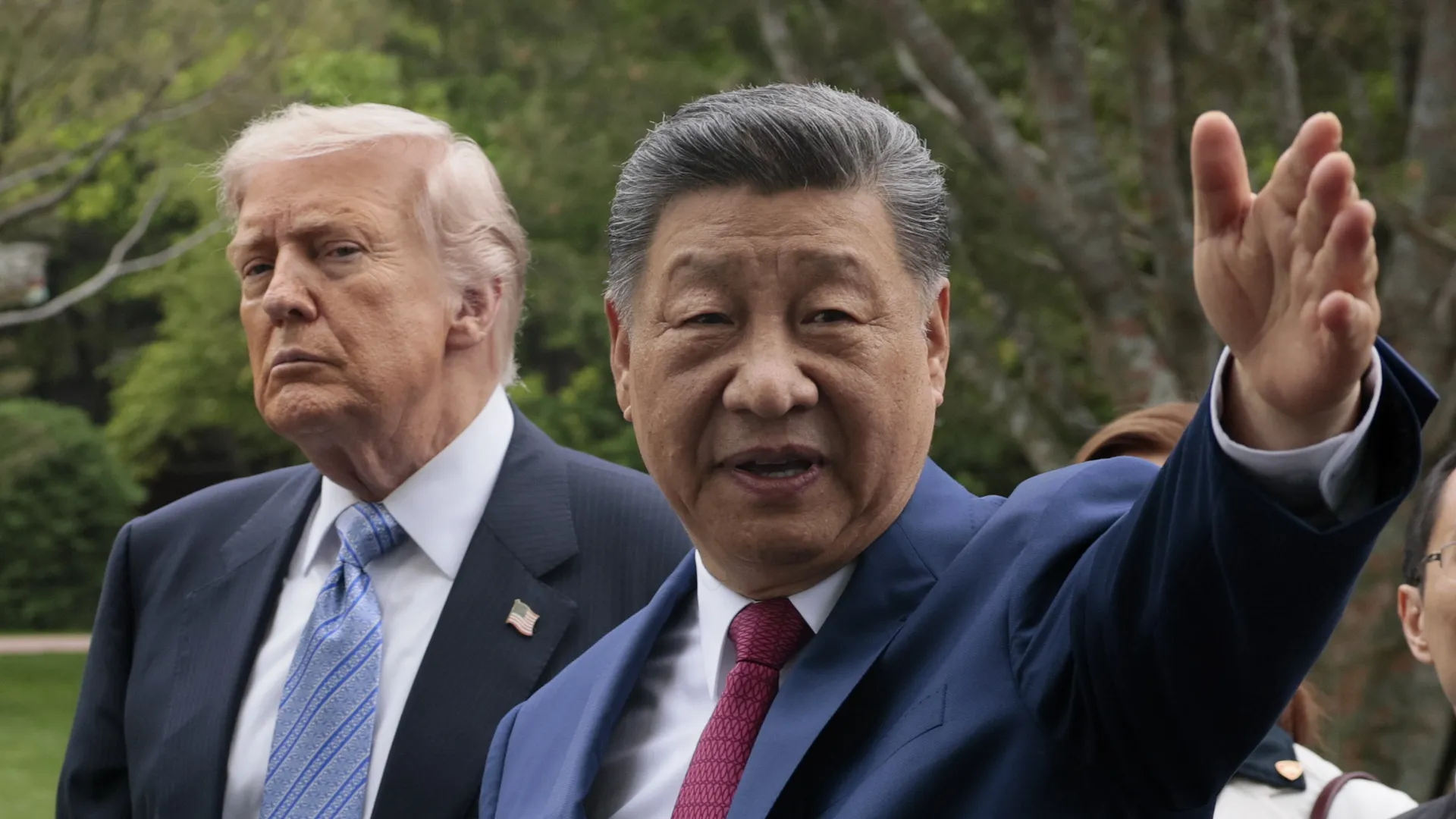
President Trump’s summit with Xi Jinping was staged as a reunion between old friends, concluding Friday with a private tour of Zhongnanhai, the Chinese Communist Party’s secretive leadership compound.
- Strolling the gardens, Trump declared the blooms around him “the most beautiful roses anyone has ever seen.” Xi promised to send him seeds.
Why it matters: The warm public choreography of the past two days has masked a stubborn reality: nearly every force shaping U.S.-China relations is pulling them apart.
- Trump spent the trip pitching closer ties with China after a decade of decoupling that he, more than any other American president, helped set in motion.
The summit seemed to produce a package of modest deliverables, though Trump’s claim of “fantastic trade deals” did not include any details.
- He told Fox News that China had committed to buy 200 Boeing jets, while Trade Representative Jamieson Greer said the U.S. expects China to commit to at least $10 billion in annual agricultural purchases. China hasn’t commented on either.
- The two sides are also negotiating a joint “Board of Trade” covering about $30 billion in non-sensitive goods, Greer said.
- Iran was discussed, but Trump’s public characterizations of Xi’s posture left more questions than answers. He told Fox that China wouldn’t supply Iran with arms but “they buy a lot of their oil there, and they’d like to keep doing that.”
China hawks in Trump’s administration worked in the days and weeks leading up to the summit to undercut the case for rapprochement.
- The State Department sanctioned three Chinese firms for providing satellite imagery that helped Iran strike U.S. forces in the Middle East.
- The Treasury Department sanctioned multiple Chinese “teapot” refineries for buying billions of dollars of Iranian oil. Beijing responded by ordering companies not to comply with U.S. sanctions.
- A White House memo written by Trump science adviser Michael Kratsios accused Chinese entities of “industrial-scale” campaigns to steal frontier AI from American companies.
- Federal prosecutors unsealed charges against the mayor of Arcadia, Calif., for acting as an illegal agent of the Chinese government — 48 hours before Trump landed in Beijing.
- Leaks from inside the government paint an even more hostile picture of the U.S.-China rivalry.
- A U.S. intelligence assessment reported by the Washington Post found that China is exploiting the Iran war to gain ground over the U.S. diplomatically, militarily and economically.
- The New York Times reported Wednesday that Chinese companies are negotiating clandestine arms sales to Iran, routing weapons through third countries — including in Africa — to hide their origins.
- Xi — while warning Trump that mishandling Taiwan could provoke “an extremely dangerous situation” — played his own part in the summit’s friendly choreography.
- Beijing rolled out the red carpet for Secretary of State Marco Rubio, who remains sanctioned for his criticism of China’s human rights abuses as a U.S. senator.
- At Thursday’s state banquet, Xi told Trump that China’s “great rejuvenation” — the Communist Party’s signature political slogan — and “Make America Great Again” could go “hand in hand.”
- Both leaders have clear incentives to maintain the truce, for now at least.
- Trump doesn’t need any more election-year economic shocks, particularly after Xi’s crippling ban on rare earth mineral exports during last year’s trade war.
- And Xi likely believes “strategic stability” with the U.S. will help China push ahead with its own priorities, from military modernization to high-tech dominance.
- As the leaders play nice, their governments are working furiously in the background to reduce their dependence on one another.
- Trump’s push for closer economic ties is at odds with with a U.S. political climate that has spent the last several years treating Chinese capital as radioactive.
- Amid growing security concerns, Chinese investment in the U.S. has collapsed from roughly $45 billion in 2016 to less than $3 billion last year, according to Rhodium Group.
- Treasury Secretary Scott Bessent said the two sides are discussing a framework for steering Chinese investment into non-sensitive sectors — a sign of how deeply national security fears have constrained economic ties.
- The bottom line: Two aging nationalist leaders, presiding over the world’s most dangerous rivalry, spent the week performing a friendship neither of their governments seems willing to sustain.
(Axion)
