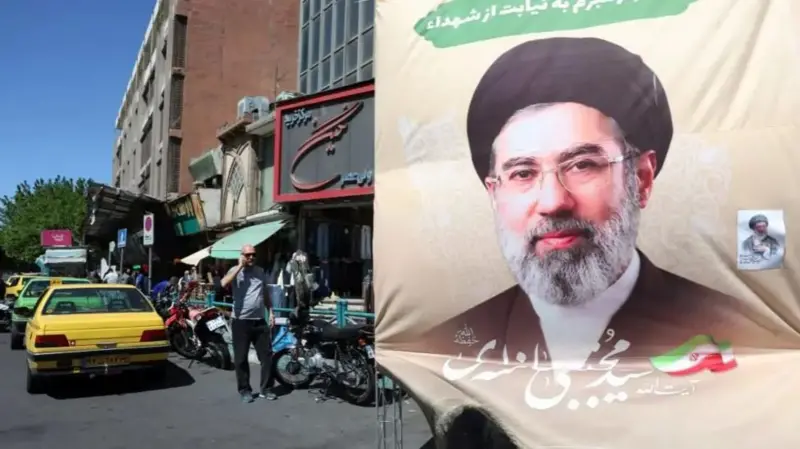
File: Mojtaba Khamenei (R) has not been seen in public since succeeding his father as supreme leader
Iran publicly detailed the injuries suffered by Ayatollah Mojtaba Khamenei for the first time, with an Iranian official claiming that he “is now in good health.” The Iranian supreme leader has not been seen since the Feb. 28 attack that killed his father and longtime supreme leader Ali Khamenei. Iranian official Mazaher Hosseini confirmed he was hurt in the attacks, saying he suffered injuries to his back and kneecap. He added that Khamenei’s knee is expected to heal soon
But what is publicly known right now is still highly fragmented, politically filtered, and impossible to independently verify with certainty.
Iranian officials have now publicly acknowledged for the first time that Mojtaba Khamenei was injured during the February 28 strikes that killed his father, Ali Khamenei. According to Iranian official Mazaher Hosseini, Mojtaba suffered injuries to his kneecap and back and was reportedly knocked down by the blast. Iranian state-linked media insist he is “in full health” and recovering.
However, there are several important reasons analysts remain skeptical about the official narrative:
- Mojtaba has not appeared publicly since the strike.
- No fully verified recent video has emerged showing him speaking publicly.
- Reports about the severity of his injuries vary dramatically.
- Some Western intelligence-linked reports claim his injuries may be significantly worse than Iran admits, including burns, disfigurement, or mobility impairment.
There is also growing reporting that the real day-to-day authority inside Iran may currently rest more with senior IRGC commanders and power brokers than with Mojtaba personally.
Strategically, the key issue is not simply whether his knee heals.
The bigger question is:
Who is actually running Iran right now?
Several indicators suggest:
- the IRGC has gained extraordinary influence,
- decision-making may be fragmented,
- communications remain tightly controlled,
- and the regime is deliberately concealing internal vulnerabilities.
Iranian systems historically place enormous importance on projecting strength and continuity. Public silence from a supreme leader for this long is highly unusual and naturally fuels speculation.
At the same time, one should be cautious about accepting the more sensational claims circulating online or in tabloid-style reporting. Some reports contain highly speculative or politically charged assertions that cannot be independently verified and may reflect information warfare as much as intelligence.
The most reliable conclusion at this point is probably this:
- He was almost certainly injured in the strike.
- Iran is trying to downplay the severity.
- Western intelligence sources appear to believe the injuries and internal instability are more serious than Tehran admits.
- The IRGC’s role inside the system has likely expanded considerably during his absence from public view.
And from a geopolitical perspective, prolonged invisibility itself matters. In authoritarian systems, visible leadership is part of deterrence and regime legitimacy. When the supreme leader disappears from public life during a national crisis, speculation about internal fractures inevitably grows.
