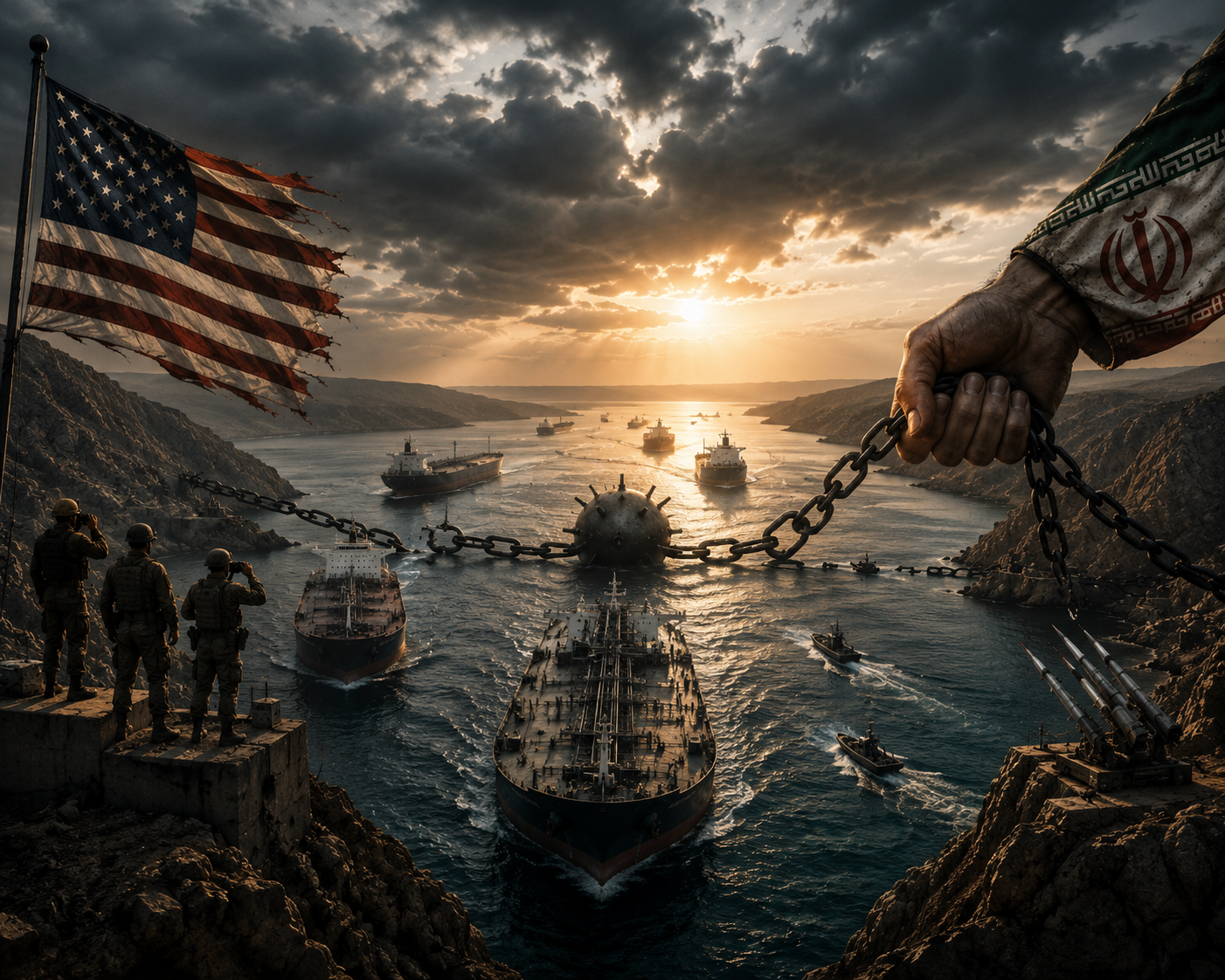
Image : The chained Strait of Hormuz today: tankers waiting for Iran’s permission to pass after paying a toll—as America watches.
The world cannot reward the weaponization of the global economy
By: The Editorial Board, Opinion
The central issue in any agreement between the United States and Iran should not be limited to uranium enrichment levels, sanctions relief, or temporary ceasefires. The core issue is far larger and far more dangerous:
Will the world accept Iranian control over freedom of navigation in the Strait of Hormuz?
If the answer is yes, then nothing meaningful was achieved from this war. On the contrary, the conflict will have produced one of the greatest strategic failures in modern Western policy: legitimizing the weaponization of the world’s most important energy chokepoint.
For more than two months, global shipping through Hormuz has been severely disrupted. Hundreds of vessels have been stranded, insurance costs have soared, energy markets have been destabilized, and America’s allies in Europe and Asia have suffered enormous economic uncertainty.
Even worse, reports indicate that Iran has attempted to formalize control over the strait through transit approvals, toll mechanisms, and new maritime oversight structures.
That crosses a historic red line.
The Strait of Hormuz is not Iran’s private waterway. It is one of the world’s essential international maritime arteries through which roughly one-fifth of global oil and major LNG flows move every day.
If Iran succeeds in imposing de facto control over passage, every hostile power and armed proxy in the world will learn the same lesson:
Global commerce can be blackmailed.
That is why freedom of navigation must become the central pillar of any agreement—not a side issue buried in technical negotiations.
At the same time, Iran continues insisting that the release of billions of dollars in frozen assets must be part of any agreement. Reports surrounding the negotiations indicate that sanctions relief and access to frozen Iranian funds remain central demands from Tehran.
That raises a fundamental question:
Why should the world reward the weaponization of international navigation?
If Iran succeeds in disrupting the Strait of Hormuz, pressuring the global economy, and then emerges from negotiations with sanctions relief, frozen assets, and greater regional leverage, the lesson to every hostile regime and armed proxy will be unmistakable:
strategic blackmail works.
The concern is not theoretical. Critics of previous agreements warned that large financial relief packages could indirectly strengthen Iran’s regional influence network at a time when armed proxies across the Middle East were already destabilizing Lebanon, Iraq, Syria, Gaza, and Yemen.
Any release of frozen funds without permanent guarantees for freedom of navigation risks sending the worst possible message:
that the world is prepared to pay for the restoration of rights that should never have been threatened in the first place.
Freedom of navigation is not a concession to be purchased.
It is a principle of international order.
The Trump administration keeps repeating that it is waiting for Iran’s response. But the longer the delay continues without clear conditions or consequences, the greater the damage to American credibility and deterrence.
Deterrence is not measured by speeches. It is measured by whether adversaries believe America will enforce international norms.
During the tanker wars of the late 1980s, Ronald Reagan understood this clearly. The mission was not merely about oil. It was about protecting the principle that no country could hold the global economy hostage.
Today, the danger is even greater because the world is watching whether the United States and its allies will normalize a new reality in which commercial shipping requires Iran’s permission.
That would represent a historic collapse of the post–World War II maritime order.
America’s allies have the most to lose:
- Europe depends heavily on Gulf energy.
- Japan, South Korea, India, and China rely on uninterrupted Hormuz flows.
- Gulf Arab states depend on secure exports for national survival.
Yet instead of emerging stronger from this conflict, America’s allies appear more vulnerable, more economically exposed, and more uncertain about the future of maritime security.
Several multinational efforts are now being discussed to restore commercial confidence in the strait, including British and French naval deployments alongside U.S.-led initiatives.
But the world cannot afford symbolic missions alone.
Any agreement with Iran must include:
- unconditional freedom of navigation,
- permanent guarantees for commercial shipping,
- removal of any Iranian transit approval system,
- and explicit recognition that international waterways cannot be militarized or taxed by coercion.
Otherwise, the message to the world will be devastating:
that after all the destruction, instability, and economic damage, Iran emerged with greater leverage over the global economy than before the war began.
That would not be peace.
It would be surrender disguised as diplomacy.
