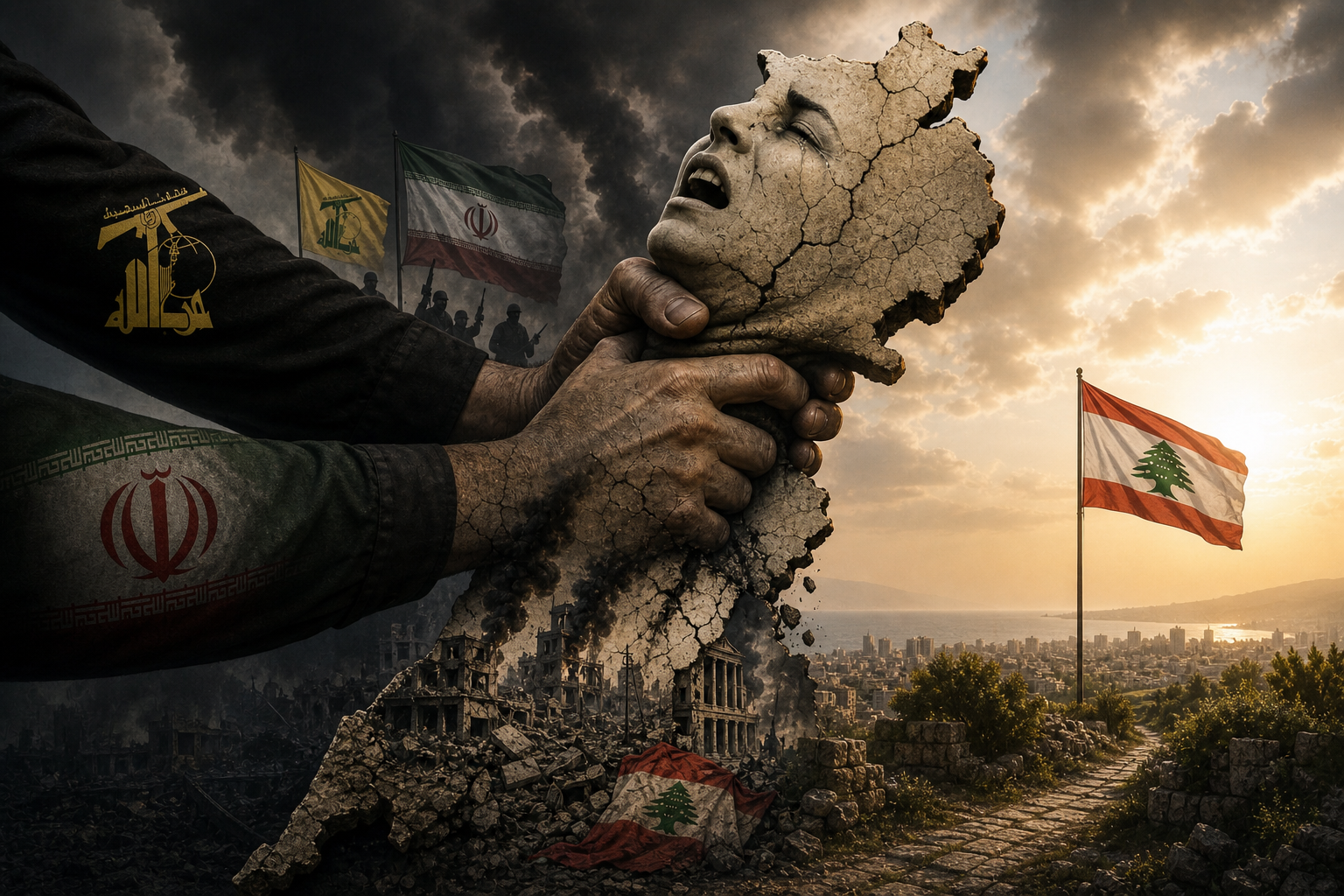
How the illusion of resistance suffocated a nation and handed its future to foreign power
By : The Editorial Board, Opinion
As the war grinds on and more Lebanese civilians pay the price, a familiar narrative resurfaces on television screens: lectures about “resistance,” sacrifice, and dignity. But repetition does not make a claim true.
It is time to confront a reality many have long avoided:
The concept of “resistance” in Lebanon has been distorted—if not entirely manufactured—to serve agendas that have little to do with Lebanon itself.
A Narrative Built on Selective Memory
The origins of today’s armed movements in Lebanon are often presented as a natural response to occupation and injustice. But history is more complex—and less convenient.
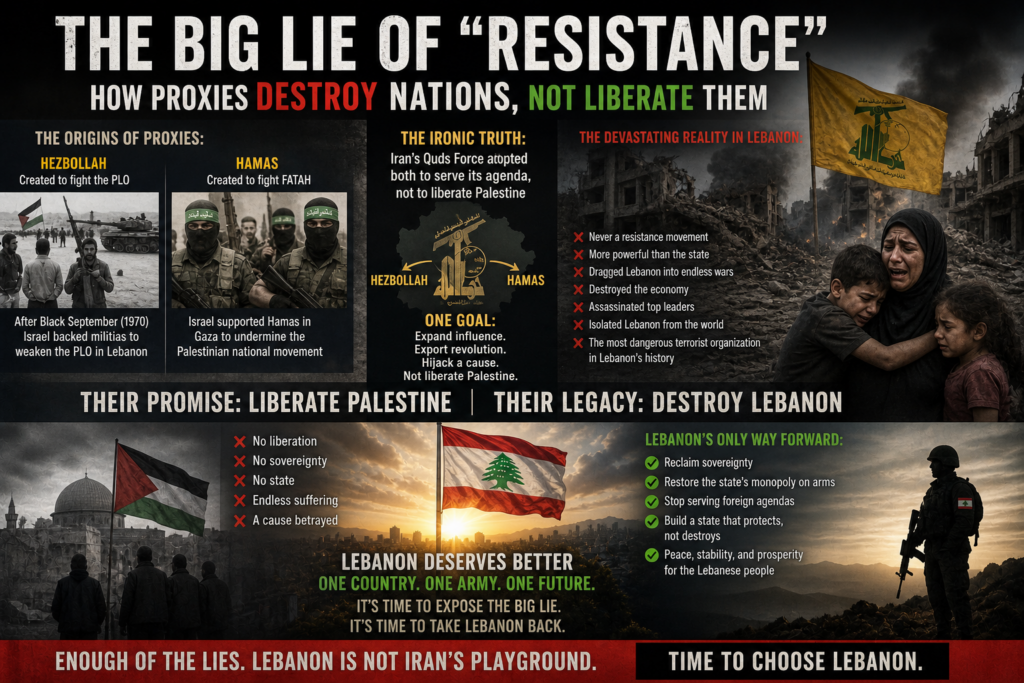
In the early 1970s, after the events of Black September, Palestinian armed groups relocated to southern Lebanon and began launching attacks across the Israeli border. The result was predictable: retaliation, escalation, and destruction—much of it borne by the Lebanese People , particularly in the south.
The Shiite community, far from being protected, became the primary victim of this cycle.
From Local Conflict to Regional Instrument
The emergence of Hezbollah in the early 1980s did not occur in a vacuum. It developed within the broader strategic framework of Islamic Revolutionary Guard Corps influence in the region.
From its inception, Hezbollah was not simply a local resistance movement. It was structured, funded, and guided as part of a larger regional project—one that prioritized influence and leverage over national sovereignty.
Its role mirrored that of other groups aligned with Tehran’s strategy:
- Expand geopolitical reach
- Maintain pressure points against adversaries
- Operate beyond the authority of national governments
This is not resistance in the traditional sense. It is proxy warfare.
The Cost of the Illusion
The consequences of this model are visible today:
- Lebanese territory becomes a battlefield for conflicts not entirely its own
- State authority is weakened by competing armed power
- Civilian populations bear the overwhelming cost
- Repeated wars and destruction of infrastructure
- Economic collapse and international isolation
- Political paralysis and erosion of state authority
- Entire villages have been reduced to rubble, with some areas “almost wiped off the map” after recent conflicts
And perhaps most critically:
The promise of liberation remains unfulfilled—decade after decade.
The same pattern extends beyond Lebanon. Groups like Hamas have also been drawn into broader regional dynamics, where local struggles become instruments in larger strategic contests.
The result is not liberation. It is stagnation, fragmentation, and repeated devastation.
The Strategic Truth
If the objective were truly the liberation of land and the protection of people, the outcomes would look very different after all these years.
Instead, what we see is:
- No lasting territorial gains
- No stable governance structures
- No sustainable path to peace
That is not a strategy for victory. It is a cycle of perpetual conflict.
Time to End the Illusion
Lebanon now faces a defining choice:
Continue to operate under narratives that justify endless war,
or
Reassert the principle that every sovereign nation requires:
One army. One authority. One decision on war and peace.
This is not a political slogan. It is the foundation of any functioning state.
Final Word
The language of resistance has been used for decades to justify actions that have brought repeated destruction to Lebanon and suffering to its people.
It is time to separate myth from reality.
Time to expose the big lie.
And time for Lebanon to reclaim its future—from narratives that have delivered everything except peace.
