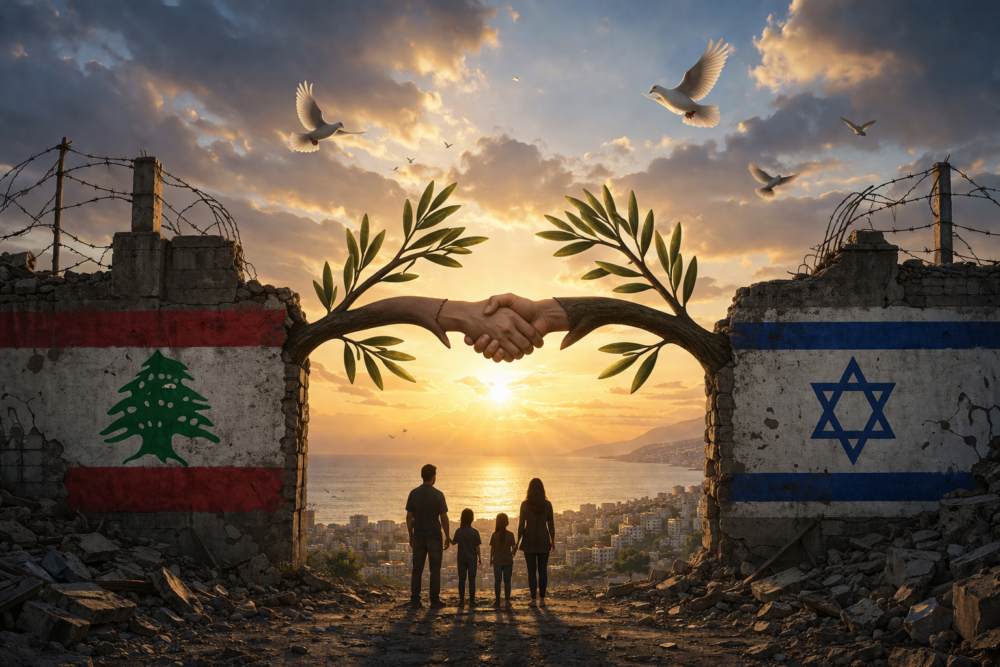
After decades of failed war, a narrow window for peace has finally opened
By : The Editorial Board, Opinion
War has once again devastated Lebanon and shaken Israel’s northern front. Cities lie in ruins, families are displaced, and yet—out of this destruction—something rare has emerged: a real opportunity for peace.
This is the paradox of 2026. The very conflict that deepened division has also exposed the limits of war. And for the first time in decades, both Lebanon and Israel are confronting the same strategic truth: there is no military solution that delivers lasting security.
A Door History Has Reopened
Following the U.S.-brokered truce in April, direct talks between Lebanese and Israeli officials began in Washington. This alone marks a historic shift. Since the failed 1983 agreement, diplomacy between the two states has been indirect, cautious, and often symbolic. Today, it is direct—and driven by necessity.
Lebanon enters these talks with a clear objective: restore sovereignty. For years, the country has lived with a “state within a state,” where decisions of war and peace were not fully under government control. That model has now proven catastrophic.
Israel, for its part, is pursuing something it has failed to secure through repeated wars: a stable northern border. Endless cycles of escalation have not eliminated threats—they have entrenched them. A negotiated framework, if done right, offers what military force could not: durability.
The United States understands what is at stake. Its mediation is not simply about ending a war—it is about reshaping the regional order by replacing proxy conflict with state-to-state diplomacy.
The Unavoidable Reality: Peace Ends the Militia Era
Hezbollah’s rejection of negotiations is not surprising. Peace represents an existential threat to any armed group operating outside the authority of the state.
This is the core issue Lebanon must resolve:
A country cannot claim sovereignty while tolerating competing centers of power.
If peace takes hold, the logic of armed “resistance” collapses. Borders become defined, disputes become diplomatic, and the justification for militias disappears.
That is why this moment is so consequential. It is not only about ending a war—it is about redefining the structure of the Lebanese state.
The Burden of Destruction—and the Demand for Change
The cost of this war has been staggering: thousands dead, over a million displaced, and vast مناطق reduced to rubble. But beyond the numbers lies a deeper shift. Public tolerance for recurring destruction is eroding.
Lebanese citizens are asking what their leaders must now answer: How many times can a nation rebuild the same tragedy?
This question is not emotional—it is strategic. It reflects a growing recognition that stability, not perpetual confrontation, is the foundation of prosperity and dignity.
Israel’s Test: Security Through Strength or Through Agreement
Israel now faces a choice that will define the outcome of these talks. It can insist on unilateral demands—buffer zones, imposed security conditions—and risk repeating the failure of 1983.
Or it can pursue a balanced agreement that recognizes Lebanon’s sovereignty and builds mutual security through reciprocity.
History is unforgiving on this point:
Agreements that ignore sovereignty do not endure—they collapse under their own imbalance.
A lasting peace requires equality between states, not dominance by one over the other.
A Regional Turning Point
The implications extend far beyond Lebanon and Israel. A successful agreement would:
- Undermine the model of proxy warfare
- Strengthen state institutions across the region
- Signal that diplomacy—not militias—can resolve conflicts
At a time when the Middle East is searching for stability, this could become a defining precedent.
Let Peace Be the Winner
After all the loss, only one outcome can justify the cost: peace.
Not a temporary ceasefire. Not a pause before the next war. But a real, enforceable, and lasting agreement between two sovereign states.
Because in the end, the true winners will not be governments or factions. They will be the الناس:
- اللبنانيون returning to homes without fear of the next strike
- الإسرائيليون living without the threat of rockets
- Two nations finally able to exist as neighbors, not enemies
Final Word
War has had decades to prove its case—and it has failed.
Peace now has one opportunity to succeed.
It must not be missed.
