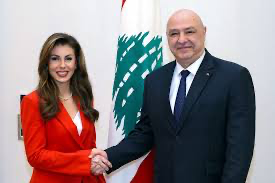
File photo- US envoy Morgan Ortagus and Lebanon President Joseph Aoun at the presidential palace in Baabda Lebanon
In an interview with *Israel Hayom*, former Deputy Middle East Envoy Morgan Ortagus discussed the trajectory of the Israeli-Lebanese talks she helped mediate. She argued that “peace with Lebanon is, in many respects, one of the most important relationships—and one of the most critical arenas—in which Israel must achieve peace; it is its immediate neighbor.” She further noted that “the greatest beneficiaries of peace between Lebanon and Israel would be the country’s Shiite citizens.”
She added: “Who suffers the most when Hezbollah drags Israel into war? The Shiites. They stand to reap the greatest benefits—not only because they would no longer be repeatedly displaced from their communities, nor face destruction and loss of life, but also because the strongest commercial ties that will emerge between Israel and Lebanon—and in short order—will most likely be with the Lebanese Shiites.”
She revealed that she “pressed hard on Israel and the Israeli military to work with Lebanon. I stated that we must assist them—provided they are willing to accept that assistance, and whenever they become so,” noting that “the problem is that Lebanon suffers from a system plagued by structural corruption, and this extends to the military establishment as well. However, the positive aspect regarding the army is that it is an institution that enjoys a high degree of public trust among the Lebanese people. Therefore, there is a foundation upon which to build.”
She further explained that Lebanon’s hesitation regarding holding a meeting at the head-of-state level does not concern her, stating: “When the time is right, this meeting will take place. Aoun is the President, and he has taken very bold steps to lead these negotiations; however, Salam is also a key figure, as the government is accountable to him.” She added: “Lebanon operates under a system where any agreement reached will require not only a vote by Salam’s government but also parliamentary approval—a body led, of course, by the Speaker of the House, Nabih Berri, and the Shiite bloc—and they, too, will have a say in the matter.”
Israeli and Lebanese ambassadors to Washington met twice this month in Washington, DC — the first such meetings in decades — after Iran-backed Hezbollah group drew Lebanon into the Middle East war on March 2, sparking heavy Israeli strikes and a ground invasion.
After the first talks, US President Donald Trump announced a 10-day ceasefire in Lebanon that began on April 17, and a three-week extension after the second round.
Trump has said he hopes to host Lebanese President Joseph Aoun and Israeli Prime Minister Benjamin Netanyahu “over the next couple of weeks” as the two countries prepare for direct negotiations.
The planned negotiations have caused a rift in Lebanon, with Hezbollah rejecting direct negotiations as well as Lebanon’s previous commitment to disarm it.
“Lebanon stands at a crossroads. Its people have a historic opportunity to reclaim their country and shape their future as a truly sovereign, independent nation,” the US ambassador to Lebanon said in a statement , adding that “the time for hesitation is over”.
A direct meeting between Aoun and Netanyahu, “facilitated by President Trump, would give Lebanon the chance to secure concrete guarantees on full sovereignty, territorial integrity, secure borders, humanitarian and reconstruction support, and the complete restoration of Lebanese state authority over every inch of its territory — guaranteed by the United States,” the statement added.
Aoun who is banking on the talks to secure an Israeli army withdrawal from southern Lebanon and a final demarcation of the shared border, was even the target of an implicit death threat issued by officials from the Iranian-backed Hezbollah.
The threat was taken seriously in Beirut given the pro-Iranian movement’s track record, with several of its members convicted by the UN Special Tribunal for Lebanon (STL) over the 2005 assassinations of several Lebanese leaders.
