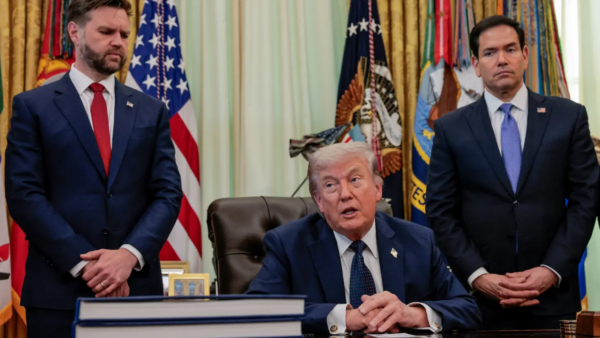
U.S. President Donald Trump speaks in the Oval Office, with Vice President JD Vance and Secretary of State Marco Rubio standing behind him, at the White House in Washington, D.C., U.S., April 23, 2026.
SUMMARY
- Israel and Lebanon agreed to extend their ceasefire by three weeks following a meeting in the White House with top U.S. officials, President Donald Trump said.
- Trump said that he, Vice President JD Vance, Secretary of State Marco Rubio, U.S. Ambassador to Israel Mike Huckabee and U.S. Ambassador to Lebanon Michel Issa were part of the Oval Office meeting.
Washington –
Israel and Lebanon agreed to extend their ceasefire by three weeks following a meeting in the White House with top U.S. officials, President Donald Trumpsaid Thursday.
“The Meeting went very well!” Trump said in a Truth Social post announcing the extension of the temporary truce.
“The United States is going to work with Lebanon in order to help it protect itself from Hezbollah,” Trump wrote, referring to the Iran-backed militia group.
“The Ceasefire between Israel and Lebanon will be extended by THREE WEEKS,” he wrote.
“The United States is going to work with Lebanon in order to help it protect itself from Hezbollah,” Trump said in a social media post. He added later in the Oval Office that he expects to meet in Washington with Israeli Prime Minister Benjamin Netanyahu and Lebanese President Joseph Aoun in the next couple of weeks.
The agreement provides breathing room for Israel and Lebanon to continue diplomacy by pushing off the looming expiration of an initial, 10-day ceasefire brokered last week.
Trump’s post Thursday afternoon said that “High Ranking Representatives” of the two countries met with him, Vice President JD Vance, Secretary of State Marco Rubio, U.S. Ambassador to Israel Mike Huckabee and U.S. Ambassador to Lebanon Michel Issa in the Oval Office.
“The United States is going to work with Lebanon in order to help it protect itself from Hezbollah,” Trump said in a social media post. He added later in the Oval Office that he expects to meet in Washington with Israeli Prime Minister Benjamin Netanyahu and Lebanese President Joseph Aoun in the next couple of weeks.
Lebanese Ambassador Nada Hamadeh Moawad thanked Trump “for all your effort to help and to support Lebanon.” She referenced his “Make America Great Again” slogan when she said, “And I think with your help, with your support, we can make Lebanon great again.”
Lebanon presses wider-reaching negotiations
Aoun, the Lebanese president, said a day earlier that during the talks Hamadeh would ask for an end to Israeli home demolitions in villages and towns occupied by Israel after the latest war broke out on March 2.
Preparations were being made for wider-reaching negotiations. The aim of the future talks is to “fully” stop Israeli attacks, the withdrawal of Israeli troops from Lebanon, release of Lebanese prisoners held in Israel, deployment of Lebanese troops along the border and beginning the reconstruction process, Aoun said in comments released by his office.
Israeli Foreign Minister Gideon Saar has called on Lebanon to work with Israel to disarm Hezbollah.
“We don’t have any serious disagreements with Lebanon. There are a few minor border disputes that can be solved,” Saar said during Independence Day remarks to Israel’s ambassadors and diplomatic corps. He described the neighboring country as a “failed state.”
Renewed fighting in Lebanon was tied to Iran war
The latest war started when Hezbollah fired rockets into northern Israel, two days after Israel and the U.S. launched attacks on Iran. Israel responded with widespread bombardment of Lebanon and a ground invasion, capturing dozens of towns and villages along the border.
Israel’s military occupies a buffer zone stretching as far as 6 miles (10 kilometers) into southern Lebanon. Israel says it aims to remove the threat of short-range rockets and anti-tank missiles being fired toward northern Israel.
Hezbollah has not been a participant in the diplomacy. Wafiq Safa, a high-ranking member of the militant group’s political council, has told The Associated Press that it will not abide by any agreements made during the direct talks.
The Lebanese government hopes the talks will pave the way to a permanent end to the war. While Iran has set ending the wars in Lebanon and the region as a condition for negotiations with the U.S., Lebanon insists on representing itself.
The talks last week were the first between Israel and Lebanon since 1993. Both countries have relied on indirect communication, often brokered by the U.S. or UNIFIL, the United Nations peacekeeping mission in southern Lebanon.
Lebanon’s top political authorities, critical of Hezbollah’s decision to fire rockets toward Israel on March 2 in solidarity with Iran, quickly proposed direct talks in a bid to stop the escalation, hoping Israel would not launch its ground invasion.
Despite the ceasefire that was later reached, an Israeli strike Wednesday killed Amal Khalil, a well-known Lebanese journalist covering southern Lebanon. Lebanese health officials said the Israeli military opened fire on an ambulance that responded, preventing rescuers from reaching her. Her body was pulled from the rubble of a collapsed building several hours later.
The Israeli military denied that it had deliberately targeted journalists or fired on rescuers, but the case sparked widespread anger in Lebanon ahead of the Washington talks.
After a Cabinet meeting Thursday, Lebanon’s Deputy Prime Minister Tarek Mitri said the government is working on a report documenting alleged war crimes by Israel and that ministers had discussed joining the International Criminal Court.
The latest Israel-Hezbollah war has killed over 2,300 people in Lebanon, including hundreds of women and children, and displaced over 1 million people.
CNBC/ AP
