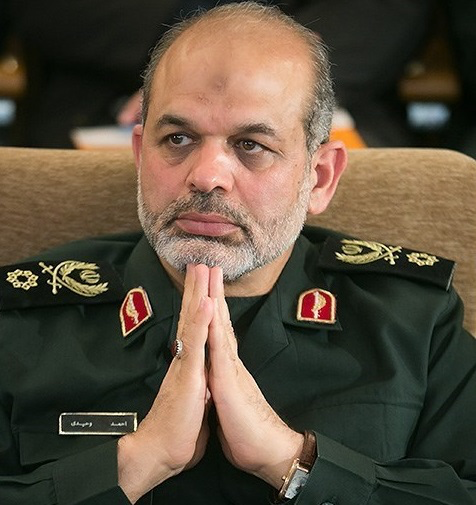
Brigadier general Ahmad Vahidi is the head of the Islamic Revolutionary Guard Corps (IRGC). Vahidi is considered a regime hardliner. He is sanctioned by Canada, the United States and the European Union for alleged involvement in terrorism. Argentina’s highest court formally charged Vahidi for the 1994 attack on the AMIA Jewish Community center in Buenos Aires.
With power shifting from clerics to commanders, Iran is no longer a theocracy—it is becoming a military state, and the region will pay the price
By : The Editorial Board, Opinion
Iran is no longer what it appears to be. Behind the façade of clerical rule, a quieter but far more consequential transformation is underway—one that could reshape the Middle East for years to come.
Power in Tehran is no longer centered in religious authority. It is consolidating within the hands of the Islamic Revolutionary Guard Corps, IRGC —the only institution with the cohesion, resources, and operational control to dominate a system under stress.
The reported elevation of Mojtaba Khamenei following his father’s death was meant to signal continuity. Instead, it has exposed a vacuum. Rare public appearances and limited visible authority suggest not consolidation, but dependence—on a military structure that now appears to be calling the shots.
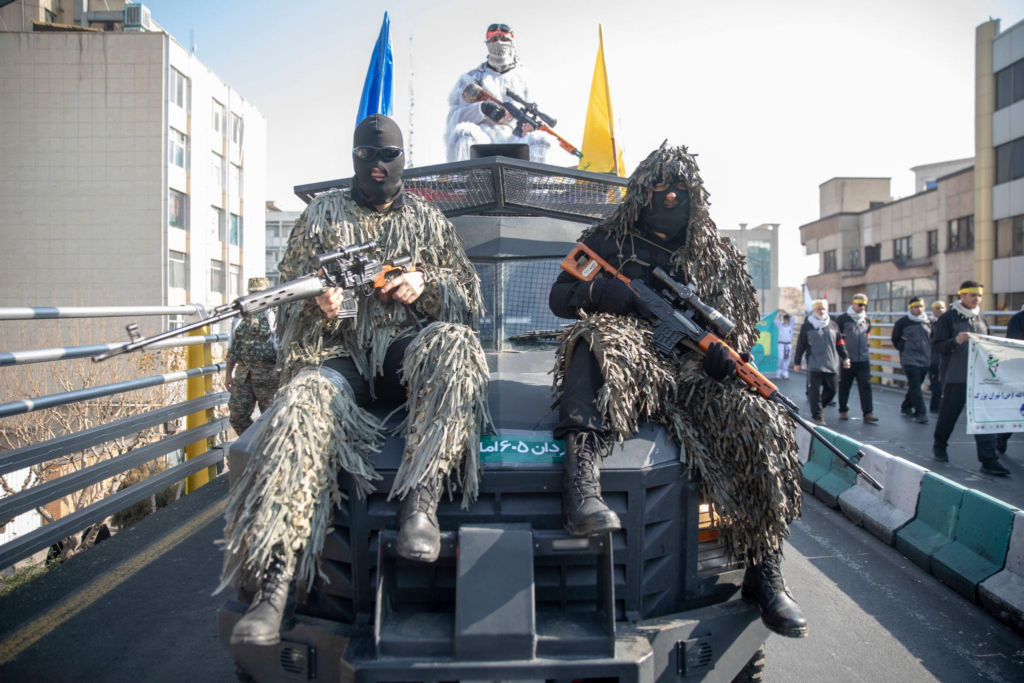
IRGC And Basij Forces Hold Military Maneuvers In Tehran
At the same time, Masoud Pezeshkian finds himself presiding over a government increasingly sidelined from real decision-making. Reports of blocked appointments and restricted authority point to a deeper truth: Iran’s civilian institutions are being hollowed out, while strategic control shifts elsewhere.
This is not a dramatic, televised coup. There are no tanks in the streets. No declarations. No official transfer of power.
It is something more subtle—and more dangerous.
A silent military takeover, where authority migrates not by decree, but by necessity.
The consequences are already visible. The war effort, drone operations, and regional strategy appear to be coordinated through networks tied to the IRGC. Economic control, long shared, is tightening. Intelligence flows increasingly bypass traditional channels.
In such a system, power does not disappear—it concentrates.
And when it concentrates in military hands, politics changes.
That reality may explain why Donald Trump reportedly chose to extend the ceasefire. Negotiating with Iran today may no longer mean negotiating with a single القيادة, but with overlapping centers of authority—some visible, others not.
Diplomacy requires clarity. Iran today offers ambiguity.
And ambiguity, in a region already on edge, is a strategic hazard.
For the Gulf states, this shift carries profound implications. A militarized Iran is not just more assertive—it is more unpredictable. Decisions may be driven by operational logic rather than political calculation. Escalation may occur without clear authorization. De-escalation may lack a credible guarantor.
This is how miscalculations happen.
This is how conflicts spiral.
For decades, Iran’s system balanced clerical authority with military power. That balance now appears to be breaking. What replaces it is not reform, nor moderation—but consolidation under the most disciplined and least accountable force in the country.
Call it what it is:
Not a formal coup—but a transfer of real power to the gun.
The world cannot afford to misread this moment. Because a regime dominated by its military does not become weaker.
It becomes harder to deter, harder to predict—and far more willing to take risks others would avoid.
And in the Middle East, that is a formula not for stability—
but for continuous crisis.
