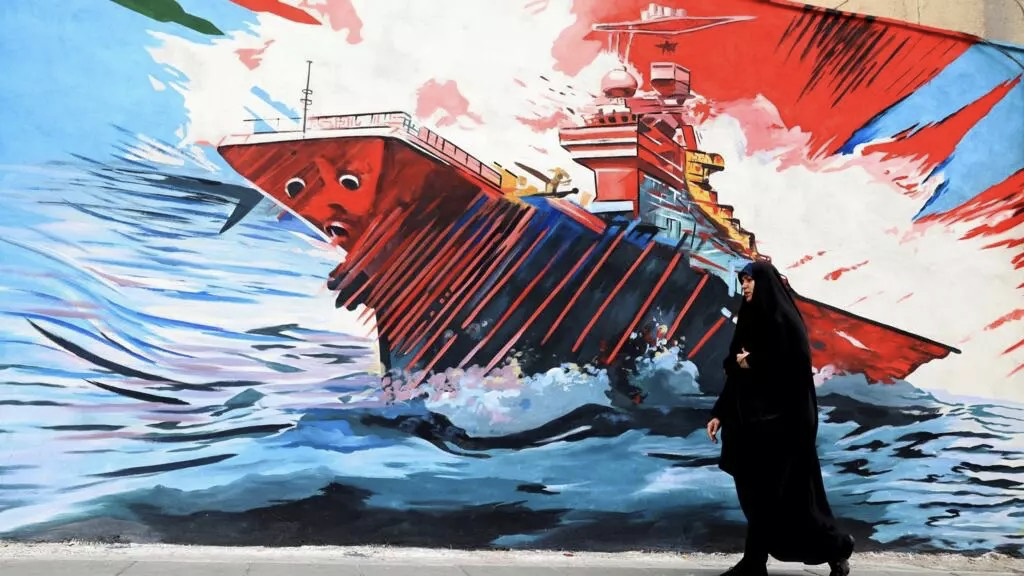
A woman walks past an anti-US and anti-Israel mural, in Tehran on April 21 2026, amid a ceasefire in the region. © Atta Kenare, AFP
Lebanon will ask for a one-month ceasefire extension in its talks with Israel in Washington on Thursday, according to an official. Earlier, Iran seized two ships in the Strait of Hormuz for what it described as maritime violations, according to Iranian state TV. This comes as President Donald Trump’s announcement that the US was extending its ceasefire with Tehran.
BEIRUT- Lebanon will request a one-month extension of the ceasefire during its meeting with Israel in Washington on Thursday, a Lebanese official told AFP.
The official, who spoke on condition of anonymity given the sensitive nature of the topic, said “Lebanon will request an extension of the truce for one month, an end of Israel’s bombing and destruction in the areas where it is present, and a commitment to the ceasefire”.
President Joseph Aoun said Wednesday that “contacts are underway to extend the ceasefire period,” which began last week and is set to expire Sunday.
‘No reaction’ from Iran despite Trump’s ceasefire extension
There has been “no reaction” from the Iranian government after President Donald Trump said the US would be extending the ongoing ceasefire, FRANCE 24’s Reza Sayah said, reporting from Tehran.
The Iranian offcials’ lack of response shows that Tehran is still “ready to fight”, Sayah said.
‘We cannot let Iran be our spokesperson’: Lebanon charts own path in talks with Israel
Lebanon is at a geopolitical crossroads, where sovereignty, regional rivalries, and international diplomacy collide.
Jad Shahrour, Communications Manager at Samir Kassir Foundation, speaks to FRANCE 24 about Lebanon’s current negotiations with Israel which he places within a broader struggle to reassert the authority of the Lebanese state.
He emphasises the necessity of disentangling Lebanon’s national decision-making from external actors, while acknowledging the deeply rooted historical tensions that complicate any path toward stability.
IRGC asserting themselves as Iran ‘responds to Trump’s method of conducting diplomacy in kind’
While external observers often seek signs of fragmentation within Tehran’s leadership, Burcu Ozcelik, Senior Research Fellow for Middle East Security within the International Security department at RUSI, suggests a more disciplined reality: one in which diversity of views exists, yet remains bounded by enduring strategic red lines.
She argues that Iran is simultaneously responding to external pressures – particularly the performative diplomacy of the Trump administration – while safeguarding core sovereign priorities, including its nuclear program and regional influence. What may appear as inconsistency is, in fact, a dual strategy: rhetorical escalation paired with cautious pragmatism.
Both Iran and the United States are navigating mounting economic and geopolitical constraints. The question is not whether pressure exists on either side, but how each calculates the cost of escalation versus compromise. Ultimately, Iran is likely to remain engaged in diplomacy, not out of concession, but as a rational extension of its national interest.
FRANCE24/AFP
