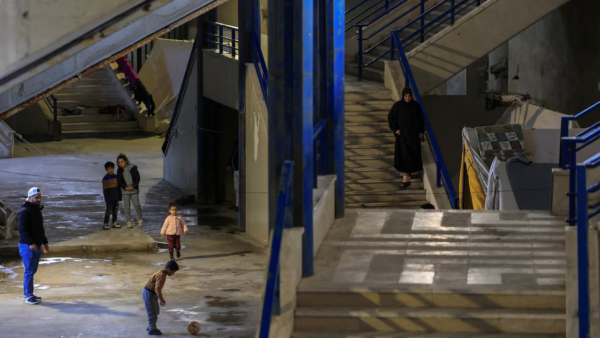
The Lebanese army started reconstruction of some of the bridges bombed by Israel during its war with Hezbollah
Here is the latest on Middle East war
Hezbollah and Iran have indicated backing for the ceasefire between Israel and Lebanon, but both say they’re poised with their “fingers on the trigger” to respond to any violations of the agreement. If the ceasefire holds, it could smooth the path to a wider deal to end the Iran war.
Israel’s fight with Hezbollah in Lebanon has been a major sticking point in the U.S.-Iran negotiations, and with the ceasefire coming into effect, President Trump voiced renewed optimism. “Good things” are happening, and the war with Iran “should be ending pretty soon,” he said.
The Strait of Hormuz remains effectively closed to commercial shipping due to Iran’s looming threats and a U.S. blockade of the country’s ports. Oil prices were down slightly Friday on the ceasefire news but are still well over their pre-war levels.
Lebanon ceasefire holds- A 10-day truce appeared to be mostly intact in Lebanon early Friday, promising a pause in fighting between Israel and the Hezbollah militant group and possibly clearing one major obstacle to a deal between Iran and the United States and Israel to end weeks of devastating war. The ceasefire began at 5 p.m. EDT.
But it remained unclear whether Israel and Hezbollah would completely stop strikes on one another and whether the militant group would recognize a deal it did not play a role in negotiating and that will leave Israeli troops occupying a stretch of southern Lebanon.
The Lebanese army posted on social media that there had been “a number of violations of the agreement, with several Israeli attacks recorded, in addition to intermittent shelling targeting a number of villages.” And French President President Emmanuel Macron said Friday he was concerned that the ceasefire “may already be undermined by ongoing military operations,” French news agency AFP reported.
Still, barrages of gunshots rang out across Beirut as residents fired into the air just after midnight to celebrate the beginning of the truce, and displaced families began moving toward southern Lebanon and Beirut’s southern suburbs despite warnings by officials not to attempt to return to their homes until it became clear whether the ceasefire would hold.
Israel warns southern Lebanon residents that troops are not leaving, and they should not return to their homes
Israel Defense Forces spokesman Avichay Adraee warned the displaced residents of towns and villages from a large region of southern Lebanon on Friday that IDF troops were not pulling out of the country amid the new ceasefire, and they should not attempt to return to their homes.
“With the entry of the ceasefire agreement into the implementation phase, the Israel Defense Forces continue to maintain their positions in southern Lebanon in the face of the ongoing terrorist activities of Hezbollah,” Adraee said in his social media post.
“Out of concern for your safety and the safety of your families’ members — until further notice — you are requested not to move south of the Litani River,” he said, referring to a river that forms a de facto demarcation line across southern Lebanon.
Lebanese authorities say more than 1 million people — roughly a fifth of the country’s entire population — have been displaced by the Israel operations.
President Trump hailed historic day for Lebanon – said on his Truth Social platform late Thursday night, after the Israel-Lebanon ceasefire came into effect, that it “May have been a historic day for Lebanon. Good things are happening!!!”
Mr. Trump announced earlier that Lebanon and Israel had agreed to a 10-day ceasefire, which took effect at 5 p.m. Eastern on Thursday, or midnight local time in the Mideast.
Earlier Thursday, Mr. Trump said on Truth Social that he hopes Hezbollah “acts nicely and well during this important period in time. It will be an GREAT moment for them if they do. No more killing. Must finally have PEACE!”
Trump said Thursday night that “the war in Iran is going along swimmingly.“
“We had to do a little journey down to Iran, and I didn’t want to do that, but we had to because we can’t let them have a nuclear weapon,” the president said during an event in Las Vegas.
U.S. Central Command said Thursday that it is using more than 10,000 U.S. service members — along with at least 12 ships and 100 aircraft — to enforce its ongoing blockade of Iranian ports.
CENTCOM, which oversees U.S. military operations in the Middle East, reiterated in a social media post that U.S. forces are not blockading the Strait of Hormuz itself, but instead “Iran’s ports and coastline.”
CBS
