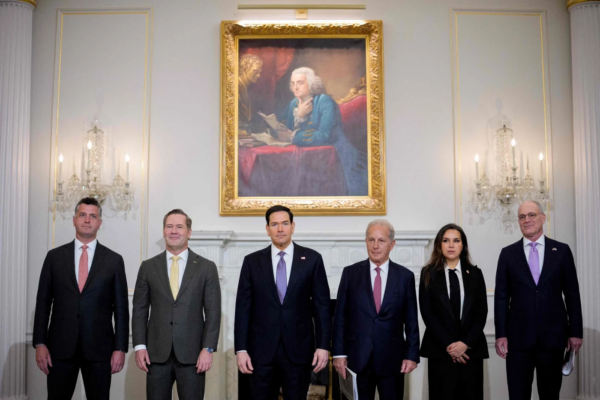
(From left-right) Counselor of US State Department Michael Needham, US Ambassador to the United Nations Michael Waltz, US Secretary of State Marco Rubio, US Ambassador to Lebanon Michel Issa, Lebanese Ambassador to the US Nada Hamadeh Moawad and Israeli Ambassador to the US Yechiel Leiter pose for photos before beginning working-level peace talks at the US State Department in Washington. -AFP PIC
Lebanon and Israel have held their first direct diplomatic talks in over three decades, a rare encounter aimed at ending fighting between Israel and the Iran-backed Hezbollah group.
No immediate outcome was expected from the discussion, which US Secretary of State Marco Rubio said was also a “historic opportunity” to end Hezbollah’s influence in the region.
The two countries do not have diplomatic relations, and the last direct, high-level talks between them took place in 1993.
Over 2,000 people have been killed since Israeli military operations in Lebanon began on 2 March, just days after US and Israeli strikes began in Iran.
Lebanese officials hope the talks result in a ceasefire and the disarmament of Hezbollah, as well as avert a renewed, long-term Israeli occupation of southern Lebanon.
Speaking to reporters ahead of the meeting, Rubio said the meeting was “a process, not an event”.
“This is more than just one day. This will take time, but we believe it is worth this endeavor,” he said. “It’s a historic gathering that we hope to build on.”
In a statement, Lebanese President Joseph Aoun said that he hopes the talks will “mark the beginning of the end of the suffering of the Lebanese people in general, and those in the south in particular.”
Hezbollah, a well-armed and sophisticated militia group that was founded by Iran in 1982, holds enormous sway in Lebanon’s predominantly Shiite south as well as in the southern suburbs of its capital, Beirut.
Politicians affiliated with the group also hold two cabinet-level positions with the government.
Their relationship with Lebanon’s central government, however, has become increasingly strained since the group moved to enter the war between Israel and Iran, its main benefactor.
In his statement, President Aoun said that the “only solution” to the conflict would be in the Lebanese armed forces “redeploying up to the internationally recognised border, and so being solely responsible for the security of the area and the safety of its residents, without the partnership of any other party”.
The Lebanese government’s capacity to confront Hezbollah, however, is limited.
Ahead of the talks, a senior member of the organisation told the Associated Press that it would not abide by any settlement agreed upon in Washington.
“As for the outcomes of this negotiation between Israel and the Israeli enemy, we are not interested in or concerned with them at all,” said Wafiq Safa, a member of Hezbollah’s political council.
“We are not bound by what they agreed to,” he added.
Ahead of the talks, a senior member of the organisation told the Associated Press that it would not abide by any settlement agreed upon in Washington.
“As for the outcomes of this negotiation between Israel and the Israeli enemy, we are not interested in or concerned with them at all,” said Wafiq Safa, a member of Hezbollah’s political council.
“We are not bound by what they agreed to,” he added.
The group claimed at least 24 attacks on Israel and Israeli troops in Lebanon on the day of the talks, with drone and rocket alarms sounding in communities across northern Israel for much of the day.
Israel says that its operations in Lebanon are aimed at disarming and dismantling the group, which it also fought in 2023 and 2024 as the war in Gaza raged.
In separate talks held between the US and Iran in Pakistan, Iranian negotiators insisted that Lebanon be included in any ceasefire – although both the US and Israel said it would not.
A US State Department official told the BBC that the Israel-Lebanon talks were planned a month ago, before the talks with Iran in Islamabad were confirmed.
“As the President has made clear, there is no link between the negotiations between the United States and Iran in Islamabad and the Israel-Lebanon talks,” the official said. “Iran dragged the Lebanese people into a war so cannot pretend to be Lebanon’s protector”
Additionally, the official said that “Iran will not be allowed to dictate the future of Lebanon any more”.
In addition to the more than 2,000 people killed, about a million people have been displaced in the conflict since the most recent hostilities began.
(BBC)
