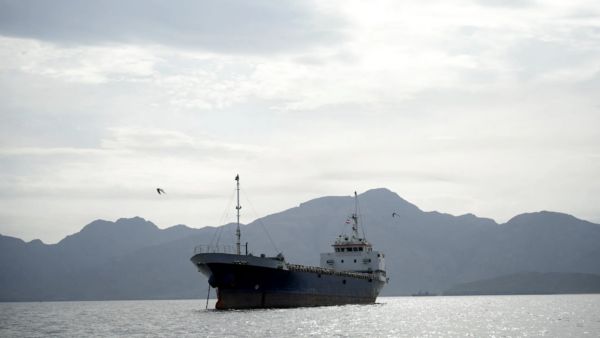
Photo- A ship in the Strait of Hormuz off the coast of Oman on Sunday.Credit…Reuters
Iran said it could suspend uranium enrichment for up to five years but the Trump administration insisted on 20 years, officials from both countries said.
Here’s the latest.
The United States and Iran have traded proposals for a suspension of Iranian nuclear activities, but remain far apart on the length of any agreement, according to Iranian and U.S. officials.
During weekend negotiations in Pakistan, the United States asked Iran for a 20-year suspension of uranium enrichment. The Iranians, in a formal response sent on Monday, said they would agree to up to five years, according to two senior Iranian officials and one U.S. official. President Trump rejected Iran’s offer, according to a U.S. official.
Israel launched airstrikes on two cities in southern Lebanon on Tuesday morning, Lebanon’s National News Agency reported, hours before envoys from Israel and Lebanon were scheduled to meet in Washington. The two sides remain sharply divided in their aims for the talks, which are not expected to produce an immediate deal to end the war between Israel and the Iran-backed Lebanese militia, Hezbollah.
The International Energy Agency on Tuesday sharply revised its forecasts for the global supply and demand for oil because of the war in Iran. The agency expects oil demand in the current quarter to shrink by 1.5 million barrels per day, which would be the deepest decline since the Covid-19 pandemic, as the spike in prices drives cutbacks around the world. The largest cuts to demand have so far come in the Middle East and Asia, but “demand destruction will spread as scarcity and higher prices persist,” the agency noted.
Resuming the typical flow of energy supplies via the Strait of Hormuz “remains the single most important variable in easing the pressure on energy supplies, prices and the global economy,” the agency said. Before the war, 20 million barrels of oil and related products passed through the strait every day. This month, flows have fallen to less than four million barrels a day.
China’s leader, Xi Jinping, said on Tuesday that his country would “continue to play a constructive role” in talks to end the war in the Middle East. “Maintaining the authority of international rule of law means not only using it when it suits us and abandoning it when it doesn’t,” he said during a meeting in Beijing with the crown prince of Abu Dhabi. “We cannot allow the world to revert to the law of the jungle.”
Israeli and Lebanese officials are set to meet in Washington.
With Israel’s bombardment of Lebanon and widened ground invasion leaving the cease-fire with Iran on shaky ground, Israeli and Lebanese officials were expected to hold rare talks on Tuesday in Washington to try to find a way forward.
The meeting would be the first direct, in-person talks in decades between Israel and Lebanon, which do not have diplomatic relations. Israel’s and Lebanon’s ambassadors to Washington were expected to participate. Secretary of State Marco Rubio will also take part, according to the State Department.
Two tankers traveling to and from the United Arab Emirates also crossed the Strait of Hormuz safely on Monday, according to Kpler. The NV Sunshine, an Indonesian tanker, entered the strait en route to the United Arab Emirates, while the Marshall Islands-flagged New Future carried petroleum products from Hamriya, an Emirati port, to Oman. Kpler did not provide specific transit times.
Also The Rich Starry, a Guyanese-flagged tanker operated by a Chinese shipping company with a Chinese crew, crossed the Strait of Hormuz on Tuesday morning, according to Kpler. It had picked up methanol from an unspecified port in the Persian Gulf and was bound for China.
Chinese Foreign Ministry spokesperson Guo Jiakun on Tuesday called the U.S. blockade of the Strait of Hormuz “dangerous and irresponsible,” warning it would worsen tensions, undermine a fragile cease-fire and risk safe transit through the strait.
Vice President JD Vance, speaking with Bret Baier on his Fox News show on Monday evening, said progress had been made and that there were “some good conversations” with Iran during talks in Pakistan over the weekend. According to Vance, the ball is now in Iran’s court and “the big question from here on out is whether Iranians will have enough flexibility.”
(New York Times)
