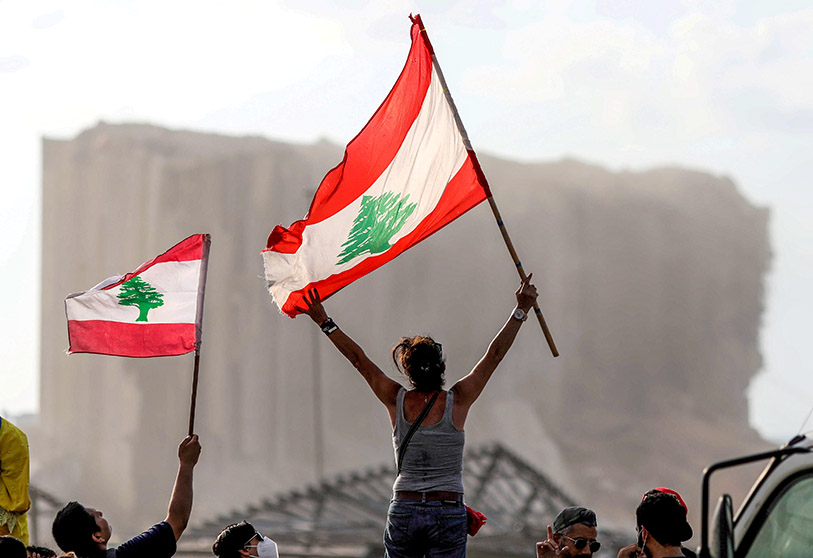
FILE PHOTO: Demonstrators wave Lebanese flags during protests near the site of a blast at Beirut’s port area where 245 people were killed , 7000 were injured and 300, 000 became homeless after thousands of tons of ammonium nitrate that were illegally stored there by Hezbollah were detonated . August 4 2020. REUTERS/Goran Tomasevic/File Photo
Lebanon is choosing diplomacy and moving forward without Hezbollah—still clinging to a war it started and cannot end
By: Ali Hussein- Lebanese Political Analyst, Op.Ed
Hezbollah’s leader Naim Qassem may reject negotiations between Lebanon and Israel—but he is no longer in a position to reject reality.
Following the killing of Hassan Nasrallah in September 2024, Hezbollah finds itself in a weaker and more uncertain position. Yet instead of reassessing its course, it continues to double down on the very strategy that has brought devastation to Lebanon.
For the first time in years, Lebanon is attempting to reclaim control over its own fate.
Under President Joseph Aoun and Prime Minister Nawaf Salam, the Lebanese state is pursuing what Hezbollah never could: a path to de-escalation through diplomacy. The upcoming talks in Washington, under U.S. auspices, aim first at securing a ceasefire, then opening the door to negotiations.
This is what responsible governments do—they try to stop wars, not expand them.
Hezbollah chose the opposite path.
On March 2, it unilaterally drew Lebanon into a regional conflict by launching rockets at Israel in support of Iran. That decision was not made by the Lebanese government, nor was it endorsed by the Lebanese people. Yet it is the entire country that has paid the price—through destruction, displacement, and deepening instability.
Now, after igniting this conflict, Hezbollah is attempting to block efforts to end it.
This contradiction speaks for itself.
Even more telling is Israel’s position. Israeli officials have made it clear they will not negotiate a ceasefire with Hezbollah. Whether one agrees with that stance or not, it underscores a critical reality: Hezbollah is not recognized as a legitimate negotiating party in this conflict.
That leaves only one viable channel—state-to-state diplomacy.
Lebanon understands this. Its leadership is seeking a ceasefire as a first step—not as a concession, but as a necessity to protect its people and preserve what remains of the country’s infrastructure and economy.
Qassem’s call for Lebanon’s president to “stand with Hezbollah” reflects a mindset that belongs to another era—one in which non-state actors dictated national decisions.
That era is ending.
Lebanon today faces a stark choice: remain a battlefield for regional powers, or reassert itself as a sovereign state capable of making decisions in the interest of its own people.
The Lebanese government appears to have made its choice.
Hezbollah can reject negotiations.
But it cannot reject the consequences of the war it started—or the reality that Lebanon is moving forward without it.
