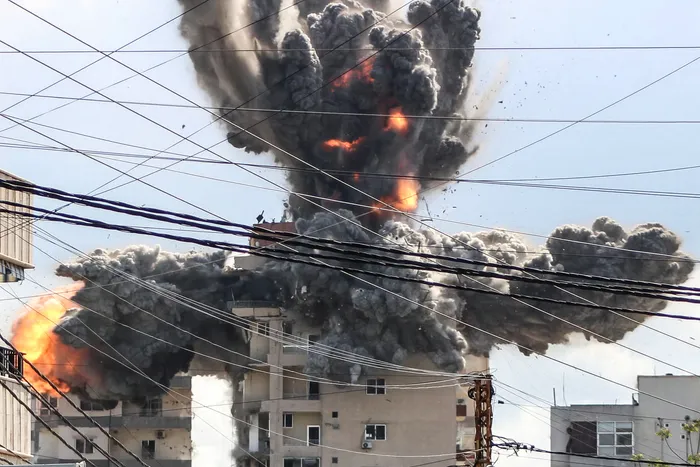
Photo- A fireball rises from a high-rise building hit by an Israeli airstrike in the area of Abbasiyeh, on the outskirts of the southern Lebanese city of Tyre, on April 8, 2026. Lebanon’s army warned people against returning to the country’s south on April 8, where the Israeli military is still launching attacks, as Israel said the ceasefire with Iran did not include its conflict with Hezbollah.
America demanded freedom of navigation. If Hormuz remains closed and Lebanon remains burning, what exactly was achieved?
By : Ya Libnan Editorial Board, Opinion
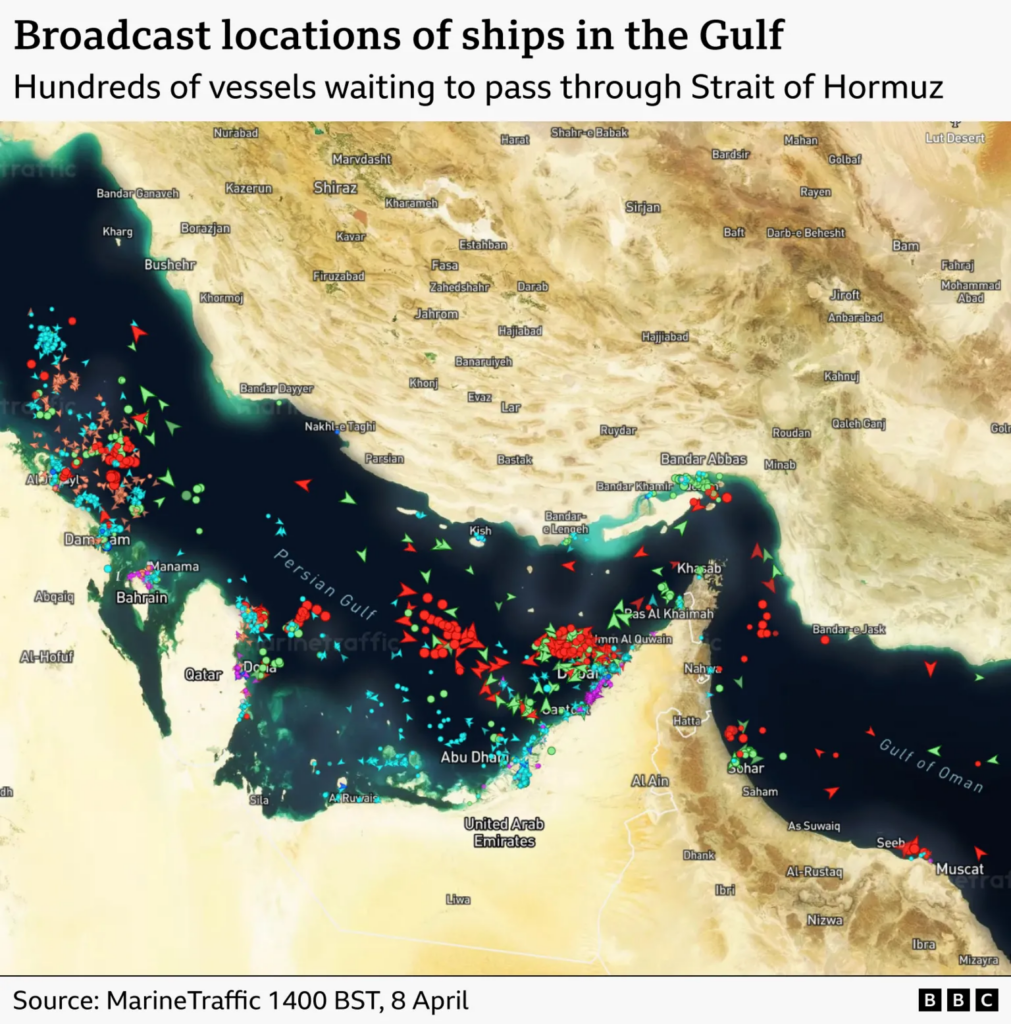
More than 800 ships sit stranded in the Persian Gulf.
Only a handful dare to move.
The Strait of Hormuz—through which nearly a quarter of the world’s oil flows—remains effectively paralyzed. Some vessels reportedly pay millions of dollars for safe passage. Others wait, uncertain if they will be the next target.
This was not a secondary issue.
This was the central objective of the United States.
Freedom of navigation in Hormuz was not just a goal—it was the condition upon which the ceasefire was built.
Yet today, the strait is still controlled, restricted, and in some cases monetized by Iran.
That alone leads to an unavoidable conclusion:
The United States achieved nothing it set out to achieve
If anything, the outcome raises even deeper concerns.
Instead of restoring open passage, the current arrangement appears to legitimize a new reality: ships move at Iran’s discretion. Some reportedly pay to pass. Others are denied altogether.
That is not freedom of navigation.
That is control.
And if the primary U.S. objective was to prevent exactly this scenario, then the result is not just a missed opportunity—it is a strategic setback.
But the failure does not end in Hormuz.
It extends to Lebanon.
Iran was not a bystander in this war. Through its Revolutionary Guard’s Quds Force, it trained, armed, and coordinated with Hezbollah. According to Lebanon’s Prime Minister Nawaf Salam, the opening rockets that ignited this front were linked to Iranian command structures.
Lebanon did not independently choose this war.
It was pulled into it.
If Iran had the influence to ignite the front, it had the responsibility—and the leverage—to shut it down.
Yet when the ceasefire was signed, Lebanon was not included.
Israel continues its strikes.
Lebanese infrastructure lies in ruins.
More than a million people remain displaced.
This reveals the full extent of the failure.
The United States did not secure freedom of navigation.
Iran did not secure protection for its ally.
And Lebanon—once again—was left to absorb the consequences.
Today, Iran holds leverage over Hormuz.
Global trade remains under threat.
And Lebanon continues to burn outside the framework of “peace.”
A ceasefire that fails to achieve its central objective is not a success.
A ceasefire that excludes an active battlefield is not complete.
And a ceasefire that leaves both conditions unmet raises a far more serious question:
Was this agreement about resolving the conflict—or simply pausing it at America’s expense and Lebanon’s cost?
If Hormuz remains closed, America’s credibility is weakened.
If Lebanon remains excluded, the region’s instability is guaranteed.
If Lebanon was part of the war, it must be part of the peace.
And if freedom of navigation was the condition, it must be delivered—not declared.
Anything less is not diplomacy.
It is failure.
