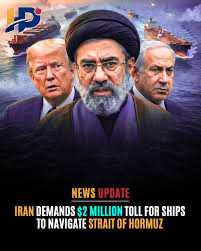
How did a war meant to weaken Iran end up enriching it? A flawed belief in regime collapse has backfired—risking a $500 billion windfall for Tehran.
By : YA LIBNAN, OP.ED.
“President Trump may have turned the Strait of Hormuz into the most profitable toll booth in the world—one that could generate more than $500 billion for Iran in just five years.”
That is not rhetoric. It is a realistic projection—if Iran emerges from this war in control of the Strait and global shipping returns to normal levels of roughly 150 ships a day.
At $2 million per vessel, Iran could collect nearly $110 billion a year—not from oil exports, but from controlling one of the world’s most critical chokepoints.
This is not how wars are supposed to end.
Four decades ago, President Ronald Reagan enforced freedom of navigation in the Gulf and imposed real costs on Iran for interference. The message was clear: the Strait of Hormuz would remain open—and free.
Today, that clarity is gone.
This war was not just a failure. It was built on a catastrophic miscalculation.
At its core was a prediction that never materialized. Israeli intelligence reportedly assured leaders in Washington and Tel Aviv that within days of the war’s start, Iran’s opposition would rise—triggering unrest that could collapse the regime.
Trump even urged Iranians to “take over your government.”
They did not.
There was no organized leadership. No unified opposition. No credible alternative ready to take control. Revolutions do not erupt on command—they require structure, coordination, and leadership. None existed.
Instead of collapse, the regime survived.
Instead of weakening Iran, this war may end up strengthening it—financially and strategically. A post-war Iran controlling Hormuz could generate massive revenues while its regional proxies grow stronger.
What began as a campaign to contain Iran risks ending as a historic strategic failure.
Not only did it fail to change the regime—it may have transformed Iran into the gatekeeper of global energy flows.
And here lies the real danger.
Iran has long relied on a network of regional proxies—Hezbollah in Lebanon, militias in Iraq, and the Houthis in Yemen—funded, armed, and sustained by Tehran to project power across the Middle East.
An enriched Iran would not keep that money at home.
It would export it.
More funding means more weapons, more recruitment, and more reach. We are already seeing how groups like the Houthis can threaten global shipping lanes and energy markets when backed by Iran.
A post-war Iran flush with tens of billions in new revenue could make these proxies more capable—and more dangerous—than ever.
This war did not change Iran. It may have changed the balance of power in its favor.”
