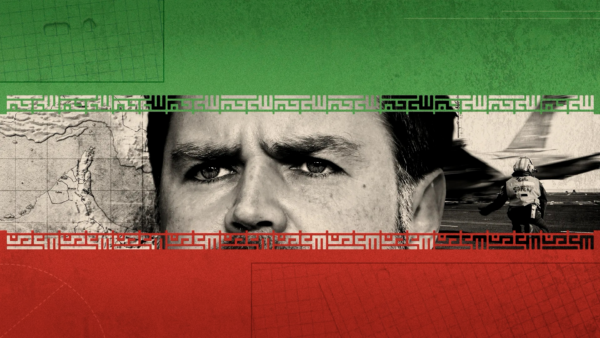
Photo illustration: Sarah Grillo/Axios. Photos: Brandon Bell and U.S. Navy via Getty Images
Vice President JD Vance is preparing to take on the most important assignment of his career: steering U.S. efforts to end a war he’d been concerned about waging in the first place.
Why it matters: Vance has already had multiple calls with Israeli Prime Minister Benjamin Netanyahu, met Gulf allies about the war and been involved in indirect communications with the Iranians. He’s expected to be the top U.S. negotiator in potential peace talks.
Vance was highly skeptical of Israel’s rosy prewar assessment of how the war would unfold, and currently expects the war to continue for another few weeks, according to U.S. and Israeli sources.
- Vance advisers think some in Israel are trying to undermine the VP, possibly because they find him insufficiently hawkish. Israeli officials deny that.
- President Trump made Vance’s role official in a Cabinet meeting on Thursday, asking the VP to give an update on Iran, and noting that he was working with Steve Witkoff and Jared Kushner on the negotiations.
Zoom in: Vance’s seniority in the administration and his well-documented opposition to open-ended conflicts overseas, White House officials say, make him a more attractive interlocutor for the Iranians than Witkoff and Kushner, who oversaw the two previous rounds of failed talks.
- Partly for those reasons, Witkoff recommended Vance as lead negotiator.
- “If the Iranians can’t strike a deal with Vance, they don’t get a deal. He’s the best they’re gonna get,” a senior administration official said.
- A White House official sought to tamp down the speculation, saying that Witkoff and Kushner “are still working their lines and the VP is ready to play his part if negotiations ripen —but we aren’t there yet. The Iranians need to decide if and how they want to come to the table.”
On Thursday, Trump extended his deadline for negotiations with Iran, as Pakistani, Egyptian and Turkish mediators keep trying to organize in-person talks.
- Iranian officials told the mediators they’re still waiting for a green light from “top leadership.” If such a summit happens, Vance could sit across the table from Iran’s speaker of parliament, Mohammad Bagher Ghalibaf.
- The administration is also considering a major military escalation if diplomacy fails.
Administration officials suspect foreign agents of spreading the word that Iran wants to negotiate with Vance.
- Vance adviser Andrew Surabian said on X that a CNN report to that effect was evidence of “a coordinated foreign propaganda op.”
- “It’s an Israeli op against JD,” another administration official told Axios, referring to the narrative that the Iranians see Vance as inclined to cut a deal and get out.
- There’s no evidence of any such Israeli operation.
Behind the scenes: White House officials started suspecting that some in the Israeli government were trying to smear Vance after a difficult phone call on Monday between Netanyahu and Vance.
- In the call, Vance mentioned that several of Netanyahu’s predictions about the war had proved far too optimistic, particularly when it came to the prospects of a popular uprising to topple the regime, according to an Israeli source and a U.S. source.
- “Before the war, Bibi really sold it to the president as being easy, as regime change being a lot likelier than it was. And the VP was clear-eyed about some of those statements,” the U.S. source said.
- The day after that call, a right-wing Israeli newspaper owned by GOP mega-donor Miriam Adelson reported that Vance had yelled at Netanyahu over the issue of settler violence against Palestinians in the West Bank.
- Multiple U.S. and Israeli sources said the story was erroneous, and Vance advisers suspected it was leaked by the Israeli side. An Israeli official denied Netanyahu planted the story, and said his office had actually denied it when approached by reporters at multiple outlets.
- The Israeli embassy in Washington declined to comment on diplomatic conversations between Netanyahu and Vance.
Vance met Wednesday with a delegation of senior Emirati officials, and on Thursday with the prime Minister of Qatar. Both meetings focused on the war, the talks with Iran and military assistance to the two Gulf allies.
- Vance has been “extensively involved” in diplomacy with Iran, both before the war and in the last few days, according to a U.S. official.
Last weekend, during the indirect exchange of messages with the Iranians, the White House floated the possibility of Vance leading a U.S. delegation for high-level peace talks.
- The White House asked the Pakistani, Egyptian and Turkish mediators to tell the Iranians that their willingness to have Vance lead the talks was proof that Trump was serious.
- Vance also chaired several National Security Council meetings on military options for Iran between the protests that began last December and the onset of war, U.S. officials say.
During the lead-up to war, Vance was one of the more skeptical internal voices, raising questions about its duration, purpose and impact on U.S. munitions stockpiles, sources say.
- Once Trump decided to go to war, though, Vance advocated for using overwhelming force to achieve victory as quickly as possible.
- Vance advisers say he’s supportive of Israel, but is concerned about potential gaps between the U.S. and Israeli objectives as the war continues.
- An Iraq War veteran, Vance told The Washington Post two days before bombs dropped on Tehran: “I do think we have to avoid repeating the mistakes of the past. I also think that we have to avoid over-learning the lessons of the past.”
The bottom line: “He has his own views, but he is going to work according to Trump instructions, and try and achieve an outcome that the president likes,” a source close to Vance said.
AXIOS
