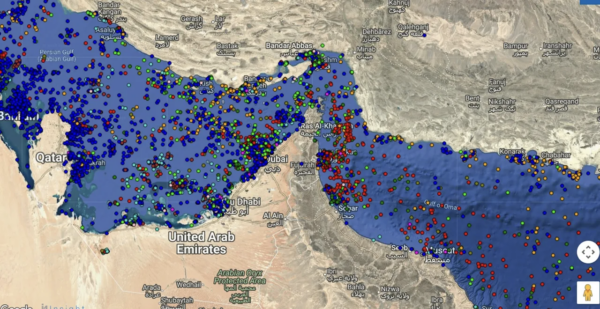
Here are the major developments we are following-
U.S. President Donald Trump has extended his deadline for Iran to reopen the Strait of Hormuz, saying the U.S. will hold off on power plant strikes for five days. Trump made the announcement on his Truth Social site hours ahead of a deadline. He added that the U.S. and Iran have had “very good and productive conversations” that could yield “a complete and total resolution” in the war.
Oil prices remained stubbornly high in early trading, with the price of Brent crude, the international standard, at around $112 a barrel, up nearly 55% since Israel and the U.S. started the war on Feb. 28 by attacking Iran.- The death toll from the war has risen to more than 1,500 people in Iran, more than 1,000 people in Lebanon, 15 in Israel and 13 U.S. military members, as well as a number of civilians on land and sea in the Gulf region. Millions of people in Lebanon and Iran have been displaced.
Iranian state television offered Tehran’s first reaction to U.S. President Donald Trump’s decision to extend a deadline for reopening the Strait of Hormuz by five days. The deadline should have been around 0000 GMT Tuesday. Instead, Trump on Monday said he extended it by five days.Reacting to the news, Iranian state television said in a graphic on screen: “U.S. president backs down following Iran’s firm warning.”
Oman’s top diplomat says his country, which has long mediated between the U.S. and Iran, was working to secure safe transit through the Strait of Hormuz. He did not elaborate.
China’s Middle East envoy pinned the blame squarely on the U.S. and Israel for a war he said has dealt a heavy blow to the global economy and shipping lanes. “We all know who started this war,” Zhai Jun told reporters in Beijing after a recent trip to Saudi Arabia, the UAE, Bahrain, Kuwait and Egypt.
Trump says talks ongoing- Trump added that the suspension of his threat to attack Iranian power plants was “subject to the success of the ongoing meetings and discussions.” Prior to Trump’s announcement, Iranian Foreign Minister Abbas Araghchi acknowledged talking by phone with his Turkish counterpart, Hakan Fidan. Turkey has been an intermediary before in negotiations between Tehran and Washington.
Modi says Iran war straining India’s energy security– Speaking in Parliament, Prime Minister Narendra Modi on Monday compared the challenges caused by the war to those faced during the COVID-19 pandemic and said India needs to be equally prepared this time.
Explosion rocks Tehran Associated Press journalists heard explosions across multiple points in Iran’s capital, Tehran, on Monday afternoon. It wasn’t immediately clear what was hit.
Iran fired 2 missiles and 36 drones at Bahrain in the past 24 hours, Bahrain’s Defense Ministry says
Kremlin warns US against striking Iran’s nuclear power plant– The Kremlin said Monday that any U.S. strikes on Iran’s Russia-built nuclear power plant could trigger “irreparable” consequences. Asked about President Donald Trump’s warning to “obliterate” Iran’s power plants if it doesn’t fully open the Strait of Hormuz, Kremlin spokesman Dmitry Peskov told reporters that the “catastrophically tense” situation in the region could only be settled by political and diplomatic means. Russia built the Bushehr-1 nuclear power plant in Iran, a 915 MW pressurized water reactor that connected to the grid in 2011. Reported projectile strike at Iran’s Bushehr nuclear power complex on Monday raised concerns
.In the half hour after President Trump posted about the constructive conversations with Iran, there were remarkable changes in markets.
Broadly put, energy prices tumbled in expectation of a more normal supply of oil and gas. The Brent crude oil price fell 12% to below $100 a barrel.
Stock markets: Turned around on expectations of a pathway to end the war, with US markets predicted to open up 2-3%.
To be clear, all these markets are still in worse shape versus where they were before the conflict.
The death toll from the war has risen to more than 1,500 people in Iran, more than 1,000 people in Lebanon, 15 in Israel and 13 U.S. military members, as well as a number of civilians on land and sea in the Gulf region. Millions of people in Lebanon and Iran have been displaced.
A farmer WAS killed north Israel by Israel shelling , not by Hezbollah as claimed by the iran backed group
Lebanese PM Nawaf Salam accused the IRGC of directing Hezbollah operations as Israel ramps up strikes and plans a ground offensive. President Joseph Aoun warned bridge attacks signal a possible invasion, raising fears of wider escalation in the Israel-Lebanon conflict.
AP/BBC
